Since people first settled together, doors were never just about keeping out the weather. They marked a boundary—private inside, public outside—and whoever controlled the door decided who could enter and who had to stay out. That basic principle scaled over time: from homes to city gates, and eventually to state borders. With each step, control, security, and ownership became more deeply embedded in the structure of society. If you cannot decide who enters your home, it ceases to truly belong to you—and the same logic applies to societies.
Today, as unprecedented mass migration reshapes the global landscape, this principle sits at the centre of political debate. Borders function like doors: not abstract lines, but instruments through which communities maintain order, define themselves, and ensure security.
This is the premise on which a recently premiered documentary on migration by the Budapest-based think tank Danube Institute, titled The Future at the Gate, sits. The film, presented to the audience first—before its official premiere, scheduled for 8 April—at the Institute’s Family Formation and the Future conference on Tuesday, 31 March, sheds light on a less discussed aspect of the debate surrounding mass migration: the role of the gatekeepers—and the hostility they face.
🎬 Come&see our 1st documentary feature at the wonderful Urania National Film Theatre on 8 April
— Danube Institute (@InstituteDanube) April 2, 2026
For free tickets, register ⤵️https://t.co/KG7MENcc1N pic.twitter.com/b2FEd4QxWj
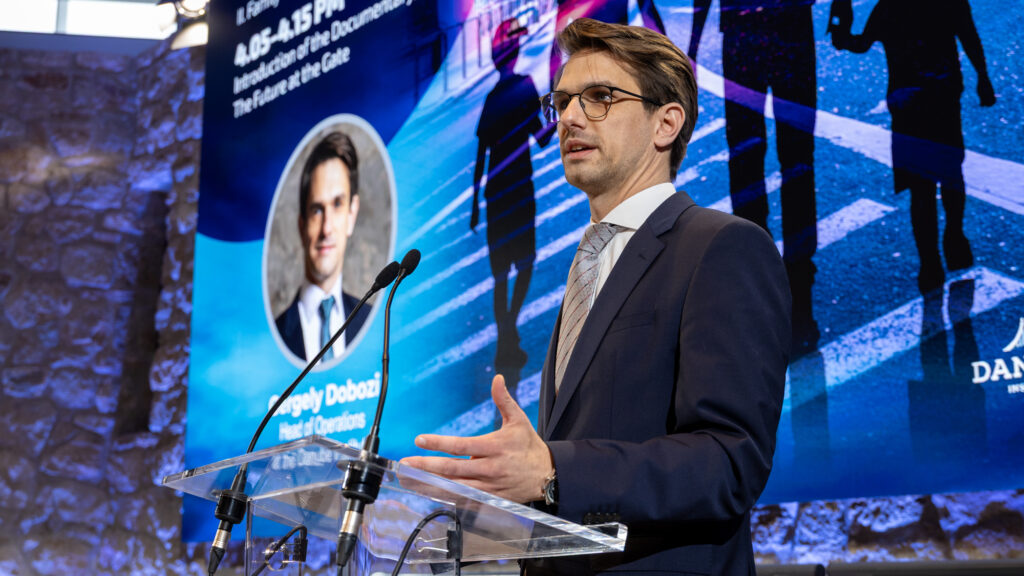
As highlighted by Director of Operations at the Danube Institute and co-producer of the documentary Gergely Dobozi, ‘gatekeepers are not only guarding borders’, but they are actually the ‘gatekeepers of the future’. ‘Every gate represents a decision’, he continued, ‘a decision about who is allowed to enter and who is left outside, about which voices are heard and which are ignored’, adding that ‘these decisions have to be justified.’
According to Dobozi, the question the documentary tries to answer is: ‘Who decides what is justified?’ ‘This is where the role of the gatekeepers starts being crucial, because it is not only their actions that occur, it is also their attitude,’ highlighting that if the gates are opened, in the name of diversity and progress, it leads to what we are currently witnessing in many Western European countries regarding failed integration of migrants, increasing crime rates and violence, and chaos. ‘If the gate is closed, order and control can be maintained,’ Dobozi argued.
‘This is why the attitude of the gatekeeper matters so much. In fact, it is everything, because the future does not just happen—it is shaped at the gate,’ he concluded his introductory remarks before the documentary premiere started.
The film takes us back to 2015, before and during the peak of the migration crisis, which ultimately resulted in more than one million people, mostly from the MENA region, entering European soil. At the time, two tragic terror attacks rocked France and the whole of Europe: the Bataclan attack, which resulted in more than a hundred deaths in multiple locations in Paris, and the Charlie Hebdo attack, where journalists were killed because they depicted Muhammad, the most important human figure of the Islamic religion.
These incidents represent the consequences of opening the gates—even though many Western European countries, including France and Germany, for decades promoted mass migration, potentially letting thousands of terrorist cells into their societies. If the gates are opened, instability flows in.
However, the documentary’s main focus is on those who kept—or tried to keep—the gates closed, and more importantly, on how they are treated by the European Union’s mainstream political establishment. One of these gatekeepers is former Director of the European Border and Coast Guard Agency (Frontex) Fabrice Leggeri. At the beginning of the crisis in 2015, Leggeri made several decisions which, at the time and since then, met with serious criticism from human rights NGOs and leftist politicians.
‘If the gates are opened, instability flows in’
As he outlines in the documentary, Leggeri saw from the first moment that the crisis would be unprecedented. He took a security-based approach, prioritized strengthening external border controls, expanded surveillance and operational coordination with member states, and focused on deterrence and containment rather than search-and-rescue expansion. That did not fit well with the EU’s leadership, which, led by then-German Chancellor Angela Merkel, promoted the idea that the bloc could and should accept everybody coming from the region torn by civil wars.
For his stance and Frontex’s operational mechanisms, allegedly breaching asylum and human rights, Leggeri was vilified. Just days before the documentary’s premiere, the Paris Court of Appeal opened an investigation into Leggeri over allegations of ‘complicity in crimes against humanity’.

The other gatekeeper at the time was Hungary, which received very similar treatment from the EU to that of Leggeri. The documentary takes the audience to the country’s southern border in 2015, where masses of migrants, many of them without documents, clashed with police and border security forces. That was the reality in which Prime Minister Viktor Orbán decided to build a border fence, criminalize illegal entry, announce zero tolerance towards undocumented migrants, and resist the EU’s migrant quotas. ‘The most precise definition of this is invasion. Europe is under invasion,’ Orbán declared in November 2015, paving the way for allegations of racism, fear-mongering, and years of legal and political pressure on Hungary.
Infringement procedures, constant smear campaigns in Western mainstream media, and the withdrawal of EU funding—that is what Hungary got for keeping the gates closed. To this day, the country has to pay a fine of €1 million per day for not adjusting its policies to the EU’s migration framework.
‘Future at the Gate provides an accurate presentation of the two realities currently dividing Western and Eastern Europe’
Now, ten years later, the tide, however, seems to be changing. As more and more European citizens realize the negative consequences of open-border policies, more and more countries call on Brussels to adapt to the situation. Just recently, the European Parliament approved a new deportation framework, which could deliver competencies back to member states from Brussels’ grip.
Despite this, gatekeepers are still being demonized. Future at the Gate provides an accurate presentation of the two realities currently dividing Western and Eastern Europe. On one side, there is instability, a constant threat of terror, and parallel societies increasingly unable to function alongside each other. On the other hand, there is security, stability, and, most importantly, a sense of safety and belonging. But it takes courage to preserve that—and that courage belongs to the gatekeepers, who choose, despite all the pressure, to keep the gates closed.
Related articles:
At a time when public debate is increasingly polarized and superficial, Hungarian Conservative remains committed to depth, intellectual honesty, and independent conservative thought.
Producing high-quality journalism requires resources. Your contribution helps us expand our coverage, reach new audiences, and keep our content accessible.

Please consider supporting our mission.