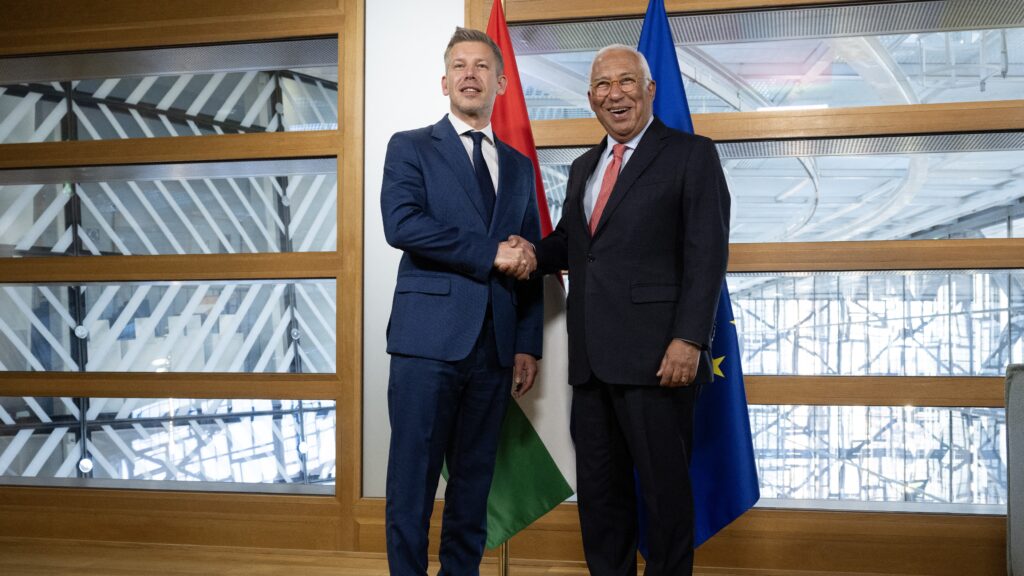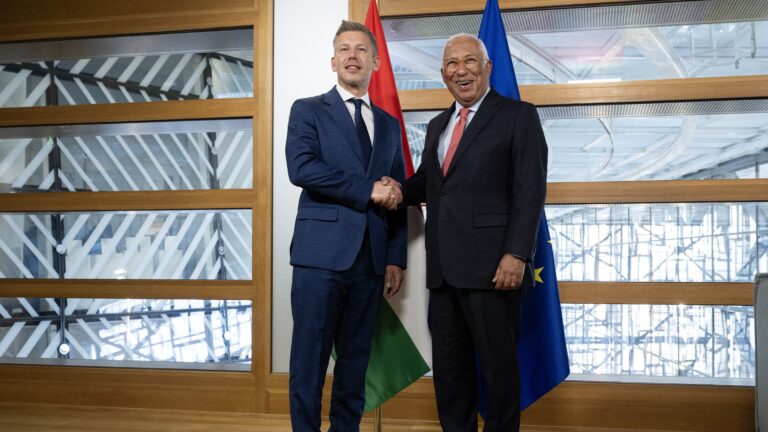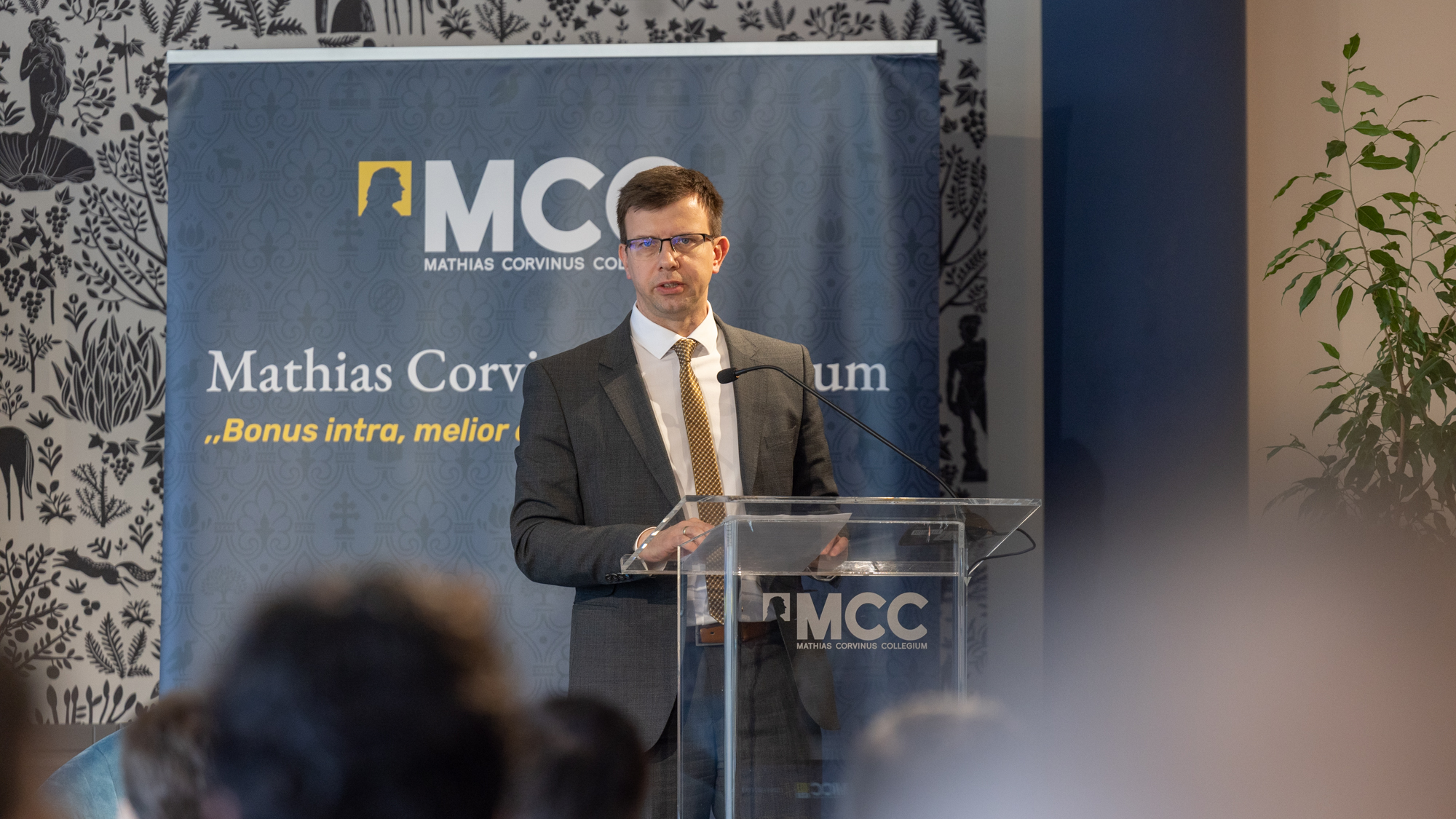
Courts at the Forefront of Europe’s Value Conflicts—this was the title of the event held by the Mathias Corvinus Collegium (MCC) at their Budapest campus by the Bottomless Lake in Budapest, Hungary, on Friday, 27 February. The topic of the day was the nefarious process by which the Court of Justice of the European Union (CJEU) in Luxembourg has become a tool to force the progressive agenda on all Member States.
This was not always the case. In his opening remarks, MCC Director General Zoltán Szalai told the audience that courts in Europe used to be the ‘passive interpreters’ of laws passed by legislatures. However, by now, the CJEU has morphed into ‘the central arena where values collide’.
He stated that ‘the future of the European Union may very well depend on whether the Court of Justice of the European Union can recognize its own limits and accommodate the political and cultural diversity of its own Member States.’ Mr Szalai then went on to declare that the absolute supremacy of EU law was nowhere written in the treaties of the Union. In fact, ‘unity through law’ was the original pitch to Member States. However, lately, the CJEU has been referring to so-called ‘federal common law’ in some of its opinions, the speaker pointed out, which he views as an infringement on Member State sovereignty.
President of the Curia of Hungary András Zs Varga spoke next. He started by opining that the debates over the national-supranational cooperation within the EU are the most important issue in Europe of the last 10–15 years. This question is also explicitly addressed in the Fundamental Law of Hungary, he added, which underscores its importance. He described the CJEU and Member States courts as ‘parallel legal systems’ and shared that the former is attempting to elevate the Charter of Fundamental Rights of the European Union to the level of legally binding law in all EU states. Justice Varga also accused the EU court of unilaterally asserting its power even in cases which clearly fall under Member State competence. He warned that this process could render national supreme courts ‘superfluous’.
Next, a panel discussion followed. It featured Researcher Martin Mendelski at the Pontifical University of Saint Thomas Aquinas; Professor and Head of the EU Law Department András Osztovits at the Károli Gáspár Reformed University; Vice Chair András Tóth of the Economic Competition Office of Hungary; and Head of the Center for European Studies Rodrigo Ballester at Mathias Corvinus Collegium. The discussion was moderated by Researcher Yann Caspar at the Center for European Studies of Mathias Corvinus Collegium.
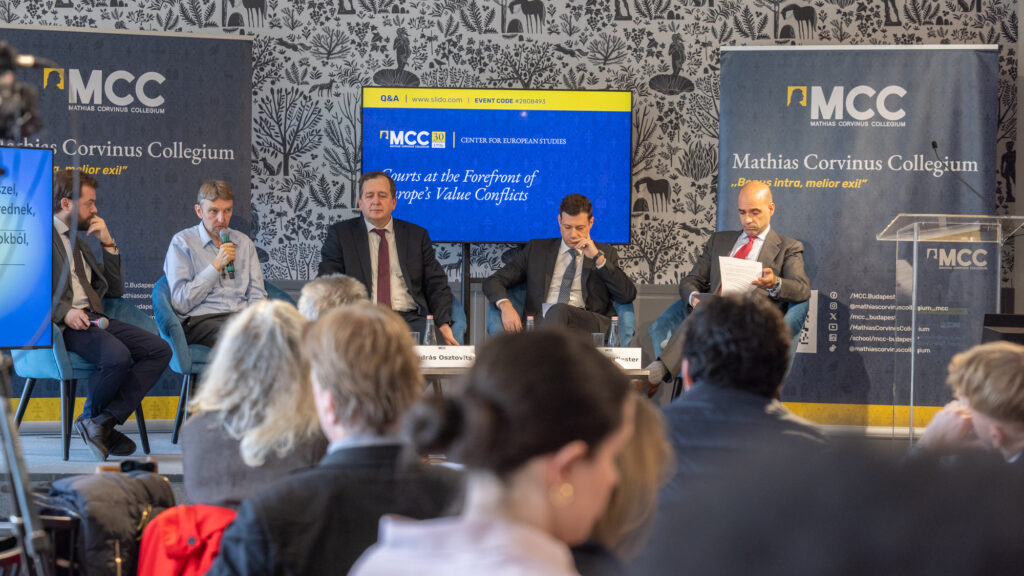
Judge Osztovits started by pointing out that, in the day-to-day work of a judge on the bench, only a very small fraction of the cases handled involve EU law or fundamental values. Rather, the vast majority of cases are more mundane and rule on matters such as VAT regulation. However, in the few instances where fundamental values directly impact the decision, judges must delve deeper into the matter, he asserted.
The speaker then used a metaphor to illustrate how he believes the relationship between the CJEU and the national court systems of Member States should function. He likened the EU Court to a father, and the national courts his sons. The father should be respected by his sons, and his instructions should be followed. However, in turn, the father must accept that his sons have autonomy and must allow differences of opinion among them.
Mr Mendelski shared that he is a Polish man who was raised in Germany and did his PhD work in Luxembourg. This gave him many different perspectives on legal systems—he likened this diversity of viewpoints to that of the different Member States within the Union. These states have also developed different historical and political understandings of ‘rule of law’, he went on to state. However, within Brussels, the view of the concept of the rule of law is more uniform. According to Mr Mendelski, the Brussels institutional system believes that the rule of law stands on six pillars: legality, legal certainty, lack of arbitrariness, judicial independence, judicial review, and the protection of human rights.
He then suggested that European courts—and, more broadly, global legal systems—are increasingly shaped by a clash between two competing worldviews: a liberal, progressive, and secular approach on the one hand, and a nationalist, traditional, and Christian perspective on the other.
Mr Tóth noted that there was a distinct shift in how the European institutions view their roles during the tenure of President Jean-Claude Juncker of the European Commission. Then, the EU shifted its priorities from the founding principles of ‘Aristotelian common good’ to the pursuit of the establishment of a ‘European demos’, the speaker claimed. He also went on to say that the former socialist states of the Eastern bloc—Poland, Czechia, Slovakia, Croatia, Bulgaria, and Hungary—did not join the European Union because of shared ‘European values’, but because they viewed the Union as a shared economic project.
Meanwhile, Mr Ballester spoke of a ‘woke schism’ within the European Union, an institution which he believes was once ‘extremely pragmatic’ but has now turned highly ideological to the point that the speaker even wondered if being liberal-progressive is a legally mandated requirement in the EU of today. The CJEU has asserted jurisdiction in cases which have no ‘cross-border dimension,’ he added. As an example, he brought up a 2023 ruling by the European court, which forced Bulgaria to recognize the parenthood of a lesbian couple from Spain, who conceived a child through surrogacy.
After the panel concluded, Minister for European Union Affairs János Bóka of Hungary took the stage for some brief closing remarks.
He started by telling the audience that values are increasingly prevalent in court decisions—not just in the EU, but across the Globe. The Minister then levelled a series of criticisms at the Court of Justice of the European Union. He claimed that the CJEU is engaged in ‘social engineering’, is aiming to become a de facto ‘federal constitutional court’, and is regularly overstepping its boundaries. The separation of powers does not exist within the European Union, he added.
As an example of a recent problematic ruling by the European Court, Minister Bóka cited the CJEU’s recent decision, which deemed Poland’s Constitutional Tribunal illegitimate. With such decisions, he argued, the CJEU is setting itself up to be able to ‘influence any major political issue in any of the Member States, which would be a “coup d’état” over European sovereignty,’ he warned.
Related articles:
At a time when public debate is increasingly polarized and superficial, Hungarian Conservative remains committed to depth, intellectual honesty, and independent conservative thought.
Producing high-quality journalism requires resources. Your contribution helps us expand our coverage, reach new audiences, and keep our content accessible.

Please consider supporting our mission.