The following is a translated and edited version of an article originally published in Hungarian in Képmás Magazin (kepmas.hu) on 16 January 2026.
Magdi Hajdani Józsefné was led to the pro-life cause through the process of healing following her own abortion. In 2017, together with her companions, she launched the 40 Days for Life campaign in Hungary, taking on its coordination and organizing it in Budapest twice a year. Since then, several other Hungarian cities have joined, for a total of 12 so far. Ahead of their upcoming campaign taking place between 18 February and 29 March 2026, they are also organizing an international preparatory day on 31 January at the Franciscan friary in Pest. Applications are open until 23 January.
***
What are the most recent developments around the 40 Days for Life movement, globally and in Hungary?
The global movement continues to be effective since its launch in 2004 in Texas. According to their records, it is now active in 71 countries, involving one million volunteers and 20,000 churches. To date, we track more than 26,000 babies saved, 275 healthcare workers converting and leaving the abortion industry, and 184 abortion centers closing or ceasing operations.
In Europe, however, the movement is not spreading at the same pace. England was among the first to join, and in larger numbers; they have also succeeded in closing several abortion facilities. The Spanish, the Croatians, and the Hungarians are currently the most active on the continent, with the movement now present in nearly 40 cities in Croatia and 13 cities in Hungary. During their autumn campaign, all nurses at the Zagreb hospital refused to take part in abortions, effectively blocking the procedures for a long period… In France and Germany, the movement has only recently begun to take shape.
Poland, with strong Christian roots, used a different method: they displayed large banners in public spaces and shopping centers showing images of aborted, dismembered fetuses, confronting large numbers of people with what actually happens during the procedure. They were frequently attacked legally, but by invoking freedom of speech, they avoided legal consequences. Even with this approach, it took 20 years of shaping public attitudes before a stricter pro-life legislative proposal could be passed.
How do the campaigns work? In Hungary, for example, there are no abortion clinics as such…
In Hungary, abortions are carried out within the public healthcare system, that is, in hospitals. In Budapest, there are several departments in the SOTE II. Clinic’s building, not only gynecology, so we pray outside, close to the building, on Hugonnay Vilma Square. With our signs, we wish to speak to people’s hearts and to make the purpose of our presence and prayer clear. Those interested can receive information, and if people personally affected approach us, we explain which pro-life organizations they can turn to for help—organizations that are more experienced both in providing information and in terms of practical assistance. In other cities in Hungary, campaigns also take place near healthcare institutions. Mothers with young children who serve as organizers hold prayer walks, walking around the buildings instead of staying in one place. I regularly publish where and when these prayer opportunities become available.
‘Do you know why the protection of life is important?’
There are one or two participants who feel we should do more; they try to establish direct contact with passers-by by handing out leaflets, but this is quite rare and not necessarily worthy of support, as we never know what personal background someone may have. If they do address people, they may at most ask: ‘Do you know why the protection of life is important?’ This gives an opportunity for conversation, but we must never be intrusive. Every organizer and participant signs a peace pledge, accepting the Christian code of conduct laid down in that pledge. If someone doesn’t observe those rules, we may ask them to leave…
What have been the most important lessons of the ten campaigns over five years?
Every campaign has been a struggle, but God has always helped us. Sadly, even during the most recent autumn campaign in Budapest, it happened that someone stood alone outside the clinic building in a city of one and a half million people… Nevertheless, it is a great joy that awareness-raising has also begun in the countryside in this way and that the campaigns there have been effective, even though they take place with fewer hours and fewer people praying.
One of our Budapest-based volunteers, Levente Bodnár, started a ministry in Karcag after getting married. This was where the first 12-hour service outside Budapest took place; he alone covered 390 of the 480 hours. He had relatively few helpers, yet he is aware of one baby who was saved as a result. It is no coincidence either that a baby shelter for infants left in hospitals was opened there recently. He joined us in 2017 when he was not even a believer yet. After many shared services, he came to our Pentecostal congregation and was eventually baptized. He has since become my faithful companion in organizing the Budapest campaigns. Two of our other companions, who met during the Budapest service, also got married to each other.
Did the idea for the preparatory day come from the Days for Life?
The first Day for Life was held in Vác in 2021 at the initiative of Bishop Zsolt Marton, who is the nationwide diocesan coordinator for family issues. Many pro-life organizations and Christian communities gathered then, and they have continued to devote time to subsequent meetings. Their aim is to strengthen pro-life thinking and to draw attention to its various aspects. Even today, many people are uncertain, including about how Christian this approach really is. It is important that everyone understands: this is about the importance of sexual education, about helping women in crisis pregnancies—and not about blaming them. The third area of life protection, which affects many people, is to heal the pain of losing a child. Unprocessed grief can often become the psychological root of various illnesses.
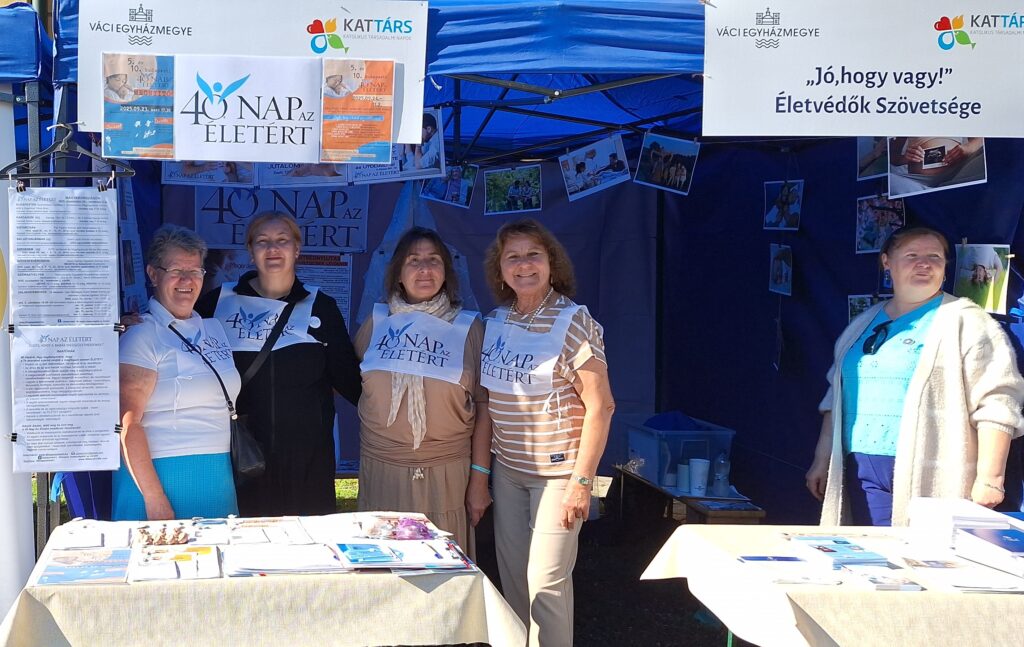
The event on 31 January is different. The idea materialized last November, building on the success of a preparatory session held before our most recent campaign, which we organized together with the Franciscan friars in Pest and CitizenGo. The initial feedback made me uncertain, but my church leader advised me to start organizing it and explore whether the idea truly came from God. I was looking after my grandchildren when I received a call from Jó, hogy vagy! Pro-Life Alliance: Father Zoltán Osztie would be able to stay for the entire morning and even open the event—and then the request for this interview followed as well. These moments confirm for me that God is at work in our cause even when I personally cannot be, for example, because I’m fulfilling family responsibilities.
What is your main goal?
One of our shared intentions has been to open towards young people, but I also consider it important to increase the number of Hungarians who pray—for any cause. A war has been taking place in one of our neighboring countries since 2022. Just as Abraham bargained with God over the number of righteous people, my goal too is to be kind in the eyes of the Lord. Parliamentary elections are also approaching, causing a great deal of tension and breakdown of trust among Hungarians. In my view, hostility among Christians is the greatest obstacle preventing many people from listening to the message of the Gospel.
Moreover, since 2021, meetings for European leaders have been organized every year, and what I heard there was of great significance to me—for example, that there are difficulties everywhere and that we must not be frightened by them. They also place great emphasis on strengthening ourselves collectively through expressing gratitude and sharing the testimonies experienced during campaigns. Connecting pro-life organizations and networks and strengthening one another through joint prayer is also extremely important.
What do you need most at present?
Organizers. We support all three previously mentioned areas of life protection through prayer—sexual education, practical help, and the processing of loss of children—but much more attention should be paid to ensuring continuous support in these areas even between campaigns. For everyone, but especially for those working in education and awareness-raising, it would be a huge help if they did not have to find venues themselves. There is also a need for more preparatory events like this in every participating city.
From young people, we primarily need technical and communication support, for example, translating and subtitling English-language videos, managing our website and social media pages, and helping with the organization of events. Solving accommodation and transport will not be easy either.
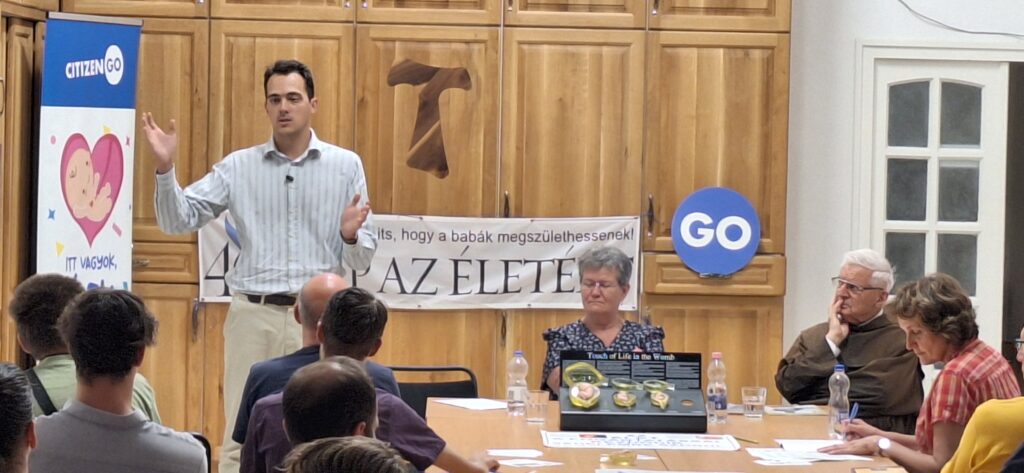
Greater involvement from the Church and individual parishes would also be needed: promoting our events, organizing participants, offering prayer support, and Mass intentions. It would be good if church communities or pro-life organizations could each take responsibility for a few hours or even an entire day. And of course, individual prayer volunteers are also very much needed. The aim is that at every hour, at least two people pray together in unity of purpose. From our pool of around 40 people, we ensure the presence of at least one person; the second person should feel that they need to be there so that together they can ensure continuity. Let us love one another enough not to leave anyone alone.
About the event:
The event begins at 8am on 31 January and will take place in the main hall of the Franciscan Church in Central Budapest. The organizers’ opening address speech will be followed by video messages from Shawn Carney, CEO of 40 Days for Life USA, and Robert Colquhoun, International Campaign Director.
Éva Eberlein, identity coach, will speak about the importance of sexual education; Emília Ádámszki, health visitor from the Family Protection Service, will address the issue of responsibility in pregnancy terminations. Éva Pálinkás from the Várva Várt Foundation will explain what kind of support women in crisis pregnancies need; Anna György-Deák (Path of Protection) will speak about processing the pain of child loss; and Ágota Fenyvesiné Gábriel, cantor, will share her personal story. István Horvát, Secretary General of the Hungarian Evangelical Alliance, will present his practical experience in educating teenagers. Dániel Dobó will introduce the international pro-life organizations Life International and SaveOne.
After the lunch break, Petra Tišljarić, leader of the Croatian movement, will share her experiences via video message, followed by a report from Adrián Uracs, former organizer in Novi Sad, who, since getting married last year, has been strengthening the Croatian team. Feedback is also expected from Polish pro-life activists on how they succeeded in reshaping public thinking.
Afterwards, Valéria Sréderné Devecz and Katalin Leinemann will talk about how they started and what results they have achieved in Vác, followed by Hajnalka Kissevichné Toldi, who will present the steps being taken to build a culture of life in Székesfehérvár. Finally, the other organizers will also introduce themselves shortly: Bernadett Márkus (Debrecen), Levente Bodnár (Karcag), Virág Bálint-Szedmák (Kistarcsa), Zsuzsa Kurgyis (Kecskemét), Katalin Gyurisné Hutter (Szeged), and Anett Kosárné Varga (Szombathely).
Related articles: