Among the many dictatorial measures of the Rákosi regime, one of the most emblematic was the wave of deportations carried out in 1951. In the spring and summer of that year (officially between 21 May and 18 July, although other dates also appear on the deportation orders), more than 5,000 families—some 12,000 to 14,000 people in total—were forcibly removed from Budapest to rural areas, with extremely short notice and usually under completely inhumane conditions, on the basis of an old law. Those deported were forbidden to enter the territory of the capital.
According to official propaganda, those subjected to deportation were ‘princes, counts, barons, the ministers of Horthy…former gendarmerie officers’, ‘assistants of the Gestapo’, and ‘allies of the ruling classes who exploited the people’.[1] Reality, of course—as this chapter will also demonstrate—was quite different.
First, let us quote a vivid example of the living conditions of those who were deported. Béla Aggteleky, a lieutenant general and chronicler of the events in the Castle District on 15 October 1944—who on the day of the attempted Hungarian exit from WWII ordered his troops to attack the Germans—recalled his deportation as follows:
‘We were taken to a solitary farmstead in the Jászság region, ten km from Újszász, which we were forbidden to leave. Together with my wife, I worked as a day labourer and crop harvester. My younger son was soon exempted from deportation, as they needed him as an engineer. My wife and I were left alone. In our single rammed-earth room, we lived through a total of nine floods—three every spring. Each time the water surrounded the isolated house, and even broke through inside the room, yet we were not allowed to leave. I transported the straw, with which we heated the room, from a stack 200 meters away, to the oven I had built myself, using a raft made of planks. There were occasions when, on the surface of the flood, the water froze to a thickness of ten–15 cm…At such times, for weeks on end, a thick crust of ice covered the landscape, across which…one could “move about” only with one’s feet wrapped in rags. The issue of drinking and cooking water (the water source was about 300 meters from the house) was a separate problem. Our fuel for cooking—since there was not a trace of wood or coal—was dried cattle dung, which we collected on Sundays during walks on the pasture.’[2]
‘Those deported were forbidden to enter the territory of the capital’
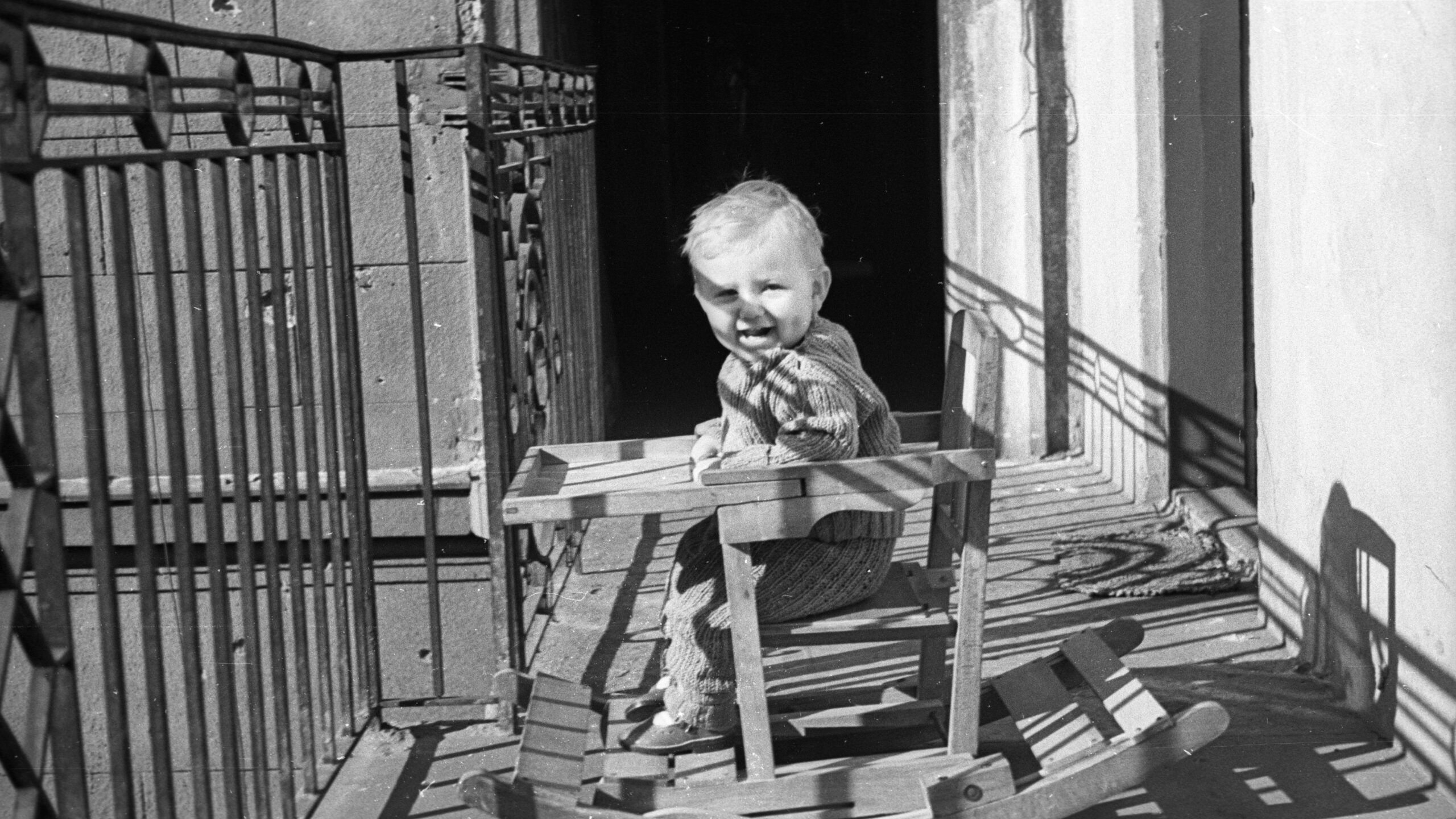
Some were permitted to take shelter with relatives in the countryside, but the majority of such requests were rejected. Only in the rarest cases did deportees arrive under relatively consolidated conditions. Here we have essentially selected the most extreme cases from the files of residents deported from the Castle District, although in total we have identified more than 500 cases from Budapest’s 1st District—and even this is not the full number, only those for which documentary material has survived. This article will focus especially on deported families with little children, and our further articles will inspect other interesting cases as well.
The deportations were usually preceded by surveillance of the persons to be deported and the preparation of a background or environmental assessment. This is also demonstrated by the case file of Ferenc Szalay, an employee of the Ministry of Finance, who was deported together with his mother-in-law—the widow of Ferenc Grundel, namely one Gőbel Kamilla—his wife Margit Grundel, and his sons—six-year-old Péter and three-year-old András—to Tápiógyöngye from their apartment at 10 Várfok Street, 1st floor, flat 6.
The basis for the deportation was that the widowed Mrs Grundel was ‘the widow of a retired lieutenant colonel’. Szalay advanced several arguments in an attempt to save his family. First, he explained that they lived together with his mother-in-law only so that, while he and his wife were at work, the grandmother could look after the children. He also emphasized that the late Ferenc Grundel had retired in 1921 as a military veterinarian and had died in 1932, and therefore could not be accused of any wartime crimes. Furthermore, he pointed out that he was a ministry employee and a member of the Hungarian Workers’ Party (MDP).
Nevertheless, according to his file, an evaluation was requested from the MDP organization of the Ministry of Finance—all workplaces had local Communist organizations active among the workers—which was duly provided by party secretary Lajos Hazai. He described Szalay as ‘bourgeois in outlook’, someone who ‘tries to maintain appearances, but when it comes to his own person, our Party’s policies must be strongly substantiated to him. He engages in lengthy debates to prove his own correctness, and although he eventually accepts the comrades’ arguments, it is evident from his face that he is not convinced by what the comrades clearly and correctly explain to him through educational work.’
After the deportation took place in July 1952, the parents reported that even by January 1953, they had still been unable to find work, and that the elderly Mrs Grundel was suffering from a severe eye condition, so that ‘the provision of food for our minor children is becoming increasingly difficult.’ They therefore requested that the children be allowed to move to relatives in the town of Marcali, who would be willing to take them in. This request, however, was not supported by the Council of the Municipality of Marcali, which stated that it did ‘not wish, under any circumstances, to increase the number of those who are enemies of our socialist state system’. Let’s keep in mind that this was written about a kindergarten-aged child and his toddler sibling!
Since the family failed to ‘grasp the message’ and submitted further petitions, they were informed in 1952 that their case had been completely closed and that no further requests would be considered: ‘We consider the deportation of Ferenc Szalay and his family to be justified.’[3]
The deportations were often justified on the basis of the individual’s social status, yet labels such as ‘landowner’ or ‘tavern owner’ did not always reflect reality. Károly Menártovics, described as a ‘tavern owner’, together with his wife and their 11-year-old son, received the deportation order on 5 July 1951 at their apartment at 5 Ostrom Street, ground floor, flat 2, in Budapest’s 1st District. Their new place of residence was designated as Tarcal, in Borsod-Abaúj-Zemplén County.
In the decision, Menártovics was listed as a ‘tavern owner’, although he immediately pointed out that he had only owned a tavern between 1948 and 1950 and was currently working as a waiter; moreover, he was a member of a trade union. His wife was a bedridden cancer patient, for which he provided medical certification. Before the complaint had even been reviewed, the police reported that ‘the individual in question’ had already been ‘sent on his way’ to ‘the designated place of residence’. During this time, their son was staying with relatives in Doba, in Veszprém County. The police could not let this pass, and the boy was also deported; he arrived in Tarcal in January 1952. Menártovics submitted a petition requesting that the boy be allowed to remain in Doba, as he had already been attending school there. The request was rejected with the justification: ‘It cannot be granted; he can attend school in Tarcal as well.’[4]
The deportation file of the vitéz Baron Dénes Hellenbach Jr contains a series of tragic misunderstandings. The man, who was not only of noble ancestry but was also a member of the Order of the Vitéz, a kind of elite organization for veterans founded by Miklós Horthy, lived at 13 Dísz Square, together with his mother, the widow of Dénes Hellenbach (Mária Dessewffy), and his adopted son, six-year-old László Hellenbach (born Király). They were deported on 12 July 1952, with Adács in Heves County designated as their new place of residence.
In response to the deportation order, Hellenbach stated that he himself was an employee of the Hungarian National Bank; that he was merely an aspirant to the title of vitéz; that he had never served at the front; and that his mother was completely incapable of supporting herself. Despite this, the deportation was carried out.
His foster son, László, however, was staying with relatives in Somogy County, and therefore, in January 1952, the police warned the adoptive father that the child would be expelled if he was not taken to Adács. The family indicated that the boy’s biological father, László Király, had been a worker who, during the siege, had assisted the Soviets as a civilian by transporting ammunition, and had been shot by the Germans for this; in this sense, the child had no connection whatsoever to the family’s noble origins. Moreover, the adoptive father had found work in nearby Felnémet and was only at home once a week, making it impossible for him to supervise the child.
Nevertheless, in March 1952, the Ministry of the Interior instructed the head of the Heves County Police Headquarters to ‘determine whether Baron Hellenbach László has arrived in Adács.’ The deliberate inclusion of the word ‘Baron’ in the name of a half-orphaned child who came from a poor family shows the cynicism of the Communist dictatorship. Finally, in August 1952, permission was granted for the boy to move to the town of Nemesvid to live with his biological relatives (probably meaning his mother, who was strangely absent from the story). It is unclear when the adoptive father himself was able to leave Adács; later sources indicate that he was living somewhere else in the countryside.[5]
In these cases, deportation functioned not as a temporary administrative measure but as a deliberate breaking of children’s lives, severing them from education, family stability, and any sense of security. The files reveal a system in which even illness, orphanhood, or proven loyalty counted for nothing once a child and his or her family had been stamped with the label of ‘class enemy’.
[1] Új Élet, 21 June 1951, pp. 1–2.
[2] Hadtörténeti Levéltár (Military Archives), Personalia, Aggteleky estate, Box no 286, pp. 550–551.
[3] Állambiztonsági Szolgálatok Történeti Levéltára (ÁBSZTL), 2.5.6. I.s. A 01580/1951.
[4] ÁBSZTL, 2.5.6. I.s. 02689/1951.
[5] ÁBSZTL, 2.5.6. I.s. A 00860/1951.
Read more: