Following an embarrassing spectacle in Ireland that saw nearly 13 per cent of voters cast ‘spoilt’ ballots while an unapologetic leftist cruised to victory in the Irish presidential race, establishment-liberal politicians like Tánaiste [Deputy Prime Minister] Simon Harris exhibited timid initial signs of policy reversal on the immigration issue.
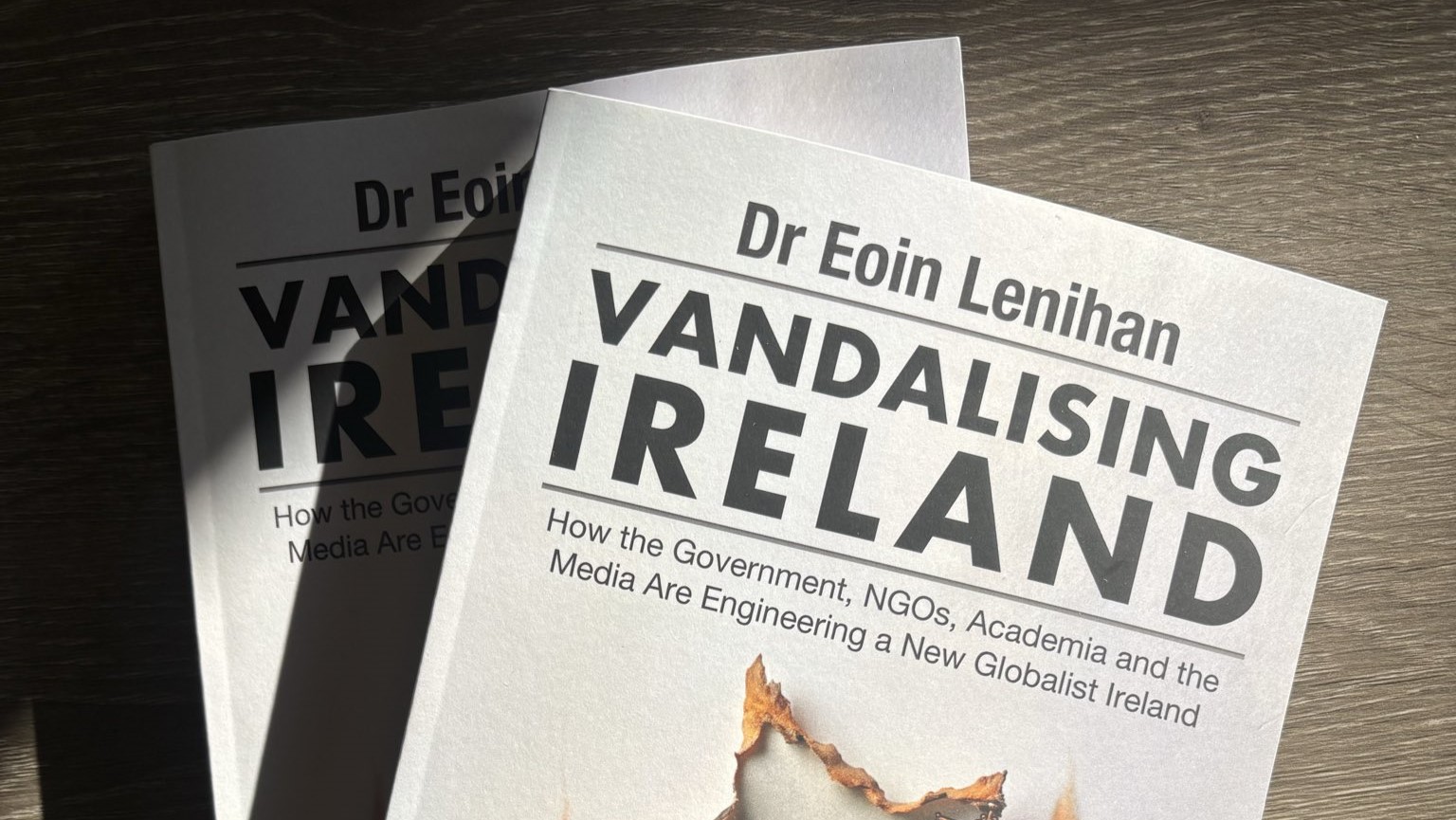
It is a matter on which Irish elites like Harris have militantly suppressed debate. An average-length column does not offer adequate space to describe the treachery of this pivot. Fortunately, Dr Eoin Lenihan’s newly published Vandalising Ireland commendably examines this and other ills of modern Ireland.
Lenihan contends Ireland is a ‘crippled democracy’, one in which the people are casting about without an identity. ‘The Celtic Tiger brought mass immigration, massive foreign direct investment, wealth and unprecedented greed to Ireland,’ he writes. ‘By the time the historic 33rd Dáil [lower house of parliament] coalition of Fianna Fáil, Fine Gael and The Greens took control in 2020, Ireland was a nation in which almost a quarter of its occupants were born overseas, with little more than the pursuit of money to unite them.’
How did Ireland become so non-Irish in such a short period? How did a country famous for its Catholic heritage become so zealous for secular, nihilistic social arrangements? How is there no electable alternative to liberals and leftists in the Irish political landscape?
Lenihan skilfully guides readers through Irish history to the unique political conditions that exist today. This includes the centuries of British rule, the development of the Catholic Church’s prominence, famine, emigration, and the socioeconomic idiosyncrasies of de Valera’s Ireland.
‘How did Ireland become so non-Irish in such a short period?’
Lenihan attributes the historical devolution of social governance to the Catholic Church and political expediency of government subsidies to many of the problems today; now these manifest themselves in devolution to left-wing NGOs and subsidies from the European Union.
The book’s chapter on the Irish media landscape is particularly enlightening. He explains how enormous government subsidisation and strict libel laws have made Irish journalism highly subservient to government interests. Add in the reality that media outlets employ members of a monolithic Irish professional class, crafted by an activist Irish university system, and the reader can see how mainstream Irish media have become so nakedly propagandistic.
Hungarians unfamiliar with Coimisiún na Meán, the Irish state media regulator, should acquaint themselves, as its increasingly dystopian tendencies are closely linked with EU media policy and the efforts of transnational NGOs.
Still, why can there be no electoral alternative for Irish voters? Dr Lenihan traces the obstacles confronting small anti-establishment parties like Aontú and Independent Ireland, as well as several overtly nationalist micro-parties. Shunning the temptation to focus only on destructive endeavours, he suggests a plan for returning Irish society to a rootedness in culture and community. Whether demographics and time will allow for such a plan to materialize is an open question.
Hungarian readers will be interested to know that Lenihan briefly discusses their homeland near the end of Vandalising. Addressing diaspora issues, he writes:
‘Hungary’s Fidesz, the party of Viktor Orbán, is also a proponent of the political summer camp concept, and each year the party comes to Romania to connect with the Magyar—ethnic Hungarian—population and to boost a sense of community and national pride, inclusive of its diaspora. The annual summer camp includes political speeches with a keynote by Orbán himself mixed with concerts, cultural events, and sports. These events by AUR and Fidesz have been crucial in shaking young, disenfranchised voters out of their apathy towards the political system and making them feel part of something special. More importantly, such events identify and hone a core political base, as well as providing a pool of committed leaders from which to stock a political party with candidates.’1
Later, he adds, ‘AUR and Fidesz owe a great deal of their success to their diasporas. While the Irish diaspora cannot vote in Irish elections, they will—as proven with funding for Sinn Féin in the 1970s and 1980s—provide financial, media, and networking backing to an overtly pro-Irish movement.’ It is a reminder that, while foreigners often keenly follow Prime Minister Orbán’s words at Tusványos, they also are noticing the wider strategy underlying such activities.
Confronting a diaspora exponentially larger than Ireland’s current population, Irish policymakers surely should not disregard Lenihan’s Carpathian examples.
‘Dr Lenihan’s book is consigned to a role of breaking official taboos’
A few points warrant critical discussion. Dr Lenihan prescribes a laissez-faire approach to the metastasizing Irish state and its myriad social ills. This reviewer is sceptical that more laissez-faire is the solution in a country that has become a case study of corporate excess and rootlessness. Ideally, numerous voices on a broad Irish Right would contest these ideas.
Alas, Dr Lenihan’s book is consigned to a role of breaking official taboos, at least for now.
Dr Lenihan surprisingly skips over the events of November 2023, in which an Algerian migrant stabbed three children and a school worker, and riots erupted in Dublin. The episode captured international attention. Government culpability lingers, as the alleged attacker’s trial has not begun. Finally, at times, Lenihan seems too willing to accept popular anti-Church rhetoric in analysing the collapse of Catholic Church influence in Irish society.
These are but minor criticisms of an energetic, timely study. Perhaps its author will consider a revised edition, as Irish societal events have continued apace. Prior to the aforementioned ‘spoilt-vote’ presidential election, Irish and foreigners alike were appalled at the alleged rape of a ten-year-old girl under state care at the hands of a North African migrant. In fact, Dr Lenihan several times mentions Citywest, the mixed-use development transformed into a migrant-housing facility on the outskirts of Dublin, where the crime allegedly occurred. It is written evidence of the idea that ‘something like this was bound to happen.’
Vandalising Ireland could not possibly be uplifting, but it is written with the energy and passion of a man who irrefutably loves his country. Consider this lament, in which Lenihan takes up the mantle of Irish revolutionaries of old:
‘Ireland is a crippled democracy where voters have only the illusion of choice each time an election comes around. It is the reason that elections are met with lower and lower turnouts, with a historic low of 59.7 per cent in 2024. It is the reason young employed people are living at home with their parents without hope of ever owning their own home. It is the reason Ireland leads the EU in the number of young people who want to leave their homeland. It is the reason that Irish people are told by their leaders that they are a rich nation, yet they struggle to pay childcare costs. It is also the reason that Ireland is burning.’
- Lenihan, Eoin, Vandalising Ireland, Western Front Books, pp. 298. ↩︎
Related articles:
At a time when public debate is increasingly polarized and superficial, Hungarian Conservative remains committed to depth, intellectual honesty, and independent conservative thought.
Producing high-quality journalism requires resources. Your contribution helps us expand our coverage, reach new audiences, and keep our content accessible.

Please consider supporting our mission.