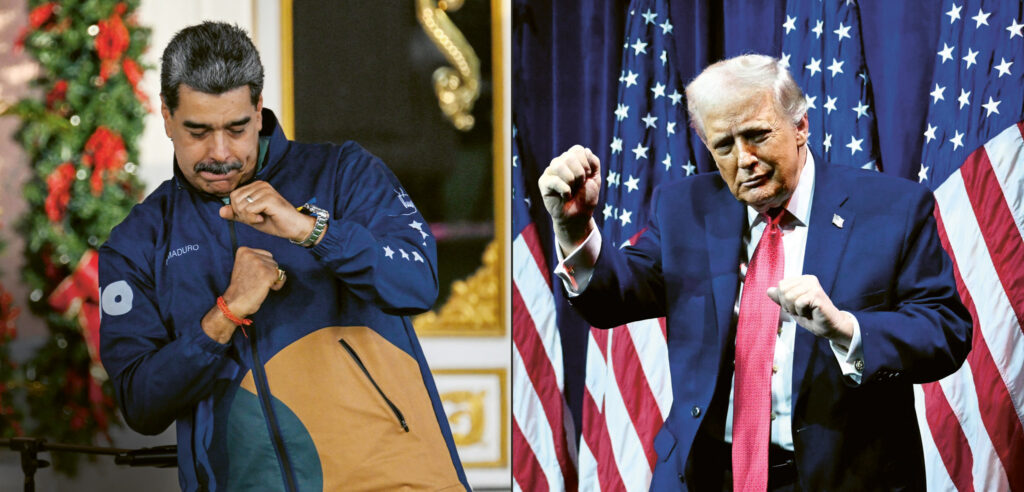
If 2025 was the year in which the liberal world order collapsed, 2026 may become the year in which something new is reborn to replace it amidst the chaotic transformation currently unfolding. Hungarian Prime Minister Viktor Orbán referred to this emerging order as the ‘age of nations’ at his year-opening international press conference on 5 January, and as the term aptly captures the contours of the order now taking shape, let us stick with it. Meanwhile, the United States’ operation to capture Venezuelan President Nicolás Maduro on 3 January, and the developments that followed, have revealed the defining characteristics of this new world order more clearly than anything seen before.
Now that we have a name, it is worth taking a closer look at what those characteristics are. The liberal world order that dominated international relations and economics after the fall of the Soviet Union did not emerge overnight. It grew out of the post–World War II settlement and took its modern shape during and after the Cold War, when the United States and its Western partners built a sprawling system of multilateral institutions, open markets, and collective security arrangements to manage great-power competition and encourage cooperation across borders.
In the post–Cold War era, with the United States firmly established as the sole superpower, this system was actively extended beyond the West into a global project. Liberal norms of rules-based cooperation, economic openness, and the promotion of democratic governance and human rights were embedded in institutions ranging from the United Nations and NATO to the World Trade Organization and the International Monetary Fund, all underpinned by American military, financial, and diplomatic leadership. The binding force of the liberal order was international law, which served as a framework through which smaller states could protect their interests against larger powers.
Yet its liberal pretensions often masked Western strategic interests; its promotion of human rights and democratic values frequently devolved into virtue signalling; it struggled to reconcile great-power primacy with claims of universal legitimacy; and its internal contradictions foreshadowed the very unravelling that now appears to be underway.
Less Unipolar, Less Hypocritical, More Pragmatic
By contrast, the emerging world order is less unipolar, even if it remains far from a clearly multipolar system—something many anticipate may take shape once the current transformational chaos settles. The publication of the new US National Security Strategy at the end of last year, together with the Trump Corollary to the Monroe Doctrine—which we saw applied in practice in Venezuela for the first time—has made it clear that Trump intends to do everything in his power to keep Washington as the strongest pole of the new order, asserting control over the Western Hemisphere while sending clear messages to both Beijing and Moscow.
Unlike its predecessor, the emerging order will not be grounded in liberal norms and rules, nor will major powers bind themselves to international law. The Venezuelan operation crystallized this shift and drew widespread criticism because it explicitly challenged core principles of sovereignty, non-intervention, and the prohibition on the use of force enshrined in the United Nations Charter.
At the same time, there is an evident contradiction. Many critics, including myself, argue that the liberal world order itself applied international law in a highly selective manner, to put it mildly. When the interests of the United States or the broader transatlantic alliance so dictated, international law rarely functioned as an effective safeguard for smaller states. One need only recall the invasion of Iraq. Nor did international law provide protection for Georgia or Ukraine against Russia’s military power.
It is therefore more accurate to say that neither world order has truly been governed by international law; the difference is that the emerging one does not hypocritically claim to be.
‘The emerging order will not be grounded in liberal norms and rules, nor will major powers bind themselves to international law’
Another defining feature of the emerging world order is transactional diplomacy—a far more pragmatic, deal-centred approach to international relations that places material interests and explicit bargains above lofty ideals or moral posturing. Where the liberal order once emphasized shared values, long-term commitments, and multilateral frameworks, today’s great powers are increasingly engaged in negotiations resembling business transactions, with cooperation contingent on clear benefits and reciprocal concessions rather than ideological alignment or normative solidarity.
In this transactional environment, alliances and partnerships are sustained not by shared principles but by what each party stands to gain, while legal and normative commitments are treated as flexible instruments to be leveraged or set aside depending on immediate advantage. Even strategic cooperation may emerge not from a shared vision of order, but from a pragmatic convergence of interests that makes a short-term deal worthwhile.
This means that every nation must bring something tangible to the table: energy resources, raw materials, technological or financial power, strategic geography—anything of real value. In the world order to come, countries without meaningful transactional ‘assets’ will struggle to endure, and those that relied on ideological protection alone are right to panic.
The current US push to purchase Greenland from Denmark will serve as a clear test case for this form of transactional diplomacy, and the outcome of the negotiations will significantly shape the trajectory of the emerging world order. At present, the situation remains messy, with Washington, Copenhagen, and the EU issuing emotionally charged statements. Yet there are rational pathways through which a deal could be structured to benefit the United States, Greenland, and Europe alike.
Many Question Marks Persist
Greenland also raises a major unresolved question about the new world order: how will existing alliances respond to these shifts—will they adapt to new realities, or will they fracture and give way to new alignments? This question applies most directly to NATO, the alliance that defined the security architecture of the liberal world order. Greenland could become either NATO’s graveyard or its rebirth, depending entirely on how far the parties involved are able to narrow their positions.
Washington’s stance is clear: it sees Greenland as strategically indispensable. Greenland itself is divided. Independence from Denmark has long been debated, yet there is little appetite to become part of the United States—nor would this be necessary, given existing treaty frameworks such as the Compact of Free Association. Denmark, meanwhile, and the EU alongside it, appear to be clinging to the reflexes of the old liberal order, reinforced by a heavy dose of virtue signalling. ‘Denmark has never said that they “needed” Greenland. Denmark has said that Greenland is an expense, and they would leave us if we became independent. So I think it is a much more positive remark than we have ever seen from Denmark,’ Greenlandic MP Kuno Fencker told POLITICO Brussels.
One of the United States’ greatest advantages over China and Russia in an emerging multipolar order is its complex alliance system, built over the past 80 years. Neither Beijing nor Moscow possesses a comparable network, even if organizations such as BRICS or the Shanghai Cooperation Organization are taken into account. Allowing the transatlantic alliance to disintegrate would be a grave strategic error. For Washington, it would risk forfeiting the marginal advantage needed to remain the strongest pole; for Europe, it would threaten its relevance in the new world order.
‘Allowing the transatlantic alliance to disintegrate would be a grave strategic error’
It remains uncertain how China and Russia will respond to the transformations unfolding in the Western Hemisphere. China has already demonstrated its ability to flex its economic muscle against the United States during last year’s tariff war. So far, both Beijing and Moscow appear comfortable with a return to a spheres-of-influence logic in international relations. For Russia, Washington’s growing focus on the Western Hemisphere rather than Europe is particularly advantageous. Transactional diplomacy may also suit both powers: Moscow is already engaged in negotiations with Washington over Ukraine—talks that will themselves help define the contours of the new order—while Beijing may hope for similar negotiations with the United States over Taiwan.
Taken together, this is what the emerging world order looks like at the outset of 2026. International relations are currently tense, chaotic, and in flux. What is certain is that many of the defining features of this new era will be tested this year, and the shape of the emerging world order—whether stable, fragmented, or dangerous—will begin to assume a more enduring form.
Related articles: