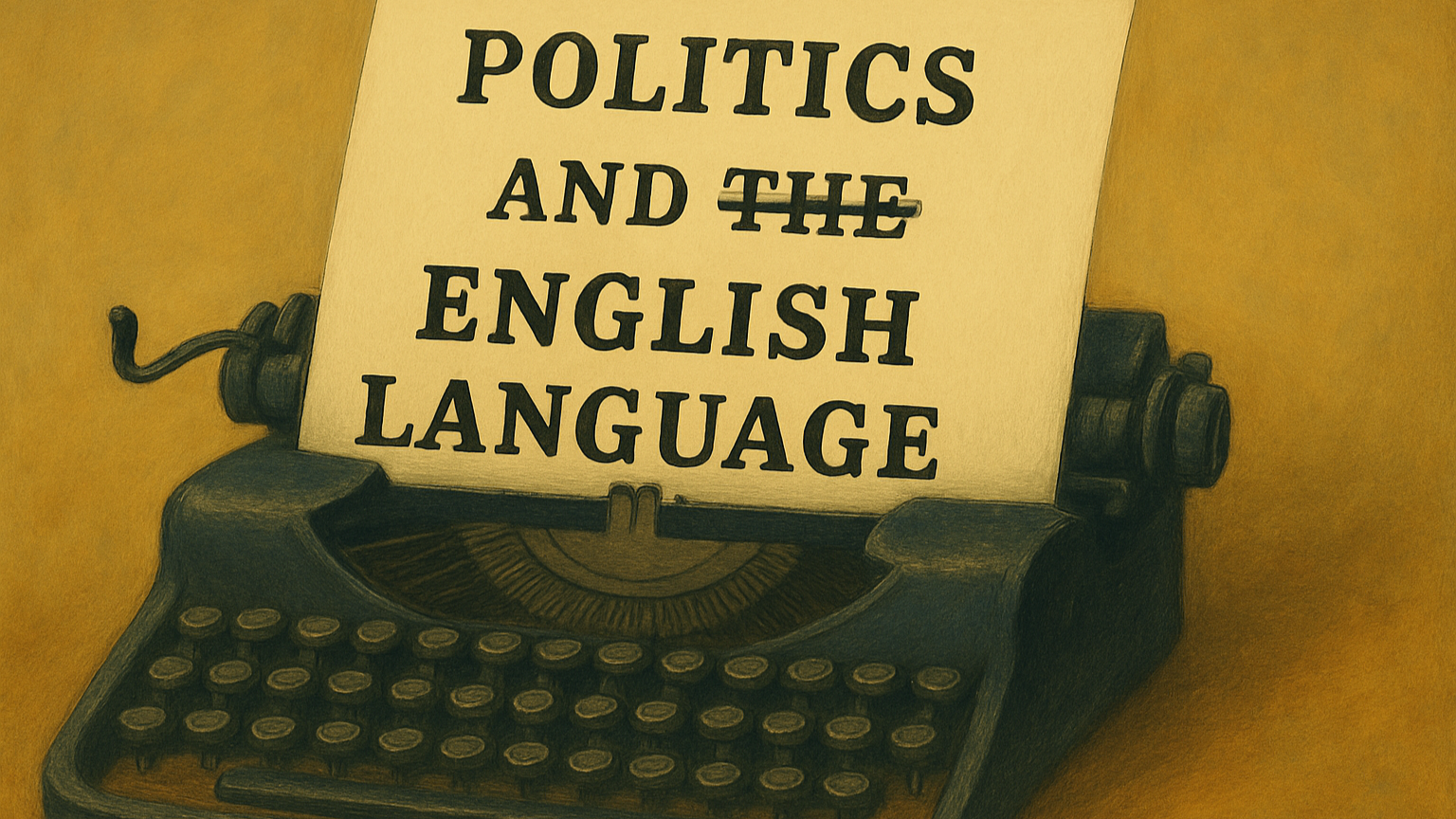
In his famous essay ‘Politics and the English Language’ (1946), George Orwell argued that there is an intimate connection between the quality of language and the state of politics.
Consider the modern use of euphemisms. Human beings have always employed euphemisms in social settings. In earlier times, they were primarily a matter of courtesy. The very word derives from the Greek euphēmē, meaning ‘beautiful speech’.
Today, courtesy is hardly the guiding principle. In our more crude, simplified culture, euphemisms have been politicized. Beautiful speech has been transformed into Newspeak and political correctness. Both tools are designed to serve particular political ambitions.
Michael Knowles captures this dynamic with precision in Speechless: Controlling Words, Controlling Minds (2021). He argues that the Left reshapes everyday language and thereby subtly alters how people think and speak. According to Knowles, Political Correctness, which he calls the ‘anti-standardised standard’, undermines tradition in two ways. First, it pressures individuals through social stigmas to adopt a radically new code of conduct. Second, it dissolves shared norms altogether.
In its way, words do not merely describe reality; they prescribe which opinions are deemed ‘correct’. At the same time, conservative and traditional perspectives are pushed aside, rendered obscure or invisible.
Take transgenderism: the claim of being ‘trapped in the wrong gender’ presupposes a false split between biology and identity. One wouldn’t need to say transman if he were only a man. Similarly, people sometimes talk about social justice rather than just justice—but if justice needs to be ‘social’, then it is no longer justice.
‘The words one uses shape how one perceives reality and adjusts to it’
Language thus gives them the power to diminish what people usually consider very serious and amplify the significance of what the ideologues themselves want to emphasize. At the same time, the conservative frame of reference narrows, and tools for telling the truth become less accessible. As Austrian philosopher Ludwig Wittgenstein famously stated: ‘The limits of my language mean the limit of my world.’ Meaning that the words one uses shape how one perceives reality and adjusts to it.
Because the issue of language doesn’t end with the culture war, it’s relevant across every level of issues and ideological questions.
Right Speaks No Longer Right
Today’s right-wing debaters adopt language shaped by media, culture, and youth education. Yet blindly adopting new codes risks cementing a narrow perception of reality, diverging from what lies outside the window.
Have you noticed that when liberals speak of ‘threats to democracy’, what they really mean are threats to liberalism? This is no coincidence.
Patrick Deneen argues in his Regime Change (2023) that the essence of modern elite formation rests on two pillars: the dismantling of traditional guardrails, ethics, morality, and local communities and civic institutions by redefining them as systems of oppression; and teaching adherents to navigate a world without guardrails.
In practice, this leads to liberal and affluent families continuing to succeed, partly because the guardrails for non-elites are destroyed without adequate replacement, and competition is thereby limited.
Let’s test Orwell’s thesis: how do conservatives discuss everyday issues? They cherish democracy, meritocracy, and communities, yet even these ideals have eroded.
Etymologically, democracy derives from the ancient Greek word demos, meaning ‘people’. It is the same for populists, but from Latin. Taking a populist stance on an issue, therefore, means aligning with the will of the people, which should be the most democratic stance of all.
At the same time, it stands in contrast to the standard liberal stance of ‘trusting experts’ on issues. Liberal goals of protecting people from populism are, in light of this, very ironic. To say the least, oligarchical.
Likewise, speaking of democracy, it is difficult to see how current circumstances of political dynamics in European countries can sometimes be discussed in terms of ‘one people’, since they have become so heterogeneous last decades. Instead, it looks more like a fragmented structure across many countries, with multiple entities, cultures, religions, and therefore different interests. Hence, they have started to look more like clientelist societies.
Meritocracy too has eroded. Gen Z hears nostalgic tales of janitors turned board members but will never see such mobility. What prevails instead is credentialism: the demand that one pass through specific institutions and secure the proper stamp of approval before even being allowed to apply.
As Deneen observes, this is not only about absorbing the culture of liberal elites but also about incurring heavy debt to learn things that are often untrue. Meanwhile, elites import labour from across the globe, with dubious credentials and work that rarely meets the promised quality.
In the US, talk of ‘strengthening communities’ often misreads reality. When conservatives speak of communities, they imagine small Christian communities where people care for one another, much like Tocqueville described in Democracy in America (1835). That is neither the liberal definition nor the reality. To ‘protect communities’ means, for liberals, to privilege categories such as the previously mentioned imported workforce, LGBTQ groups, ghettos, or ethnic enclaves. In most cases, this is done through economic transfers.
‘What emerges is a conservatism entangled in liberal codes’
The limits of our language do not end there. Even conservative-coded terms are now constrained by liberalism.
You can only be a patriot if you love the country as it currently stands, with its liberal values. Otherwise, you are an extremist, which is synonymous with bad and not to be taken seriously. Likewise, you can only be considered conservative if you want to return to how things were ten years ago. Anything beyond that makes you radical. You may call yourself Christian, as long as you tolerate modern values. Otherwise, you are an irrational fundamentalist.
What emerges is a conservatism entangled in liberal codes, leaving us to ask what remains once the borrowed language is stripped away.
Struggle for Truth
One of Samuel T Francis’s most enduring critiques of the ’Old Right’ was its detachment from reality—lost in abstractions that no longer fit the framework of modern politics. That tendency remains strikingly evident in the year 2025. When we examine the language and examine its contemporary usage, two parallel tendencies emerge: the Left uses language to transform society. At the same time, the Right adopts similar linguistic codes to justify ideals that no longer correspond to reality.
What does this mean? First: the Left has been remarkably successful in its campaign to ’control words, control minds’, as Knowles put it. Second: this has largely escaped the attention of both the old and the new Right.
But the most critical lesson in contemporary politics is this: truth can only ever be the weapon of conservatism. Language, by contrast, is one of many instruments of leftist deception. Conservatives need truth and truthful language to grasp reality as it is, not to chase an idealized vision of how it ought to be. In this, we are failing.
The fundamental task of conservatism, as always, is to interpret the meaning of the world and align action with truth, rather than attempting to reconstruct it. Andrew Breitbart famously said that ‘politics is downstream from culture.’ I would add: both politics and culture are downstream from language.
Related articles: