‘Wishing you all a beautiful and uplifting life’ were László Svak’s closing words, opening the stage for a range of performances lovingly prepared by Melbourne’s Hungarian diaspora community, commemorating 15 March, the first day of the Hungarian Revolution in 1848. The ceremony also honoured the life of Márton Farkas, who was one of the revolutionaries seeking refuge in Australia following the uprising 178 years ago. He lived in Melbourne for 40 years, as László, once a renowned chef and the current president of the Hungarian Community Co-Operative in Melbourne, left Hungary over 40 years ago.
In the past decades there have always been driven individuals committed to preserving Hungarian culture and providing a stable social support network to Hungarians arriving in Australia. Following the devoted efforts of Zoltán Varga, a priest of the Jesuit order, Ferenc Antal, a pastor of the Reformed Church, and Márta Marót in organising the diaspora in Victoria, László stepped up in 2025.
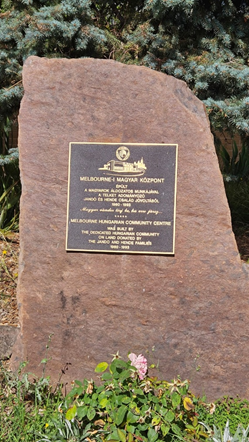
Although I have been living as an expat in various countries for nearly 12 years, I am only new in Melbourne. This event marked my intentional introduction to a Hungarian diaspora community. Pinning my cocarde to my blouse again after a long time, as a first-time visitor to the Centre I was welcomed warmly with open arms and broad smiles. Shortly after, I found myself among over 150 attendees who had one thing in common: the wish to feel connected with our Hungarian cultural heritage—be it by birth or by association.
Common Roots Some 15,000 km Apart
The commemoration on this warm, early autumn day featured three segments following Sunday mass at the Szent István Hungarian Ecumenical Church, also located on the premises. Starting at 12pm, sharing a meal prepared by a group of dedicated volunteers granted the opportunity to enjoy some scrumptiously familiar flavours and connect with fellow members of the community. About ten minutes in I found out that one gentleman across the table grew up in the same suburb in Budapest as I, going to the same school, walking the same streets and turning the same corners for years before leaving for Australia, before I was even born. Subsequently, the wreath laying ceremony commenced at 2:30pm, for which we gathered outside in the memorial garden to pay tribute to the heroes of the revolution. Principal of the Hungarian National Assembly Dr Márta Mátrai, Ambassador of Hungary H E Zsolt Csenger-Zalán, and Consul Dr Endre Domaniczky also paid their respect.
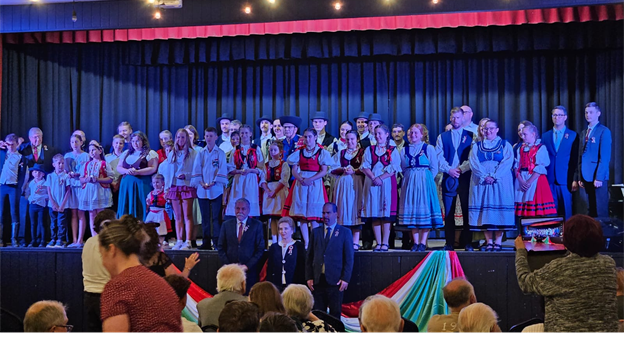
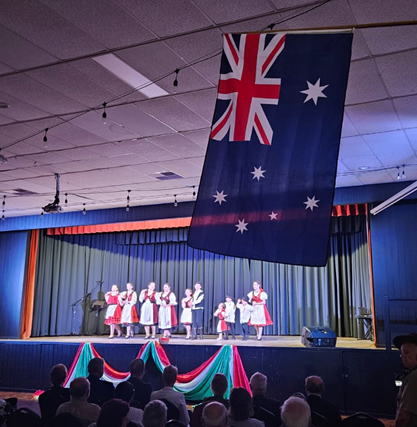
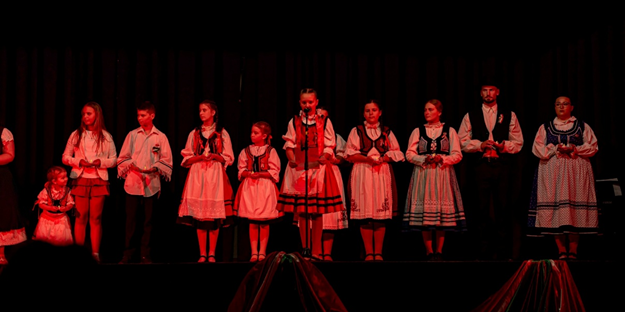
Finally, a variety of folk dance, poetry, and musical performances delivered by the committed and talented members of the Hungarian communities of Melbourne took us on a graphic journey back to the events of 1848–49, as well as to our personal memories of the past, once celebrating this national day on Hungarian soil. Singing our national anthem for the first time in years—now more than 15,000 kms away from home in chorus with those who feel just how very far that is—was a profoundly wistful experience.
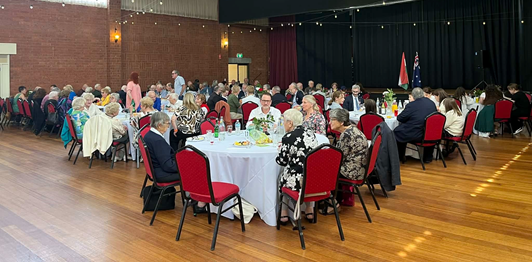
László’s words stayed with me, as they resonated with the sentiment I gathered from the unique, yet familiarly nostalgic stories told with a mixture of awe and melancholy over lunch. Located in a spacious event hall, we sat at ‘Table 15’, one of the many tables covered in white tablecloth, with a vase atop holding a bunch of fresh, red flowers. The sight was somewhat reminiscent of a wedding venue, with a soft backdrop of catchy Hungarian songs from the 1950s and 60s. All nine of us at the table had a story of how, when and why we came to Australia. With most stories featuring grave sacrifices endured due to events around the 1956 revolution, it was almost strange to be sharing mine, which spoke of the relative luxuries I was granted by a democratic homeland and a globalized, modern world: to travel for leisure and migrate by choice, not necessity.
Reasons to Connect beyond Hardship
Looking across the room I realized I must not have been alone with this slight feeling of disconnect; while a shared, difficult fate clearly created a cohesive community among those who had lived it, those outside the tolling bounds of our history, embarking their own new or inherited paths in Australia have had no, or considerably less pull towards their Hungarian roots. Scattering across the bustling cultural melting pot of Melbourne, they were out there, but not there with us. This was a bitter-sweet realization, since on the one hand, our chances to preserve our culture and experience ‘togetherness’ become limited if the community is shrinking. On the other hand, the absence of a trauma-ridden motive to join a close-knit community is what those who did attend dreamed of by leaving Hungary in the first place, following periods of severe political distress. Hardship is one, but perhaps not the only reason to nurture connections with Hungarian diaspora communities.
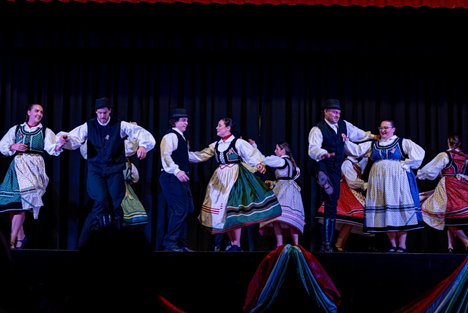
Still, the 15 March commemoration came to life thanks to the enthusiastic collaboration of several generations, many of whom were likely born in Australia. In fact, one little performer appeared to be as young as three years old (and absolutely owning the stage). Youth representing generations Alpha, Z and Y, complemented by members of generation X and the ‘baby boomers’ delivered a well-rounded, inclusive and culturally immersive experience.
Observing the Crowd
So, what did this apparent bell curve of average age, skewed towards the higher percentiles, really mean?
The more time I spent exploring the community, the more layers revealed themselves. I learned that the East Melbourne suburb of Wantirna alone is home to eight other Hungarian groups operating alongside the Hungarian Community Centre, with at least nine more active throughout the state of Victoria. Each organization is voluntarily and tirelessly shouldering the responsibility of not only keeping central elements of Hungarian culture alive but also sharing these with everyone interested at a broad variety of events and extracurricular gatherings year-round.
These include weekend schools teaching language and history, football teams, religious groups, folk dance unions, film clubs, senior citizens’ and scouts’ organizations and many more. Some events, such as the highly successful, biannually hosted ‘HungaroFest’ saw over 4000 guests with and without a Hungarian heritage, eager to see, hear, taste and love what the nearly 70,000 Hungarians living in Australia are proud of from the Motherland.

Other smaller-scale activities, such as the weekend schools and film clubs screening Hungarian movies are led by scholarship holders on temporary placements in Australia, sponsored by the Kőrösi Csoma Sándor Programme launched in 2013 by the State Secretariat for Hungarian Communities Abroad. As is the case with diverse events offered to diverse audiences, some occasions tend to attract younger crowds than others, albeit still in modest numbers. As someone who endured rather than enjoyed my solfege lessons in my early school years, I can relate to the possible feeling of reluctance to participate resulting from parents’ well-intended, yet firm nudges towards ‘getting their children cultured’. However, here in Australia the stakes are higher compared to children growing up in Hungary: with only limited exposure to a ‘niche’ culture, paralleled by the natural pull of the dominant one, the road to preserving Hungarian culture in the diaspora is considerably rockier.
As I found out, there is indeed a broad variety of activities offering a sense of cultural connection and belonging to those who seek it. I began to suspect the issue lies less in the ‘offer’ and more on the ‘seek’ end. Admitted by many members of the community I conversed with, the trend among their descendants is to focus on their Australian identity—often at the cost of their Hungarian one. This simplifies assimilation and helps merge with the majority.
‘So, here you are, too foreign for home, too foreign for here. never enough for both.’
‘Diaspora Blues’ by Ijeoma Umebinyuo
From what degree of blending and merging are you no longer considered Hungarian in the diaspora, but a ‘full Australian’? What does it mean to be fully integrated in a country? Is belonging to a diaspora subjective? Do I have to choose? Why did it take me all these years to join?
I can only attempt to answer the latter question, hoping to encourage others in my shoes to reflect on their own reasons. As a Hungarian living abroad, I have always been a part of the diaspora, whether I have been aware of it or not. Be it in Germany, Portugal or Australia, my thinking has always been somewhat binary with mutually exclusive conditions: I am either this or that. I am either Hungarian or a ‘citizen’ of my new country. Who decides? It seems to be partly a deliberate choice of my own, as well as the way (I believe) my new community would see me. I must assume there are both evolutionary reasons behind this (the will to survive with strength in numbers), and reasons of idealized social paradigms embedded in migration and integration dynamics. As a migrant, it is my duty to respect and adopt the local language, social norms and customs, and become a contributing member of the community allowing me to stay.
At the same time, as a migrant married to a fellow migrant from a continent other than my own and the one we both chose to live on, Australia, which happens to be home to an abundantly versatile bundle of cultures, choosing one single culture to adopt and exclusively respect becomes not only difficult, but also counter-intuitive, limiting. At the same time, we observed that sharing each other’s vastly different cultural heritages created stronger bonds and connected us to others in unexpected ways.
Attempting to diminish or even reject a major part of our individual identities for the sake of ‘fitting in’ created a slight but noticeable friction both internally and in our social interactions, at the very least when it came to comparing accents. As existing memories from our home countries gained their new, distant filing drawers in our minds and inevitably became laced with nostalgia, at the same time the unsatisfied feeling of being German / Portuguese / Australian ‘with an asterisk’ grew. Stepping in either direction felt like a sacrifice, challenging our integrities.
More than Scratching That Nostalgic Itch
Entering the Hungarian Community Centre in Melbourne granted me an effortless sense of belonging, albeit different to the one I tend to feel when travelling to the Motherland. I met a far-reaching history represented by the peoples of the community, embodying multiplicity.
There was also an absence of the need to choose, to categorize and arbitrarily measure everyone’s personal ‘dilution ratio of Hungarianism versus Australianism’. It was understood that regardless of the occasion, we were there to feel connected to something greater than us as individuals.
Should I Assimilate or Integrate?
Migration is a complex process, both logistically and emotionally—but it can be easier. Much like entering a village, now that I am in the Hungarian community in Melbourne I have tapped into a wealth of experience, knowledge, history, a unique culture and a network which is equipped to help any new member of the community in their process of settling in Australia. Yet most importantly, I, and anyone regardless of their age or background, get to draw from a well-studied phenomenon: psychological resilience.
In migration psychology, this is the ability to maintain mental well-being despite the challenges of migration, and day-to-day living in general. Diaspora communities can help normalize the migration struggle, provide cultural continuity, identity stability, emotional safety, offer collective coping strategies, and reduce the cognitive fatigue which can occur due to continuously ‘performing’ adaptation.
In 1992, John Berry described a fourfold model of acculturation pertaining to individual coping strategies: Separation, Marginalization, Assimilation and Integration. Separation is to reject the host culture in favour of the original one, and marginalization happens when an individual rejects both the host and the original cultures. To assimilate is to give up one’s original cultural traits in favour of the dominant one, while to integrate is to retain one’s original cultural while engaging with a new host culture.
There Is Room for Both
Despite several decades’ worth of integration into the Australian community in some cases, many attendees I spoke to preferred to converse in Hungarian with varying accents and fluency. I noticed with endearment the frequent and seamless swaps of English and Hungarian words within everyone’s conversations, mutually complimenting each other as the flow of the sentence deemed it fit. Nobody apologized; there was a certain ease in it.
Embracing Australia’s fascinating culture and traditions while simultaneously seeking out Hungarian diaspora communities do not compete with each other: they open the possibility to develop a rich and stable bicultural identity, a dual anchor.
As a Millennial born and raised in Hungary joining the community for the first time, hearing the slightly bashful yet committed re-enactment of the ‘12 demands of the Hungarian nation’ with a touch of Australian accent by those at least 15 years younger than myself was a particularly touching moment. I saw the future of the Hungarian diaspora in Australia showing up for something greater than the mere occasion we gathered for: cultural preservation enabling a dependable sense of belonging. I received a glimpse into our vicariously shared roots and futures, and an indirect encouragement to openly embrace our heritage while entering the new, because it makes us richer and stronger.
To all hesitant Hungarians in diaspora: you do not have to choose. There is room for both.
Related articles:
At a time when public debate is increasingly polarized and superficial, Hungarian Conservative remains committed to depth, intellectual honesty, and independent conservative thought.
Producing high-quality journalism requires resources. Your contribution helps us expand our coverage, reach new audiences, and keep our content accessible.

Please consider supporting our mission.