England and Argentina reached the World Cup semi-finals on a night when VAR again appeared as consequential as, or even more consequential than, the players, ending Norway and Switzerland’s unexpectedly long runs on the final day of the quarter-finals.
Norway lost 2–1 after extra time despite Andreas Schjelderup’s 36th-minute opener. Jude Bellingham equalized in the 47th minute and struck again in the 93rd minute. Argentina beat Switzerland 3–1 after extra time: Alexis Mac Allister scored after 10 minutes, Dan Ndoye levelled in the 67th, before Julián Álvarez and Lautaro Martínez decided the match in the 112th and 121st minutes.
Both games were genuinely exciting, as expected from World Cup quarter-finals, and equally controversial. As so often in the current tournament, video assistant refereeing (VAR) again stole the spotlight in both games.
Spidercam and Mistaken Identity Rule
The first controversy came when England equalized in added time at the end of the first half. Bellingham’s first goal followed a clearance by Ørjan Nyland that seemed to have struck an overhead Spidercam cable, causing the ball to fall unnaturally before England regained possession.
Referee Clément Turpin allowed play to continue, and VAR made no call. FIFA later cited the connected-ball sensor, saying it recorded no ‘heartbeat’ peak showing contact. However, footage circulating on social media appeared to show a clear change in the direction of the ball just as it hit the cable, and the BBC’s 3D replay of the game confirmed those claims.
FIFA’s explanation did not reconcile the data with images that convinced Norway’s players and staff. Head coach Ståle Solbakken said the ball ‘fell straight down from the sky’. Later in the game, Norway’s second goal was cancelled after replays found Erling Haaland committing a foul before a corner. While the call was correct, the contrast reignited complaints over the selective use of VAR technology.
Then came the Argentina–Switzerland game, which was already being watched under increased scrutiny after Lionel Messi’s side’s controversial match against Egypt in the round of 16, which fuelled accusations of FIFA favouring Argentina to win the trophy.
As anticipated, the Argentina game did not pass without a controversial VAR decision either. Shortly after Switzerland equalized in the second half and had clearly seized momentum from Argentina, Swiss striker Breel Embolo went down after what appeared to be a clear foul by Leandro Paredes in the Argentine half of the pitch. Referee João Pinheiro initially booked Paredes; however, VAR began to check the incident. After an official review, Pinheiro removed Paredes’s yellow card and booked Embolo for diving under the new ‘mistaken-identity’ rule introduced for the current tournament. As it was his second yellow card, the Swiss striker was sent off, leaving his team to play the rest of the match and extra time with ten men.
Footage supports the view that Embolo began falling before meaningful contact. The harder question is whether it was sufficiently clear to justify turning a routine subjective incident into a match-defining dismissal. Swiss coach Murat Yakin called the intervention ‘unacceptable’, saying play should have continued. Argentina scored twice against the depleted Swiss in extra time.
VAR Decides Match after Match
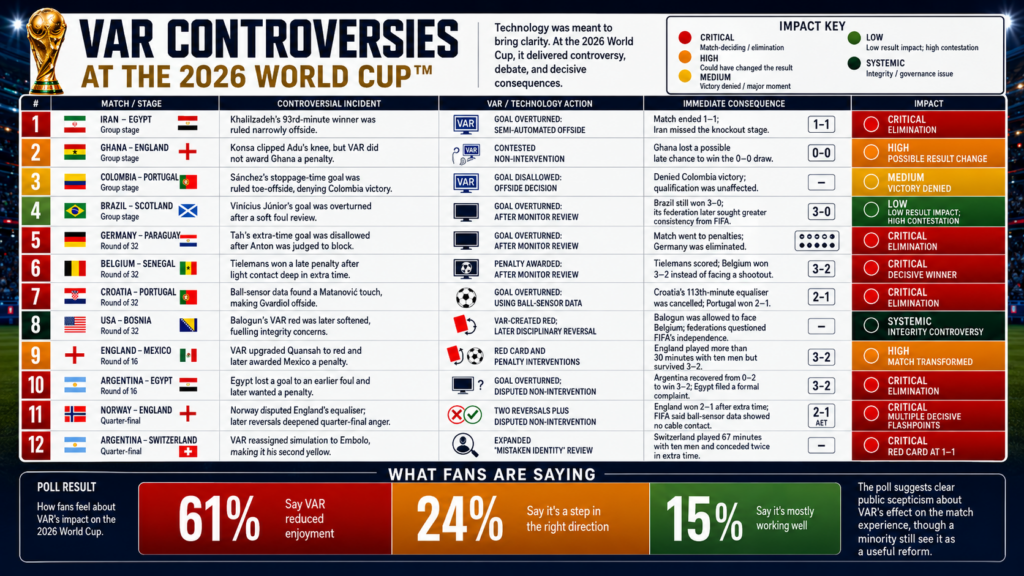
These cases fit a wider pattern. The tournament has featured a sensor-detected touch cancelling Croatia’s late equalizer against Portugal, Jonathan Tah’s extra-time goal being disallowed before Germany’s elimination, a light-contact penalty deciding Belgium–Senegal, and VAR-created red cards for Folarin Balogun and Jarell Quansah. Reuters described the trend as technological ‘mission creep’.
NetSI counted 35 formal interventions through 97 matches, compared with 26 across all 64 games in Qatar. Adding Saturday’s three gives an estimated 38 through 100 matches: a lower rate per game than in 2022, but a larger absolute footprint. Fourteen red cards have been shown, compared with four in Qatar, while expanded rules permit reviews of clearly incorrect second cautions and mistaken identity involving either team.
Data compiled by Hungarian Conservative also shows that, of the 12 major VAR controversies at the World Cup so far, seven had a critical impact on the match and all of these resulted in elimination for the respective national team.
Recent polling points to deep dissatisfaction among fans generally with VAR’s effect on enjoyment. A May YouGov survey found that 72 per cent of regular Premier League viewers considered matches less enjoyable because of the system, although 68 per cent preferred reform to abolition. A separate, self-selected FSA survey of nearly 8,000 predominantly matchgoing supporters found that 81 per cent preferred matches without VAR and 92 per cent believed it had removed the spontaneous joy of goal celebrations.
Argentina’s latest favourable VAR ruling has also intensified bias allegations already present after the round-of-16 match against Egypt. NetSI found that Argentina and Mexico had each received four favourable foul-related changes, but stressed that this was not proof of deliberate favouritism. FIFA Chief Refereeing Officer Pierluigi Collina has rejected claims of outside influence.
The controversy has accompanied Argentina on their journey into the semi-finals, and has even intensified after the Argentine Football Association became embroiled in a deep corruption scandal that broke in recent days. La Nación reported this week that US investigators were examining TourProdEnter, which handled at least $260 million in AFA income, including $57 million in transfers whose purpose was unclear from records it reviewed. The company reportedly received 30 per cent of international income plus logistics fees. No charges have been brought, no wrongdoing has been established, and no evidence links the inquiry to refereeing. Nevertheless, mistrust towards Lionel Messi’s side has significantly increased.
England and Argentina both deserve credit for advancing. Yet it is increasingly difficult to look away from the fact that VAR, introduced to remove obvious injustice, is itself generating the inconsistency, suspicion, and diminished enjoyment it was meant to eliminate or tackle.
Related articles:
At a time when public debate is increasingly polarized and superficial, Hungarian Conservative remains committed to depth, intellectual honesty, and independent conservative thought.
Producing high-quality journalism requires resources. Your contribution helps us expand our coverage, reach new audiences, and keep our content accessible.

Please consider supporting our mission.