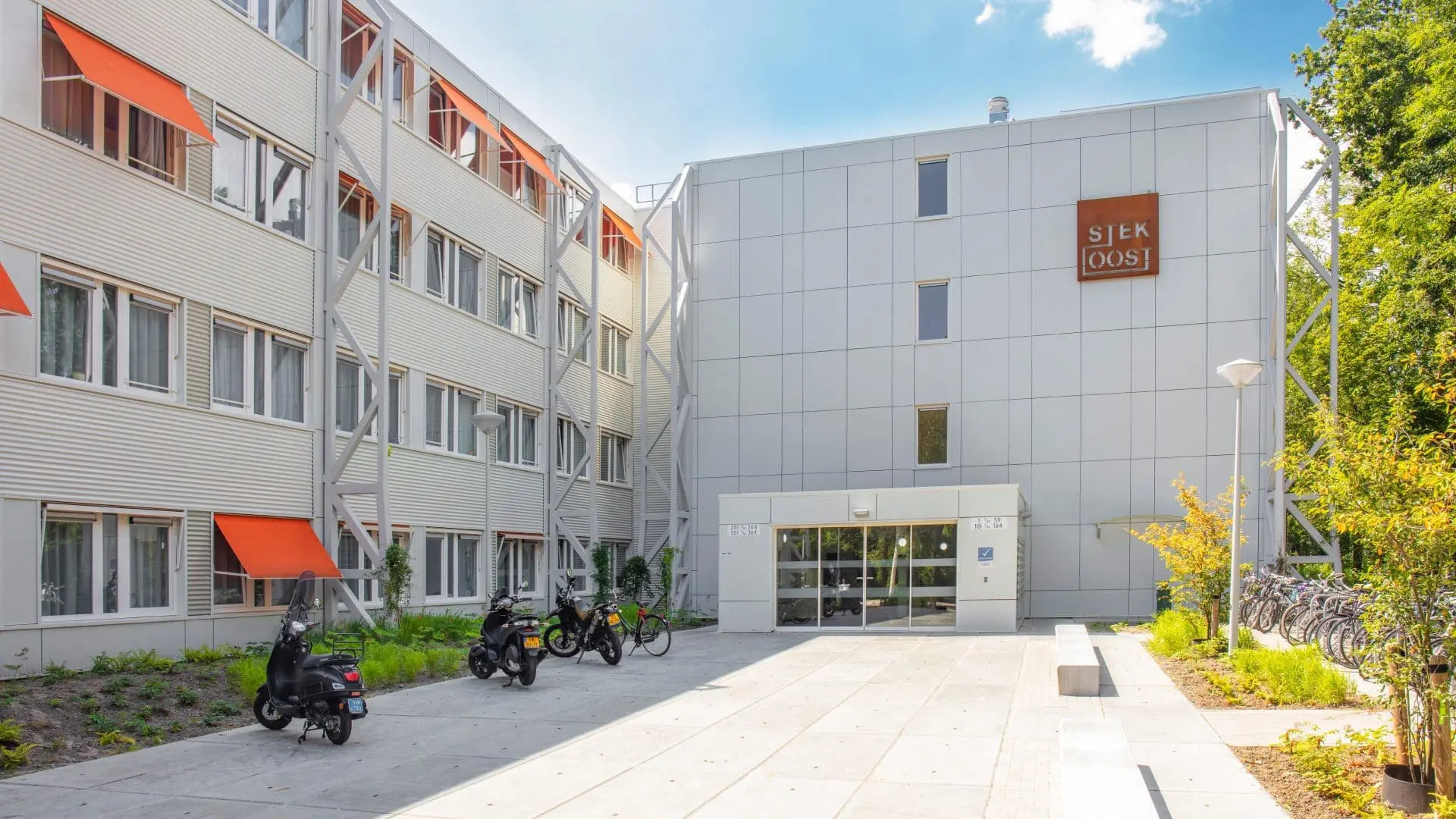
Dutch housing and migrant integration experiment Stek Oost has been rocked by years of sexual violence, intimidation and disorder. The fundamental concept of the project launched in 2018 was to house 125 indigenous students and 125 refugees under one roof, encouraging students to ‘buddy up’ with migrants to help them integrate into Dutch society. However, students reported threats, sexual abuse, and fighting through the years.
According to an investigation by Dutch documentary programme Zembla, the Stek Oost complex is located in the Watergraafsmer district in Amsterdam. Multiple students told Zembla that they experienced sexual assault, harrasment, stalking, violence repeatedly in shared living spaces. One female resident said she frequently witnessed fights in the hallways and communal living areas. Another resident described being threatened by a refugee with an eight-inch kitchen knife. Several students also claimed that despite filing multiple reports, their concerns were ignored or downplayed.
One of the most serious cases involved a Syrian refugee who was later convicted of raping two women living at Stek Oost. A former resident, identified as Amanda, told Zembla she initially wanted to help him integrate and agreed to watch a film in his room after he repeatedly asked. She said he then prevented her from leaving and sexually abused her.
Amanda reported the incident to police in 2019, but the case was dropped due to a ‘lack of evidence’. Six months later, another woman reportedly warned the housing association that she feared for her own safety and that of other women in the building. However, the local authority allegedly said it was impossible to evict the man. The refugee only left the complex after being formally arrested in March 2022. In 2024, he was sentenced to three years in prison for the rapes.
‘Several students also claimed that despite filing multiple reports, their concerns were ignored or downplayed’
Amsterdam East district chair Carolien de Heer told Zembla that even when behaviour is unacceptable and residents feel unsafe, legal barriers often prevent removing someone from housing or imposing mandatory care. ‘You keep running into the same obstacles,’ she said.
The Zembla report also cited a suspected gang rape in the summer of 2023, according to Stadgenoot, the housing organization running the site. Police told Dutch newspaper De Telegraaf they were not aware of any gang rape at the premises, but confirmed they had received seven reports of sexual assault linked to Stek Oost.
Stek Oost has faced repeated controversy since its opening. In 2022, Dutch broadcaster AT5 reported that a refugee had been accused of six sexual attacks between 2018 and 2021, leading to a prolonged legal battle over his removal.
Stadgenoot reportedly sought to close the complex as early as 2023, but the local authority refused to do so. The site is now scheduled to shut down by 2028 when its operating contract expires.
In the meantime, staff and residents described a climate of exhaustion and fear. Stadgenoot employee Mariëlle Foppen said the organization became overwhelmed and no longer wanted responsibility for safety at the complex, adding that she struggled to sleep when she could not guarantee her colleagues’ security.
The case of Stek Oost is another clear example of the repeated failures to integrate Muslim migrants into Western societies. It also shows how suicidal empathy can lead to real crimes and put European citizens’ lives in danger by refusing to recognize the threat these groups pose to Western civilization.
Related articles: