As the liberal world order falls apart and new international platforms replace old architectures, one of the most pressing challenges facing Western societies—created and fuelled by the ideology of the old order—remains illegal and mass migration. In fact, it could soon trigger irreversible changes that could lead to civilizational erasure if Europe does not act decisively and immediately. But to do that, the system built to stimulate and promote migration must be changed: international humanitarian law.
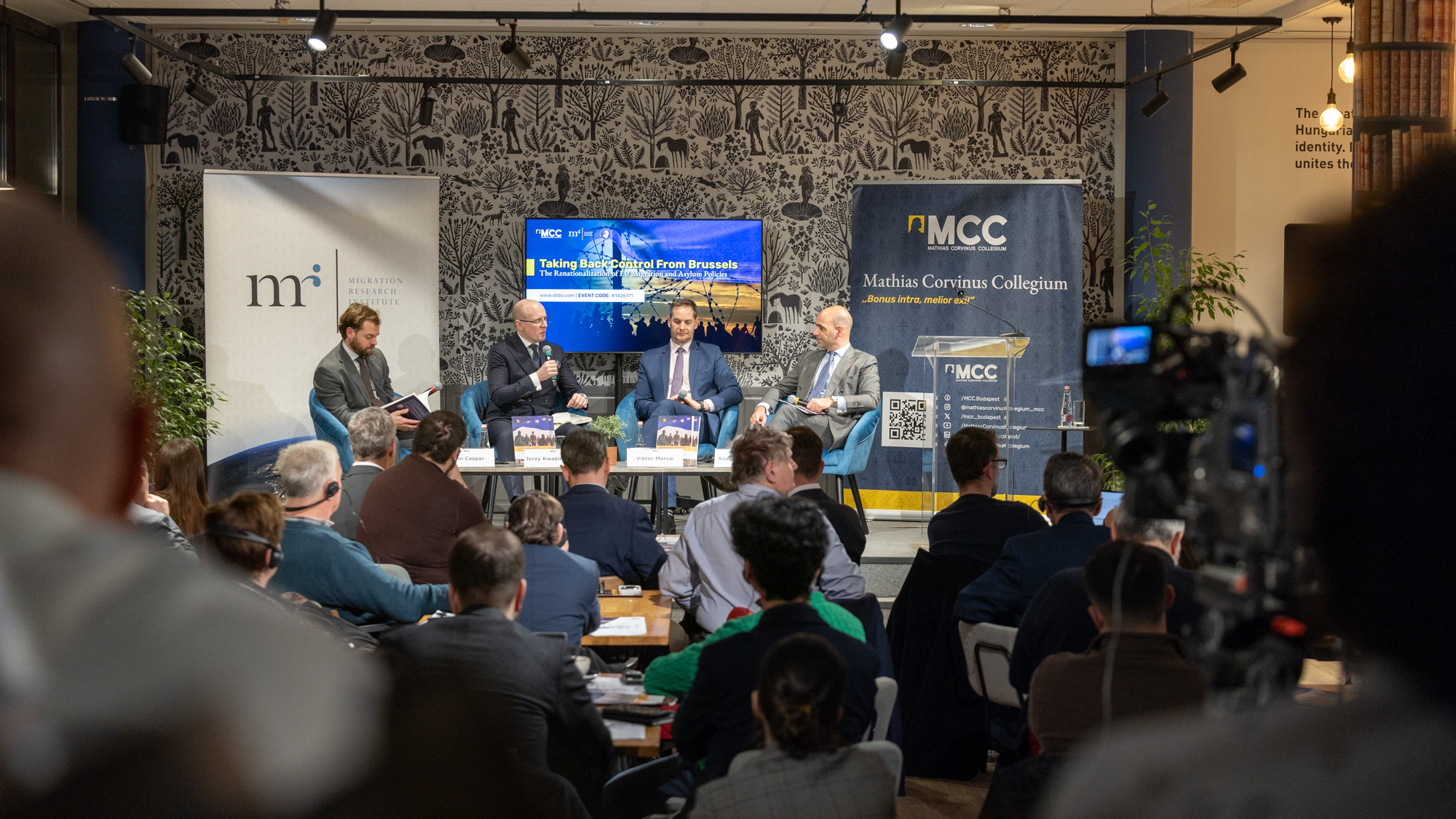
That was the main message of an event organized by Mathias Corvinus Collegium (MCC) on Thursday evening to present a groundbreaking study titled Taking Back Control From Brussels: The Renationalization of EU Migration and Asylum Policies. The report includes analysis of the European Union’s failures to tackle illegal migration over the past 30 years, proposals for legal and policy reform, and—most importantly—a pathway out of what the authors describe as an unsustainable and destructive system.
An Unfit System
The event opened with a keynote address by political director of the Hungarian prime minister and chairman of the board of trustees of MCC Balázs Orbán, who described the report as ‘more than a political statement’, arguing that it offers a serious legal analysis of how to overcome the obstacles to tackling illegal and mass migration.
Orbán said the EU has failed to stop illegal migration over the past decade, even as some member states—most notably Hungary—have resisted pressure from Brussels through legal and physical border protection and a ‘zero tolerance’ approach towards illegal migration.
The political director argued that while the migration-friendly ‘Willkommenskultur’ rhetoric of 2015 has faded, no real legal or political change has taken place at EU level. ‘They still treat migration either as an opportunity or as an administrative problem,’ he said, adding that the political will to stop illegal migration is still missing from the EU leadership.
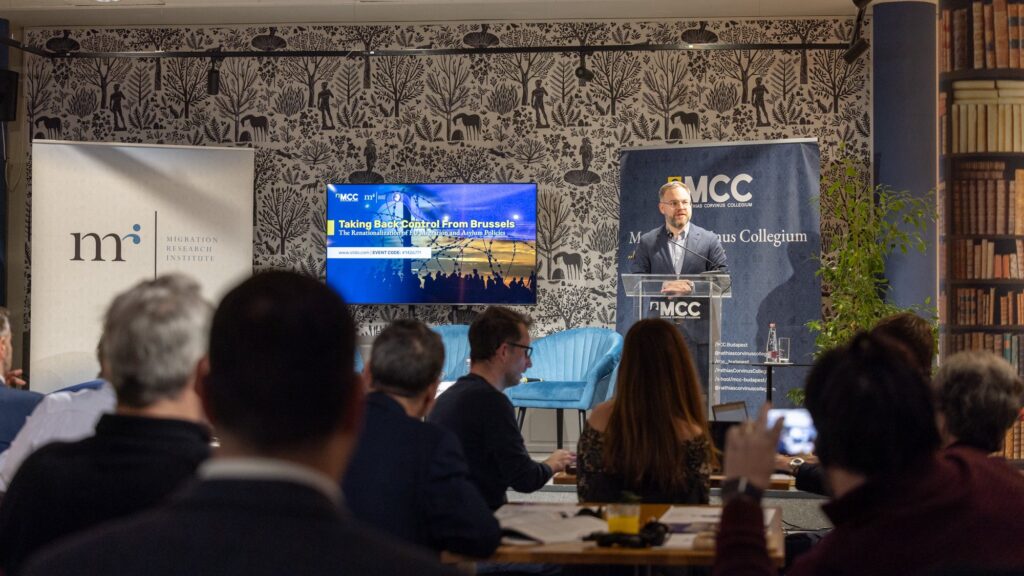
He pointed to Hungary’s border protection system as proof that firm national policies can work even in the face of Brussels’ opposition. Orbán noted that Hungary is currently facing a daily fine of €1 million for its migration policy, but added that many see this as a price worth paying for the country’s safety. ‘The European Union was established to help its member states and citizens, not to harden their lives,’ he said, accusing Brussels of punishing governments that defend their borders rather than supporting them. He also warned that anti-migration forces are under political and legal pressure across the bloc.
Orbán argued that migratory pressure will intensify in the coming years and warned of a ‘double threat’ facing Europe: the emergence of parallel societies and civil war-like conditions in parts of Western Europe, which would inevitably affect Central and Eastern Europe as well. He said meaningful progress will only be possible if the international humanitarian system is reformed, arguing that asylum and human rights frameworks are currently unfit to tackle illegal migration. In his view, EU legal practice rooted in the Geneva Convention incentivizes illegal entry, since asylum can only be requested from inside the EU.
Orbán said reform had been impossible until now, but claimed that US President Donald Trump’s re-election and the transformation it has triggered in the global order has opened the door to deeper changes in the international legal framework. He argued that a new international alliance—linking the United States with Western and Eastern European institutions—could make a rewrite of asylum rules achievable.
A Pathway Out
The keynote was followed by a panel discussion with the report’s authors: Rodrigo Ballester, Head of MCC’s Center for European Studies; Viktor Marsai, Executive Director of the Migration Research Institute; and Yann Caspar, Researcher at MCC’s Center for European Studies, who moderated the discussion. The study was produced in cooperation with Jerzy Kwaśniewski, President and Co-founder of the Ordo Iuris Institute.
Opening the conversation, Caspar said the report proposes 18 measures aimed at reversing Europe’s migration trajectory and explaining why EU policy has failed, and asked participants to elaborate on why these reforms are necessary and significant.
Marsai argued that the current asylum system functions as a powerful pull factor, as submitting an application is effectively ‘a free ticket’ into the EU. He said an increasing number of actors are facilitating illegal migration routes, while asylum seekers face an almost 90 per cent chance of remaining in Europe regardless of the legal basis of their claim. Marsai also highlighted that most arriving asylum seekers are not the poorest, but belong to the middle class—arguing that the system fails to support those most in need, since only those with sufficient financial means can reach Europe in the first place. He also noted that many migrants arrive through legal loopholes such as student visas or transit visas, and criticized the current EU framework for promoting family reunification mechanisms that expand the scale of migration beyond the initial arrivals.
‘Marsai argued that the current asylum system functions as a powerful pull factor’
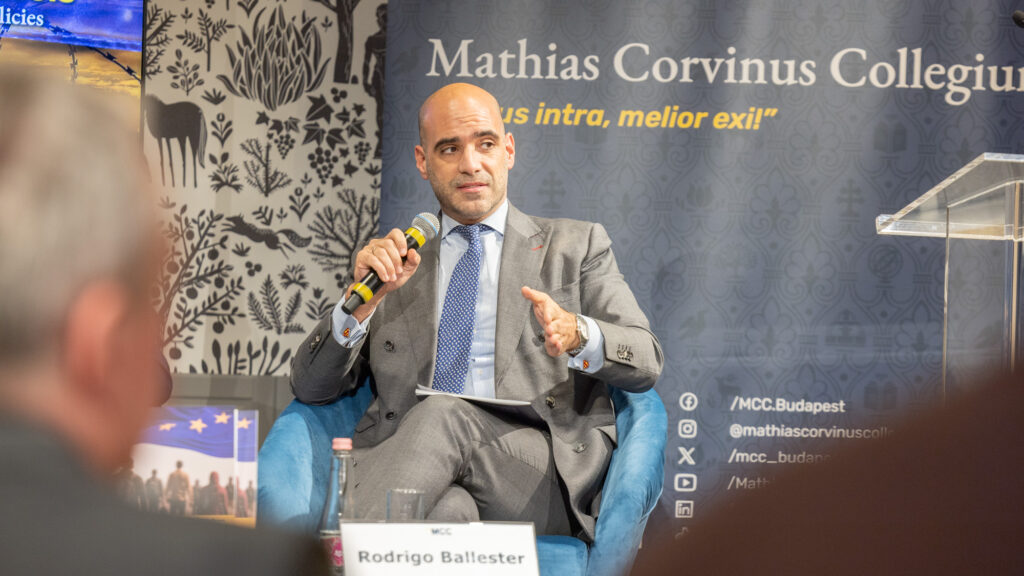
Ballester said the EU’s failure is no longer a matter of debate, arguing that some Western European countries have already undergone demographic and cultural transformations that may be irreversible. ‘We do not have time to wait,’ he warned. ‘After 30 years of EU migration policy, the result is disaster.’ He added that migration will remain a defining political issue for European voters for many election cycles to come.
He also criticized the role of activist organizations in shaping the migration debate, arguing that the term ‘NGO’ has become a misleading label. ‘These are groups of people with very serious political interests,’ he said. He emphasized the principle of subsidiarity enshrined in Article 5 of the EU Treaties, arguing that Brussels should only act when it can deliver better outcomes than member states—a standard he said the EU has clearly failed to meet on migration. He added that there are legal pathways for member states to reclaim competences from the European Commission, including opt-out mechanisms, and warned that what he described as ‘civilizational erasure’ is no longer a rhetorical exaggeration, but a real threat in parts of Western Europe.
Kwaśniewski focused on the EU’s new Migration Pact, arguing that stopping illegal migration is not even among its core objectives. Instead, he said, the pact seeks to accelerate migration procedures and provide ‘safe and legal pathways’—which he described as effectively legalizing illegal migration. He added that the pact aims to reduce uncontrolled migration by promoting controlled migration and distributing the burden of admitting migrants across member states, reflecting what he called an ideological paradigm built around ‘inclusiveness and diversity’.
Kwaśniewski argued that the report provides not only a diagnosis of the EU’s failures, but a workable legal framework both for EU reform and for rewriting international asylum law. He also stressed that many European decision-makers still underestimate the long-term impact of the migration crisis, warning that illegal migration must be treated as a security issue—one which, he said, should remain under national control through the member state veto.
The panel also addressed the role of activist groups and what the speakers described as growing judicial activism in Europe. Ballester cited the example of former Frontex director Fabrice Leggeri, claiming that he faced a coordinated smear campaign from NGOs and Brussels-linked actors because he attempted to implement stricter migration policies. He argued that Frontex has been ‘infiltrated’ by these groups to ensure that meaningful reform remains impossible, calling the situation ‘absurd’.
Kwaśniewski added that NGOs have engaged in disinformation campaigns against countries defending their borders, spreading misleading reports about the situation at the EU’s external frontiers. He accused some organizations of direct cooperation with smugglers, claiming similar patterns have been observed in the United States, particularly in Texas. He warned that NGOs increasingly position themselves as legal actors in migration policy on a global scale, undermining the authority of sovereign states.
Ballester said the EU’s migration system is reinforced through what he described as three layers of legal constraint: the United Nations framework, the European Convention on Human Rights, and the EU Court system. He argued that the European Court of Human Rights has been ‘hijacked by ideology’, consistently protecting illegal migrants while undermining state authority. ‘They protect migrants at any price,’ he said, calling the ECHR an existential threat to Europe’s survival—while acknowledging that leaving the convention would be a radical, but increasingly necessary step.
The panel concluded that Europe cannot regain control without restoring national authority over migration, limiting activist interference, and reforming both EU rules and the international asylum framework.
Related articles: