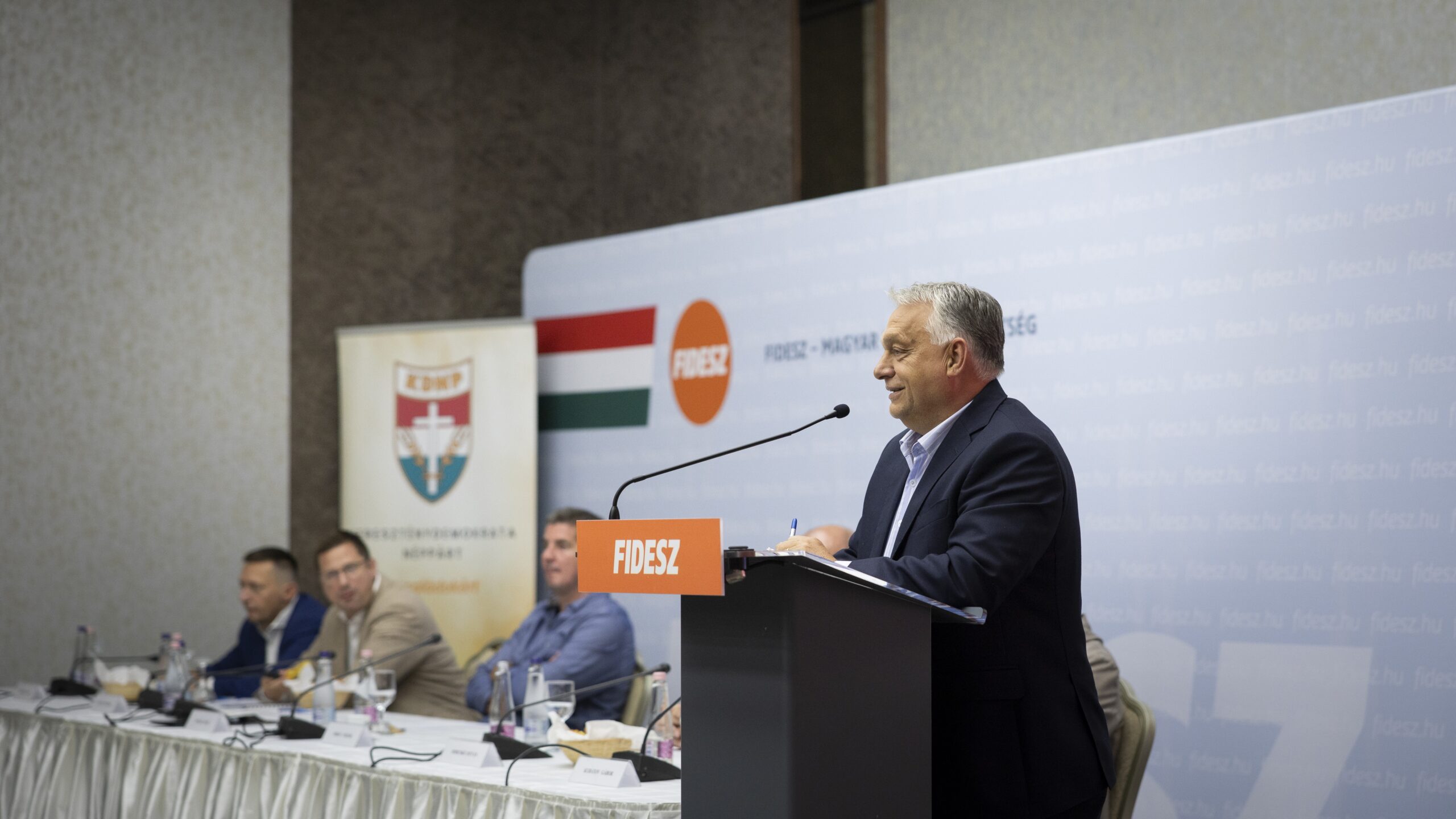
Hungary’s governing Fidesz–KDNP alliance would receive 49 per cent of the vote among committed party voters if parliamentary elections were held this Sunday, while the opposition Tisza Party would gain 41 per cent, according to a new nationwide representative poll by the Center for Fundamental Rights.
The think tank said party preference figures have remained largely unchanged over the past month, with the governing parties’ advantage stabilizing at 8 percentage points, a margin well beyond the statistical margin of error.
According to the analysis, the ruling parties’ recent growth and consolidation may be linked to the approach of the 12 April election date, as more voters perceive the safe choice as preferable to what they see as a risky alternative amid an increasingly uncertain international environment.
The Center for Fundamental Rights has published monthly nationwide party preference surveys since October. Since the start of the autumn political season, trends have consistently shown the governing alliance strengthening its leading position, expanding its advantage from around 5 percentage points to nearly double that level.
At the beginning of 2026, the Fidesz–KDNP coalition’s lead remains significant, though not insurmountable, the report said. Support for the Tisza Party, led by Péter Magyar, has stalled in recent months, fluctuating between 40 and 42 per cent among committed voters.
The think tank argued that the opposition has struggled at the start of the year, partly due to lingering effects of earlier controversies and partly because of disputes that emerged in the New Year.
According to the analysis, the governing parties benefit from the mobilization of right-leaning voters who agree with the government on what it describes as national strategic issues. These supporters prioritize peace, rejecting the implementation of the EU’s migration pact, maintaining physical and financial security, preserving utility price caps, and protecting family support schemes.
By contrast, the think tank claimed that Péter Magyar and the Tisza Party represent uncertainty for many voters, pointing to statements about withholding details to avoid political failure and proposals aligned with what it described as the Brussels mainstream. These include ideas such as introducing a multi-rate income tax, reducing family benefits, or privatizing parts of the pension system, which an increasing number of voters reportedly view as risks.
Based on data collected between 5–8 January from a sample of 1,000 adults, only one other party would cross the parliamentary threshold. The far-right Our Homeland party would enter parliament with 6 per cent support among committed voters, while the Hungarian Two-Tailed Dog Party and the Democratic Coalition would each remain below the threshold at 2 per cent.
Related articles: