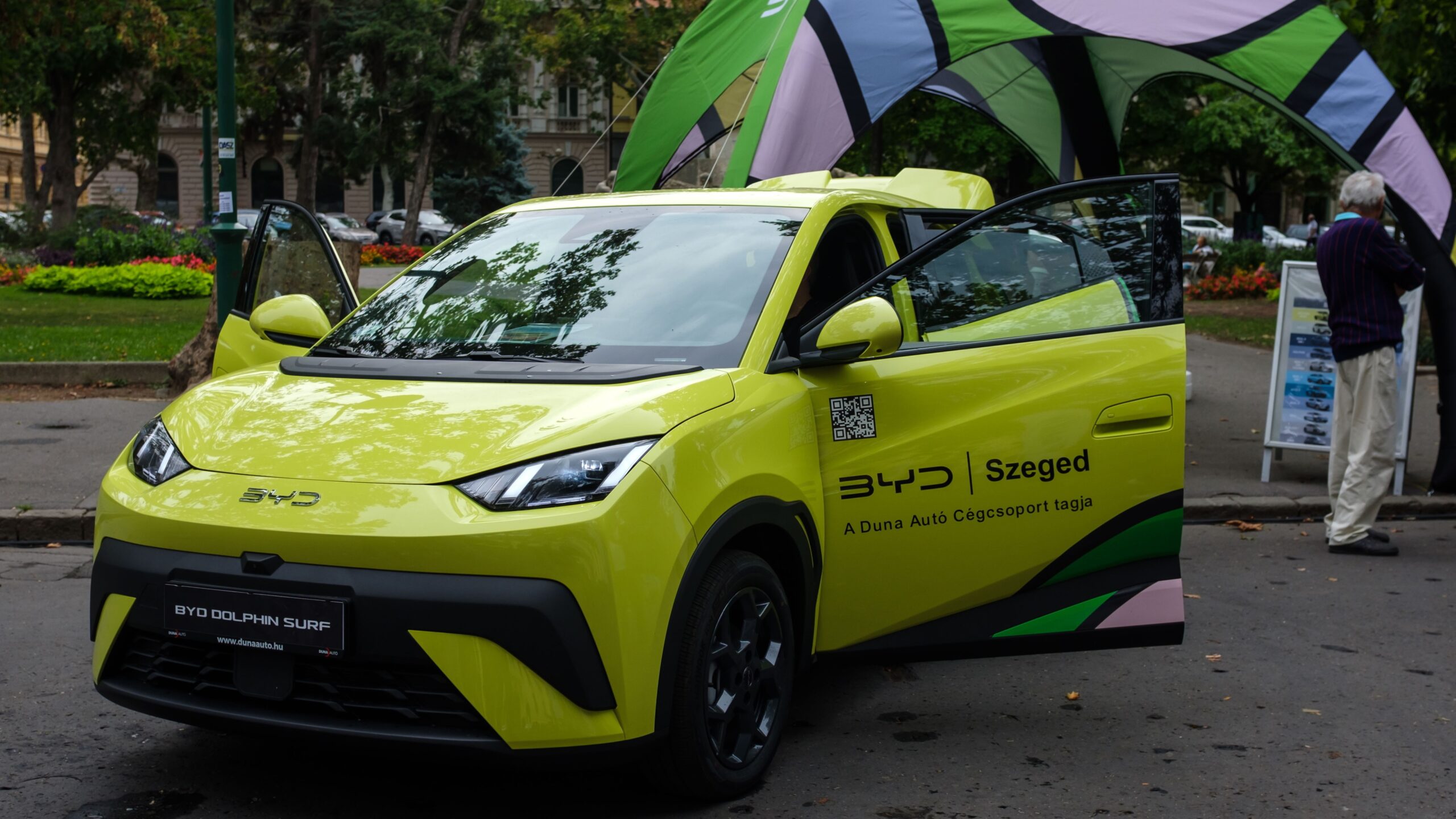
Trial production has started at BYD’s electric vehicle manufacturing plant in Szeged, Mayor László Botka announced on Thursday.
Speaking at the season-opening event of the Public Affairs Café series, Botka said the company has already hired 960 employees at its Szeged factory. Around 70 per cent of the workforce are Hungarian, most of them from Szeged.
The plant’s production will ramp up to its planned capacity over several years, in parallel with a gradual increase in employment, the mayor said.
Unemployment in Szeged is among the lowest in Hungary at 1.3 per cent. At the same time, 52 per cent of students studying at the city’s vocational training institutions do not live in Szeged. BYD has also signed a cooperation agreement with the Faculty of Engineering at the University of Szeged.
The company is also expecting workers from the wider Szeged region, including the Makó area, as well as from northern Vojvodina. Under a government commitment, cross-border commuting will be facilitated by creating a dedicated lane for commuters at the Röszke road border crossing, Botka said.
The mayor added that the factory will also employ foreign, mainly Asian, guest workers. He noted that more than 5,000 foreign students are currently studying at the University of Szeged, many of them from outside Europe, and local residents have not experienced major issues related to their presence. He also pointed out that since the 1970s and 1980s, Szeged has been more accustomed than the national average to non-European residents being part of everyday city life.
Botka also addressed the role of the municipality in the automotive investment, saying the city was responsible for providing the 300-hectare site needed for the factory. Of this area, 100 hectares were already designated as industrial land, originally intended for a new salami production plant by Pick Szeged Ltd, which will instead be built at the company’s existing site on Horgosi Road.
The remaining 200 hectares consisted mainly of agricultural land owned by numerous individuals. Most landowners accepted the compensation price set by the government office during the expropriation process, while a few took the matter to court.
The lawsuits have now been concluded with final rulings, and the courts found that the purchase prices were set irregularly and above the prescribed level, meaning landowners would be required to repay the difference. Botka said he will propose during the preparation of Szeged’s 2026 budget that the municipality waive this claim.
Related articles: