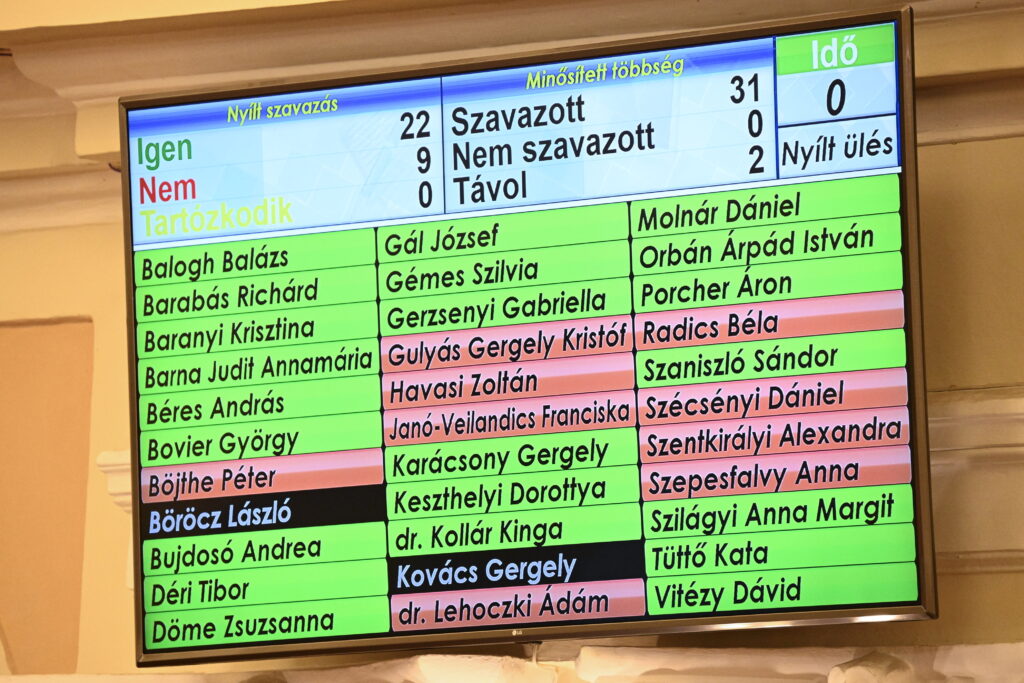
The Budapest City Assembly approved the capital’s 2026 budget on Wednesday, setting the main revenue and expenditure total at 532.5 billion forints. The proposal, submitted by Mayor Gergely Karácsony, passed with 22 votes in favour and nine against.
The governing Fidesz–KDNP group did not support the budget, while two district mayors were absent from the vote. Under the adopted ordinance, Budapest’s revenues are set at 520.5 billion forints, while expenditures amount to 523.8 billion forints, resulting in a deficit of just over 3.2 billion forints. The shortfall will be covered from previous years’ reserves, and more than 6 billion forints are earmarked for debt servicing.
The budget, described by the city leadership as ‘the budget of a new chance’, reflects what officials called an exceptionally uncertain financial environment. According to the explanatory notes, it is not yet clear whether Budapest will even be able to close its 2025 financial year, making long-term planning extremely difficult.
City leaders argue that the 2026 budget is based on the assumption of a reformed municipal financing system that restores local autonomy and ensures that no municipality becomes a net contributor to the central budget. Without this principle, they warned, even basic operations could become unmanageable, alongside investments, renovations and wage increases.
An impact assessment attached to the proposal forecasts that 2026 will again be a ‘critically difficult year’, citing rising costs driven by inflation following recent social, healthcare and economic crises. At the same time, limited fiscal room has forced the city to keep spending levels largely in line with previous years. The document also points to further pressure from government decisions, including increases in the so-called solidarity contribution paid by municipalities.
The assembly’s decision also confirmed a supplementary wage agreement with trade unions. Employees across the ‘Budapest family’ of institutions and companies are set to receive an average gross pay rise of 8.6 per cent in 2026, based on an assumed inflation rate of 3.6 per cent. Additional payments may be made in the second half of the year if inflation exceeds expectations.
During the debate, Mayor Karácsony said the budget was drafted on the assumption that, in a state governed by the rule of law, funds essential to operating the capital cannot be withdrawn despite court rulings. He reiterated that Budapest cannot function as a net payer to the central budget.
Opposition speakers from Fidesz–KDNP sharply criticized the plan, calling it unrealistic and accusing the city leadership of mismanagement and obscuring the true state of the capital’s finances. They pointed to the city’s growing debt since 2019 and proposed tighter oversight measures, including mandatory audit reports attached to future budgets.
Karácsony responded that while dozens of municipalities nationwide have required insolvency administrators, Budapest has not. He blamed the sector’s financial strain on central government measures, arguing that municipalities have lost funding equivalent to 2 per cent of GDP in recent years and that Budapest’s revenues have fallen by 25 per cent in real terms.
Other political groups offered conditional support. Representatives cited court rulings they believe will secure planned revenues and highlighted projects enabled by the budget, including bridge renovations, an expansion of public transport enforcement staff, cycling infrastructure upgrades and improvements to homeless services.
The assembly also approved a revolving credit facility for 2026, allowing Budapest to draw up to 80 billion forints at peak periods. City officials warned that heavy reliance on overdraft financing leaves the capital exposed to interest rate fluctuations, noting that interest payments since 2023 have already reached 10 billion forints.
Officials said the budget is built on the hope that municipal financing rules will change next year and that the capital’s resources will no longer be subject to further state withdrawals.
Related articles: