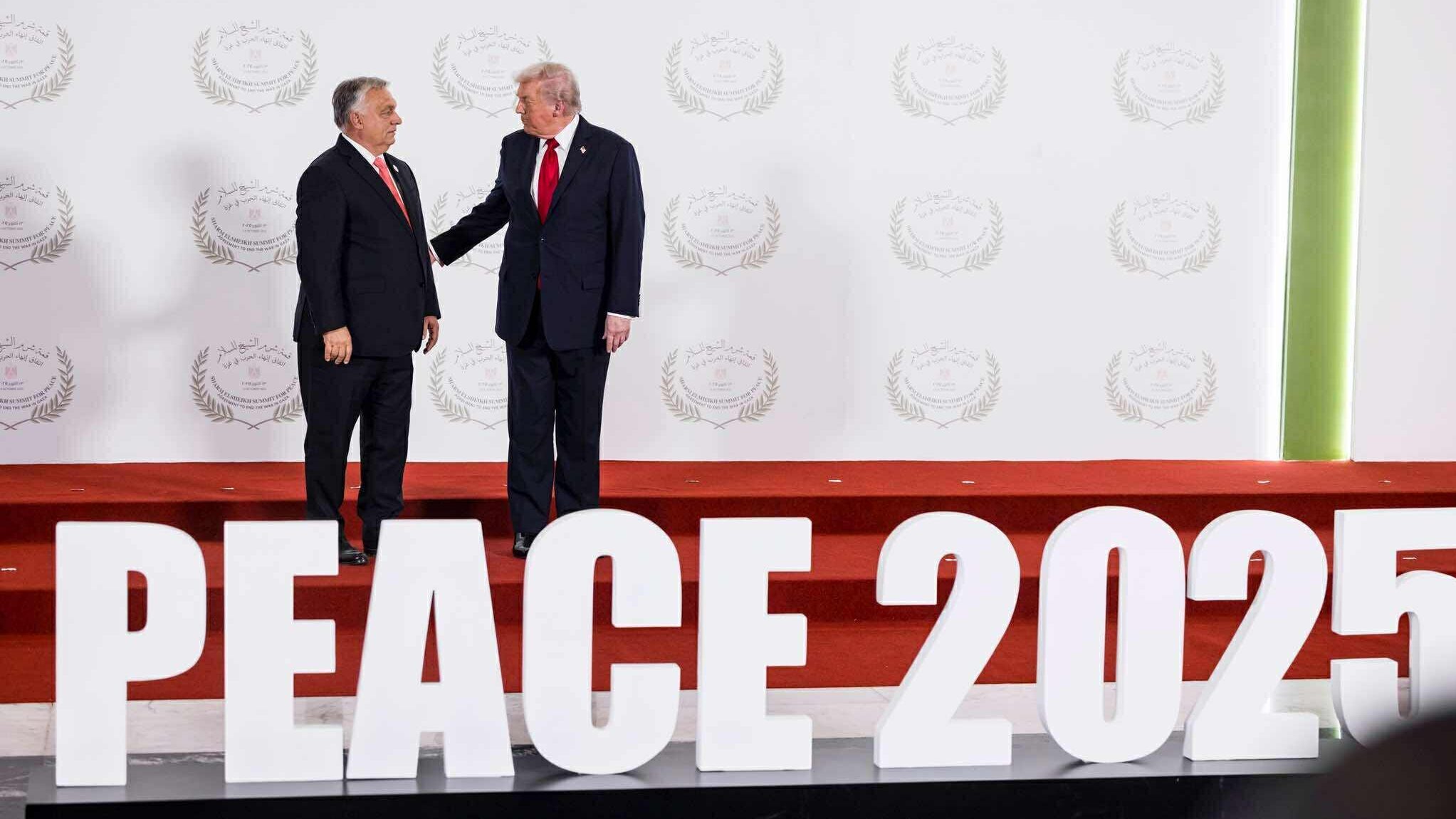
Hungarian Prime Minister Viktor Orbán has been invited to the so-called Board of Peace by US President Donald Trump, a move that immediately triggered repercussions in Hungarian domestic politics. Following the announcement by Hungarian Minister for Foreign Affairs and Trade Péter Szijjártó, Hungarian media outlets reported that Orbán’s seat on the council would cost Hungary $1 billion.
However, anyone who takes the time to read the charter of the Board of Peace will quickly see that this claim is false. Section 2.2(c) of the document states that membership is valid for three years by default, without any financial obligation. If a country chooses to contribute at least $1 billion in the first year, however, this results in an automatic extension—effectively permanent membership.
The same section also states that the president of the Board of Peace—Donald Trump—has the right to renew membership.
Who’s on Board?
According to the charter, the Board of Peace consists of two entities. The Executive Board includes Secretary of State Marco Rubio; special envoy Steve Witkoff; former British Prime Minister Tony Blair; World Bank President Ajay Banga; American businessman and Trump’s son-in-law Jared Kushner; US billionaire Marco Rowan; and US National Security Adviser Robert Gabriel. The other part of the Board of Peace consists of world leaders invited by Trump: besides Viktor Orbán, Italian Prime Minister Giorgia Meloni; King Abdullah II of Jordan; King Mohammed VI of Morocco; Kazakh President Kassym-Jomart Tokayev; Argentine President Javier Milei; and many others.
Invitations were reportedly sent to more than 60 world leaders, including Russian President Vladimir Putin, French President Emmanuel Macron, Israeli Prime Minister Benjamin Netanyahu, and the European Union’s executive. According to media reports, Paris flatly rejected the invitation, while the Kremlin is still reviewing the proposal.
‘Some earlier reporting claimed it would focus exclusively on Gaza; however, the charter does not mention the territory, signalling that its scope is broader’
There has also been confusion about the mandate of the Board of Peace. Some earlier reporting claimed it would focus exclusively on Gaza; however, the charter does not mention the territory, signalling that its scope is broader: the creation of a new international forum for conflict resolution. The implementation of the Gaza peace plan will reportedly be the first task of the new platform, and could define its future effectiveness.
According to the charter, the Board of Peace will oversee committees specifically responsible for resolving the Gaza conflict. These committees cooperate and communicate with each other, but they have different roles. Their work is directed by the Executive Council and, at the operational level, by Bulgarian UN High Representative Nikolay Mladenov. In short:
- The Gaza Executive Board is primarily a body composed of officials from key states in the region, providing diplomatic and political support for the transition in Gaza.
- The National Committee for the Administration of Gaza (NCAG) is a technocratic quasi-government consisting of Palestinian officials.
- The International Stabilization Forces (ISF) is a nascent international peacekeeping force, the composition of which remains unknown.
Related articles: