Hungary’s investment landscape is undergoing a rare and decisive shift. In 2025, the country has attracted an unprecedented volume of US capital, marking what officials describe as a historic turning point—one that is reshaping both the structure and the geography of the Hungarian economy.
According to the Hungarian Investment Promotion Agency (HIPA), US companies have announced projects worth roughly HUF 190 billion (app 494 million EUR) this year alone. These investments are concentrated in research and development, advanced manufacturing and high value-added activities—a clear departure from the low-cost production model that once defined Central Europe.
‘We have never announced this many US investments within a single year,’ CEO of HIPA and government commissioner István Joó said, speaking on the current affairs programme Konkrétan Rónai Egonnal on Index. He attributed the surge to improving political relations and the broader reset in US–Hungarian ties during Donald Trump’s presidency.
The momentum, however, did not begin in 2025. The previous year already set records. In 2024, Hungary attracted more than €10 billion in foreign direct investment, exceeding the combined total of the other three Visegrád countries. Since HIPA’s establishment in 2014, projects worth €63 billion have been implemented nationwide—a scale that has fundamentally altered Hungary’s economic profile.
Between 2014 and the first half of 2025, a total of 145 US investments worth approximately €2.5 billion were decided with the support of HIPA. The US is currently Hungary’s third largest investor, with nearly 1,400 American companies operating in Hungary contributing significantly to the transformation of the Hungarian economy. With Donald Trump taking office as US president, a whole new era began in Hungarian–American relations, which is also reflected in trade and investment volumes.
Eastern Capital Remains Dominant
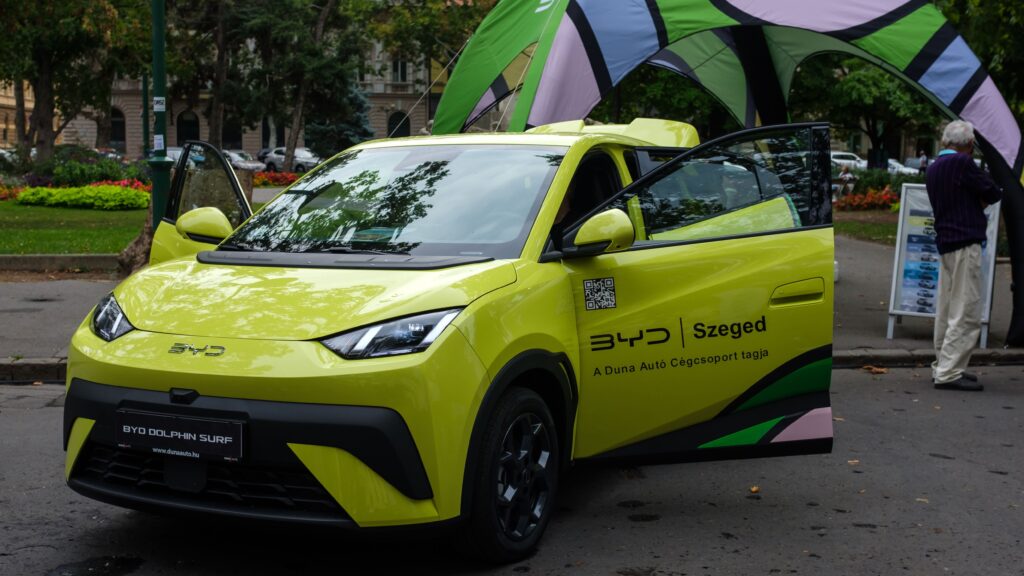
While American capital is now surging, Eastern investment continues to dominate in volume. China remains Hungary’s largest investor in 2025. The headline project is BYD’s manufacturing plant in Szeged, which will produce 300,000 vehicles annually and host the company’s European headquarters. Around 2,000 highly qualified employees will work at the site, underscoring the shift toward knowledge-intensive industry rather than simple assembly operations.
‘While American capital is now surging, Eastern investment continues to dominate in volume’
Another quietly transformative trend is the explosive growth of business services centres. Five years ago, about 50,000 people worked in the sector; today that number has risen to 120,000. HIPA has supported the creation of 116 such centres, making it one of the agency’s most successful investment categories.
Crucially, Hungary’s domestic small and medium-sized enterprises are increasingly being integrated into global supply chains. HIPA operates a supplier database of 1,200 Hungarian companies, offering them direct access to multinational investors. In the case of BYD, 120 Hungarian firms were invited to present themselves directly to the Chinese company’s headquarters—a level of engagement that would have been unthinkable just a decade ago.
The state support model behind these investments has also proven financially effective. Every forint of government support generates HUF 4.1 in budget revenue, according to HIPA. The system is strictly performance-based: companies receive funding only after facilities are built and contractual obligations are fulfilled.
R&D Taking Centre Stage
Research and development has emerged as the sector’s biggest winner. In 2024 and 2025, Hungary supported more R&D projects than ever before, leading to the creation of over 5,500 R&D jobs. Mercedes-Benz now operates a prototype development centre in Kecskemét, staffed by Hungarian engineers—a strong signal that advanced industrial know-how is taking root locally.
Investment policy is also being used to address regional imbalances. Projects are increasingly directed toward areas with available labour. Cities in the Hungarian countryside such as Ózd, Salgótarján, Orosháza, Pécs, Szekszárd and Nagykanizsa have moved onto the investment map. Békéscsaba alone gained 2,500 new jobs, while Makó and Szeged have also seen substantial employment growth.
All of this is underpinned by a tax system that remains highly competitive by international standards. Among the 38 OECD member states, Hungary ranks ninth place overall in tax competitiveness and fourth in corporate tax.
Looking ahead, HIPA is pursuing a more targeted investment strategy. A list of several hundred specific Western and Eastern companies has been compiled, and Hungary’s foreign trade attachés are actively approaching them. Priority sectors include medical technology, pharmaceuticals, composite technologies, chemicals and ICT.
The message from the data is clear: Hungary has not only retained its investment appeal, but has also entered a new era. The spectacular arrival of US capital indicates that the country's position on the global economic map is continuing to strengthen.
Related articles: