President Trump’s re-election to a non-consecutive second term has completely upended international relations. This, evidently, holds true for the relations between the United States and Europe as well. The Hungarian Institute of International Affairs (HIIA) organized an event discussing the new era titled The Western Commitment to Natural Rights: The Key to Transatlantic Renewal on Monday, 15 December at the Lónyay–Hatvany Villa in the historic Castle District of Budapest, Hungary.
President of HIIA Gladden J Pappin greeted the audience with some brief remarks. He described the gathering as a ‘special event’ and thanked the US Embassy in Budapest and the Center for Fundamental Rights for their help in introducing it.
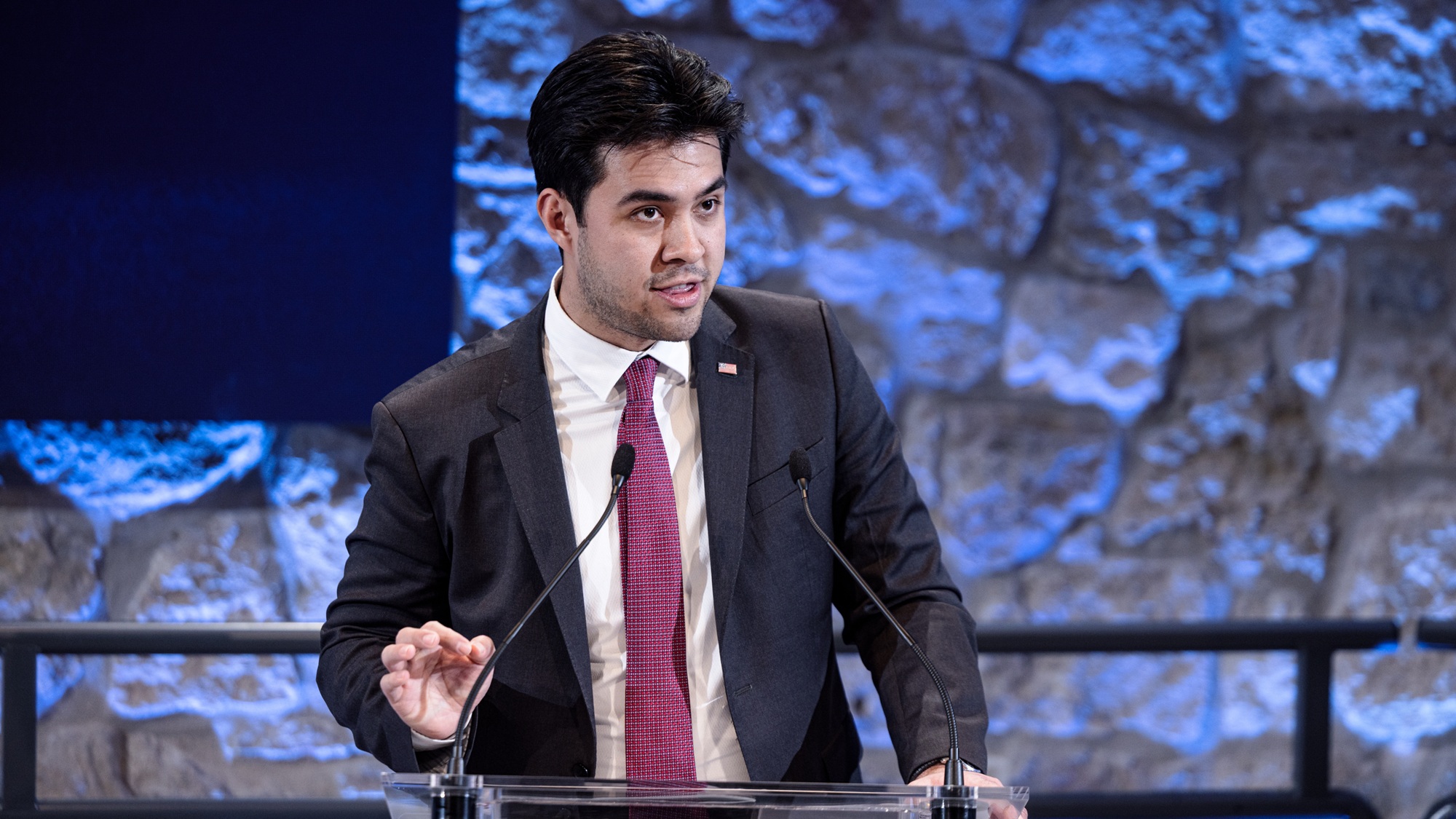
He then swiftly called Senior Advisor at the US State Department Samuel D Samson on stage. Mr Pappin also praised Samson’s recently published piece on Substack in which he described the European nations as ‘civilizational allies’ of the United States.
Mr Samson started by telling the audience that he appreciates the high attendance despite it being ‘Christmas party season’. He then also lauded the fact that, in Hungary, there is no controversy around describing holiday gatherings as ‘Christmas parties’, even in an official setting.
On a more serious note, the speaker pointed out that the city of Budapest, where the event was taking place, withstood the oppressions of the Mongols, the Ottomans, the Nazis, and the Soviets, yet it remained committed to its Western values. He then likened those oppressions to those coming from the EU, which, he believes, is working to suppress national identity and nationalist and conservative sentiments.
He brought up, for instance, the case of a former minister in Finland being criminally charged for sharing a Bible verse against homosexuality, as well as right-wing political leader Marine Le Pen being banned from running in the 2027 presidential election in France.
Mr Samson then referred to US Vice President JD Vance, who, at the Munich Security Conference in February, criticized Western European countries for not upholding free speech principles. On that point, the speaker levied criticisms of his own, at the European Union’s new Digital Services Act, which, as he explained, can be used to coerce social media companies to censor content deemed undesirable by the political elite.
He also praised Hungary for standing up to Brussels and not complying with the migrant quotas set in the Migration Pact of 2024; and warned that the EU courts—that are imposing a €1 million daily fine on Hungary for their refusal on migration—are using their power to suppress political dissent, something that he thinks is ‘weakening the transatlantic alliance’.
The speaker then described that relationship as ‘more than just an alliance’ that is ‘the living soil that our freedoms, duties, and culture spring from’. He also stated that the ‘United States is closer to Europe than any other place in the world’ in its cultural and philosophical ties.
‘The “United States is closer to Europe than any other place in the world”’
On the special relation between the US and Hungary specifically, he shared that at the end of World War II, as Soviet troops were taking control of Budapest, the Holy Crown of Hungary was entrusted to American soldiers. In the US, the Crown was kept at Fort Knox, Kentucky, before being returned to Hungary by President Jimmy Carter.
Mr Samson then went on to praise ‘the spirit of the West’, which encompasses the generational geniuses of people such as Homer, Thomas More, Ludwig van Beethoven, and George Washington, and called the United States ‘the crown jewel of that tradition’. Nearing the end of his speech, he also proudly spoke of the newly established Office of Natural Rights within the US State Department.
Mr Samson then joined a panel discussion, along with Director General for the Center for Fundamental Rights Miklós Szánthó, and Deputy State Secretary Márton Ugrósdy for the Office of the Prime Minister of Hungary’s Political Director. Mr Pappin took on the role of the moderator.
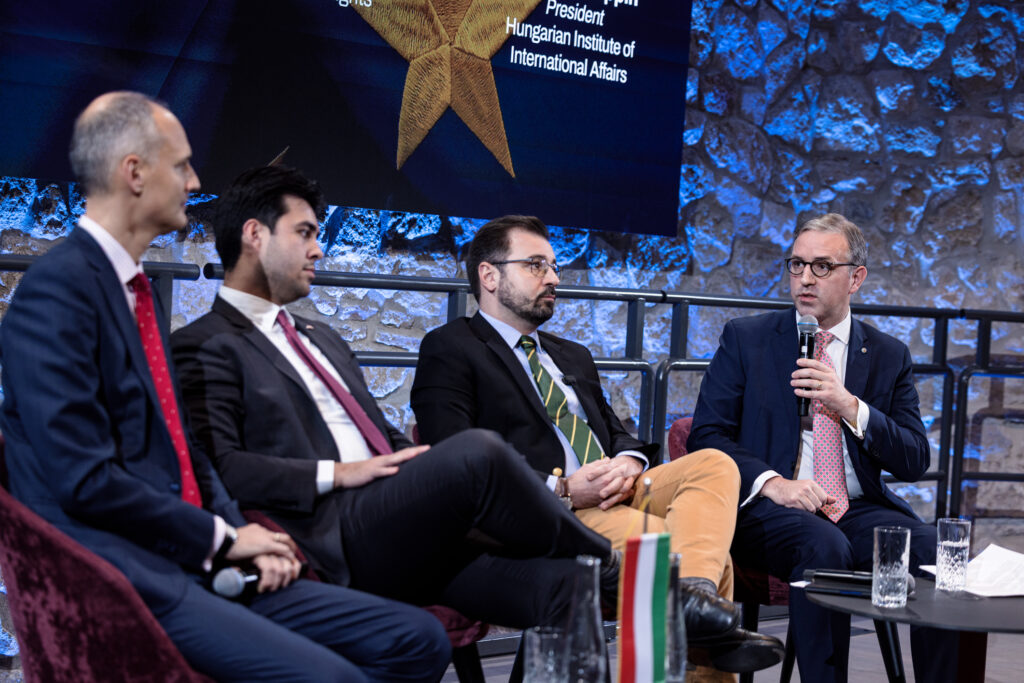
Mr Ugrósdy got the mic first. He said that the global right-wing movement is behind the progressive movement in international institutional cooperation, and therefore, it is the task of organizations like the ones present at the event to ‘bring individual, disconnected centres together’. He also opined that this network needs to promote the fundamental values of Western civilization; and people need to repeat these values, even if they seem self-evident.
Mr Szánthó started his piece by telling the audience that he could not have imagined that someone from the US State Department would be taking part in such an event a year ago, when the Biden administration was in power. But, with Mr Samson’s presence, that is now a reality. He also spoke of ‘a rising conflict’ between Brussels and Washington in the second Trump era, which he attributed to Brussels being taken over by wokeism, while President Trump being the ‘fundamentally anti-woke President’ that stands for ‘God, Homeland, and Family’. Mr Szánthó also lauded the fact that Brussels no longer has its ‘big brother’, the United States, backing it when it goes after Hungary.
At the panel, Mr Samson shared that when the State Department released its new National Security Strategy, some leaders in Europe accused it of being ‘anti-European’, when in fact it is a very pro-European manifesto, which even speaks of ‘restoring European greatness’ as one of its goals.
Mr Ugrósdy also pointed out that Europe was built on ‘free enterprise and individual rights’. Meanwhile, Mr Szánthó onimously pondered if EU leadership would end up striking some kind of deal with the rising right-wing populist parties on the continent, such as FPÖ in Austria, AfD in Germany, and PVV in the Netherlands, or if it would become a ‘full dictatorship’ and eventually ban all these parties.
Related articles: