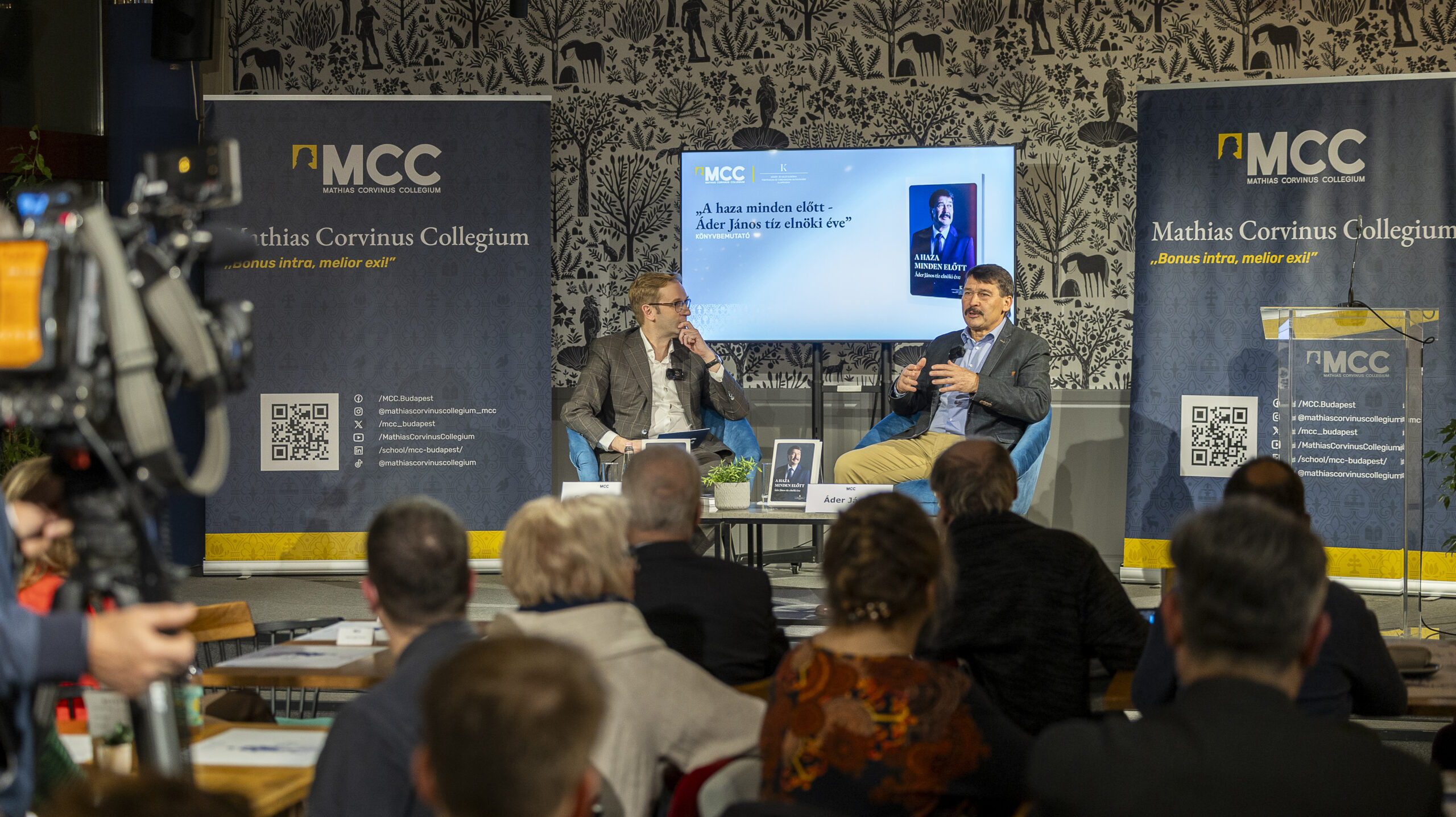
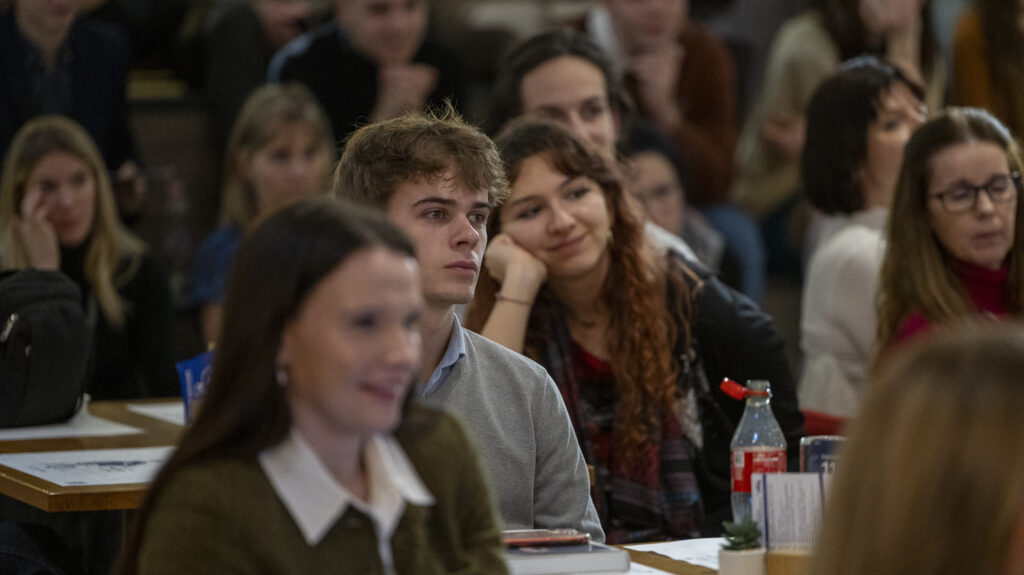
At a joint event organized by the Mathias Corvinus Collegium (MCC) and Mandiner, former President of Hungary János Áder presented his new book titled The Homeland Above All – Ten Presidential Years of János Áder. The full-house event featured a conversation between the author and Director-General of MCC Zoltán Szalai.
Áder started by explaining that the book is essentially an interview collection, an ‘interview chain’, which summarizes in a readable format virtually all the issues that arose during his decade in office—constitutional dilemmas, experiences related to the understanding of the presidential role, and previously unpublished stories.
Recalling the most important presidential moments for national unity, the former head of state highlighted the 2015 commemoration in Auschwitz. He recalled that due to a malfunction of the military aircraft, they arrived at the site by car, escorted by police, in heavy rain, watching the escorting motorcycle officer’s path with ‘fear of death’. In his speech at the memorial event, he said that if we were to remember every victim of the Holocaust for one minute, we would have to stand in silence for more than three years. According to him, his words had a profound impact on those present; the chief rabbi approached him after stepping down from the stage and touched his face—something that made the event truly memorable for him.
He similarly highlighted the parliamentary address he prepared for months for the centenary of the Treaty of Trianon. The speech later became the basis for an educational film and has since been broadcast annually by public television. Speaking about the experience of national belonging, he recalled his first pilgrimage to Csíksomlyó—the first time a sitting head of state attended the event—as well as his visit to the Csángó community in Moldavia, where the community leader greeted him by saying: ‘We have been waiting for this moment for 400 years, for either the king or the president to visit us.’
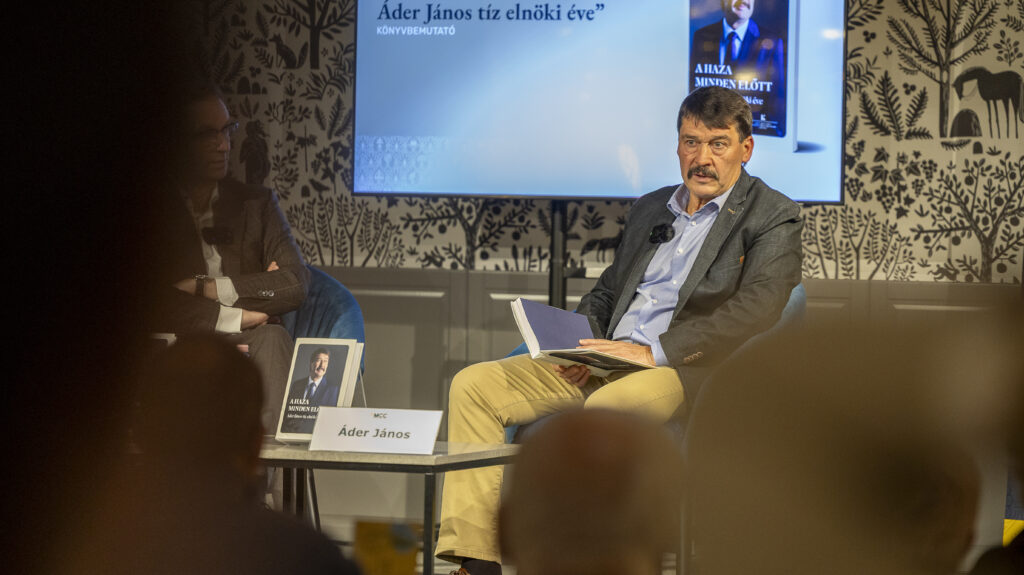
Áder also spoke in detail about his use of the presidential veto. During his ten years in office, he returned 37 laws to Parliament and in eight instances, he turned to the Constitutional Court. He stressed that he did not seek confrontation but defended his constitutional position, providing in every case detailed reasoning comparable in quality to the Constitutional Court’s decisions. The Court fully agreed with his submissions in around 80 per cent of cases and partially in others. He added that many laws were amended before the final vote based on signals from the Sándor Palace (the presidential residency in Hungary), and therefore do not appear in the statistics.
President Áder then moved to the theme of environmental protection, which he had already treated as a central issue as an MEP in Brussels. He said tackling climate change is only one slice of protecting the created world; the preservation of water, arable land, forests and biodiversity, as well as reducing overconsumption and food waste, all belong here. He drew attention to the fact that in Hungary roughly 66 kilograms of food per person are thrown away annually, with the EU average even higher. He recalled the Budapest Water Summits and the Budapest Planet sustainability expos, which in his view already present the broader framework of sustainability.
On the state of the Hungarian public discourse, he struck a critical tone. He cited the standard of János Arany and the great Hungarian publicists—Mikszáth and Ady—as benchmarks, and expressed regret that political debates today are often reduced to labels and characterizations. As a positive example, he mentioned his decades-long friendship with the jurist Mihály Bihari, with whom he maintained substantive debates and friendly dinners despite significant political differences.
After leaving public office, he remained active in community affairs: together with his wife, he established the István Regőczi Foundation to support children orphaned by the Covid pandemic. The foundation has supported around 1,600 children to date and is currently accompanying more than 1,200 of them until adulthood or until they obtain a qualification or degree. In addition to financial assistance, the foundation provides programmes, psychological support and legal aid; combined with the increased orphan’s allowance and widow’s pension, this support prevents financial destitution in most affected families.

At the end of the discussion, Áder listed a number of ‘shared achievements’ that he believes should make every Hungarian proud regardless of political affiliation: the nationwide extension of the motorway network, the more than doubling of nursery places, the renovation of hundreds of medical practices, and cultural and sports investments such as the Puskás Arena, the Danube Arena, the Várkert Bazaar, the House of Hungarian Music, the Roman Hall of the Museum of Fine Arts and the plaster collection of the Star Fort in Komárom. He compared the growth of public wealth over the past 15–16 years to the decades following the Compromise of 1867, which, as he put it, continue to shape Hungary’s character to this day.
Related articles: