The following is an adapted version of an article written by Lázár Pap, originally published in Hungarian in Magyar Krónika.
The name of the Habsburg heir to the throne will forever be associated with Sarajevo and the outbreak of World War I, but little is known about him as a person. The diary of his travels around the world provides insight into the life and thoughts of the tragic archduke.
‘Our late heir to the throne, Archduke Franz Ferdinand, who was tragically murdered, also possessed outstanding abilities and qualities that are essential for a great ruler, yet many viewed his reign with concern. The masses, who did not know him, feared him. In Austria, they feared that he would favour the Hungarians over them; here, we believed that his family connections would give way to Czech sympathies, while the Czechs complained that he did not look after their interests. Civilian circles believed he had talent only in the army’s interests, while military circles found he was not an energetic enough advocate for their cause. They speculated about his true feelings and watched for every secret revelation of his soul. Watchful eyes followed his every move, and he stood there in his cold rigidity among the millions of curious onlookers, like an unsolvable eternal mystery,’ the weekly Vasárnapi Ujság wrote in 1914, shortly after the death of Archduke Franz Ferdinand.
‘Franz Ferdinand’s immediate entourage opposed the heir to the throne making an official visit to Sarajevo in the summer of 1914’
The heir to the throne was not particularly popular among his future subjects, nor was he liked by his uncle, Franz Joseph. Those around him knew him as a sullen, withdrawn, and extremely stubborn man, and his unpredictable outbursts of anger made him particularly unpopular. The monarch had previously refused to allow his son Rudolf to have any say in state affairs, and he did not act any differently in the case of Franz Ferdinand either. In response, the archduke created what could be described as a shadow government to prepare for succession. He envisioned a more centralized empire, but its implementation would have hurt Hungarian interests. In opposition to the ‘obstacles’ of the monarchy, he championed the transformation of the dualist system into a tripartite system and sought to make gestures toward the South Slavs. However, this not only irritated the Hungarian elite but also Serbian nationalists, who feared that the South Slavic inhabitants of the empire would not want to break away, and that the dream of ‘Greater Serbia’ would vanish. It is therefore no coincidence that the head of the general staff’s secret service and Franz Ferdinand’s immediate entourage opposed the heir to the throne making an official visit to Sarajevo in the summer of 1914. His wife, Sophie Chotek, also tried to dissuade her husband from the trip, but he did not budge, as the press had already reported on the upcoming event.
The Assassination
Finally, what many had feared came to pass: the heir to the throne of the Austro–Hungarian Empire fell victim to an assassination attempt. Although he escaped the first attack unscathed, the Serbian terrorists made no mistake the second time around. First, the driver was able to swerve to avoid the grenade, but hours later, shots fired at close range finally hit their target. The assassination went down in world history, but the life of Franz Ferdinand has been completely forgotten.
Few people know, for example, that the tragically fated archduke travelled the world in the early 1890s. He wrote a diary about his travels, which was even published in book form, and details of it also appeared in Hungarian in the columns of the weekly Vasárnapi Ujság.
Kaiserin Elisabeth
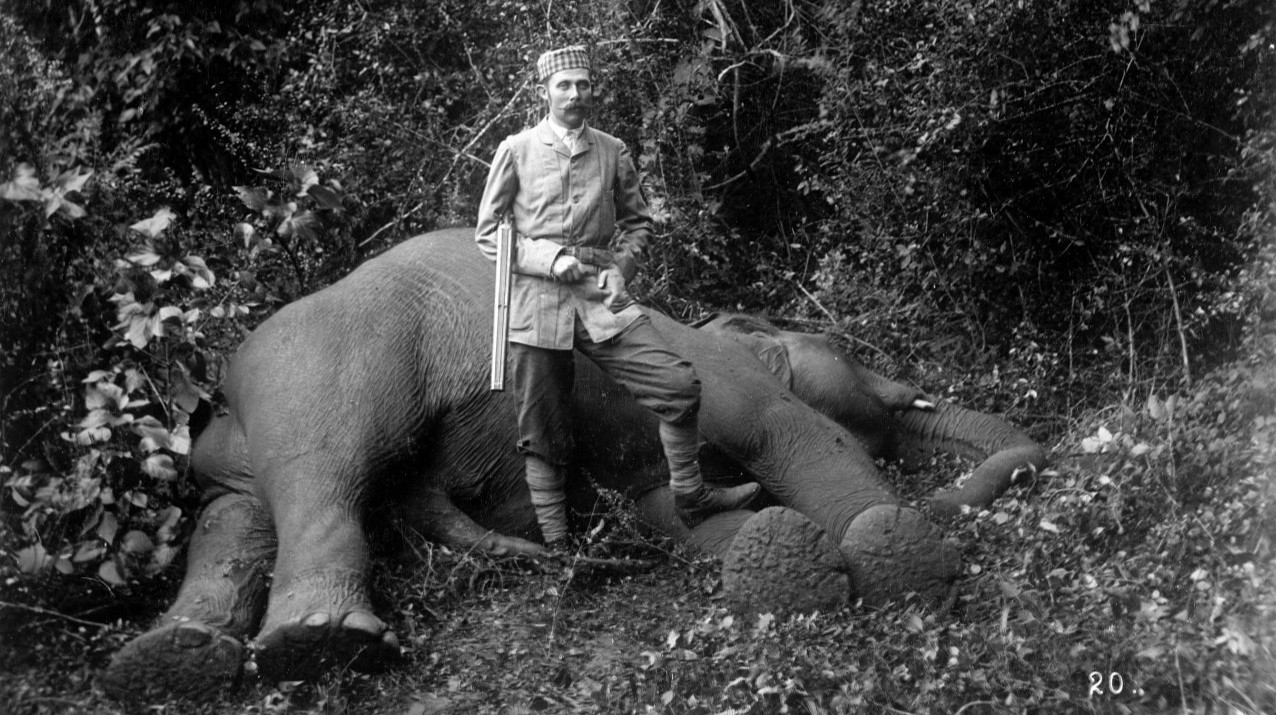
Between 1892 and 1893, Franz Ferdinand travelled around the world aboard the SMS Kaiserin Elisabeth. He visited India, Australia, and North America, where he also attended the World’s Fair in Chicago. During his travels, he indulged in his favourite pastime, hunting. These parts of the diary are the most detailed, showing that the author was a passionate hunter.
In Africa, for example, he shot flamingos and elephants, and on the island of Java, he went crocodile hunting immediately after his arrival. In addition, these writings, which were not originally intended for the general public, also reveal a lot about his personality. We can read about how he resents the hygienic conditions in India, how he finds the nose rings worn by Hindu women distasteful, and how he is horrified by the cemetery known as the Tower of Silence, where vultures do the work of gravediggers. He also did not fail to mention the bad habit of Hindus of immediately burying or cremating the dead without checking whether death had actually occurred.
In most places, Franz Ferdinand was welcomed with the pomp befitting a ruler. ‘In the state of Hyderabad, one of the largest and most populous…and relatively independent provinces of East India, the prince (nizam) welcomed him with oriental pomp reminiscent of the tales of One Thousand and One Nights, and organized, among other things, great tiger hunts for his entertainment,’ Vasárnapi Ujság reports. The train ride from Agra to Bharipur may not have been quite as exciting as a tiger hunt, but it certainly left a lasting impression on the Habsburg archduke.
Contrary to his bad reputation, Franz Ferdinand’s diary paints a picture of a cheerful and curious man who not only wrote expressively and beautifully, but also with humour and ease.
‘I felt sincere sympathy for my neighbour, the nizam, because I saw what a terribly bitter fate it seemed to be for him to have to make a toast. Immediately after the soup, he took a long piece of paper out of his pocket, on which his speech was written, and, holding it in his trembling hand, he studied it throughout the entire lunch. I am not very fond of the custom of toasting either, and so my neighbour’s anxiety and fear now affected me twice as much, because we were comrades in arms, but for him it was perhaps even more unpleasant than for me,’ the archduke narrated.
‘Contrary to his bad reputation, Franz Ferdinand’s diary paints a picture of a cheerful and curious man’
The heir to the throne not only openly expressed his disgust for Hindu customs but also formed a harsh opinion of the Australian indigenous population. ‘The inhabitants of the huts on the shore watched the work of our sailors (mooring the boats in a swampy area) with great admiration. They were Australian Negroes, the first we had seen; very peculiar people with terribly ugly features, swollen, puffy lips, and hair that was not woolly but curly. Otherwise, they already seemed to have been touched by civilization: their faces were not painted, as is customary among most of their tribal relatives; they also had some European clothing, such as brightly coloured vests and the strangest hats, black pointed caps, railway caps, etc. As soon as we stepped ashore, the women and children timidly retreated to their huts,’ he wrote.
He found life on board to be particularly intimate and friendly. In his diary, he emphasized that in the evenings, the officers gathered on deck to talk and tell interesting stories from their previous voyages. The days spent at sea, being locked in together, and the interdependence brought the crew and passengers closer together. He considered himself lucky to be part of such a circle, feeling that he had been accepted into a large family whose joys and sorrows he could share.
Consideration
During their 305-day journey, the crew covered 13,729 nautical miles. The archduke returned home with countless trophies and a collection of more than ten thousand ethnographic, handicraft, and natural history items. He exhibited the latter in his own museum. He believed that he would not only be a ruler but also an educator of his people, which is one of the reasons why he documented his travels in such detail.
‘This was his last chance to see the world without the burdens of his new role’
But why did he set out on his journey? Some speculate that he decided to take a ‘trip’ because of his illness, while others believe he was motivated by his nervous and psychological well-being. This is odd because the tuberculosis he inherited from his mother, the symptoms of which appeared already at an early age, only began to worsen in April 1894. Furthermore, he made no mention of illness in his correspondence with his concerned father in 1892, nor did he inquire about his son’s condition. Overall, it is therefore unlikely that he set out to see the world because of his health.
A much more rational explanation is as follows: since Crown Prince Rudolf had died and his father was already elderly, he was next in line to the throne, so this was his last chance to see the world without the burdens of his new role.
Related articles:
Click here to read the original article.