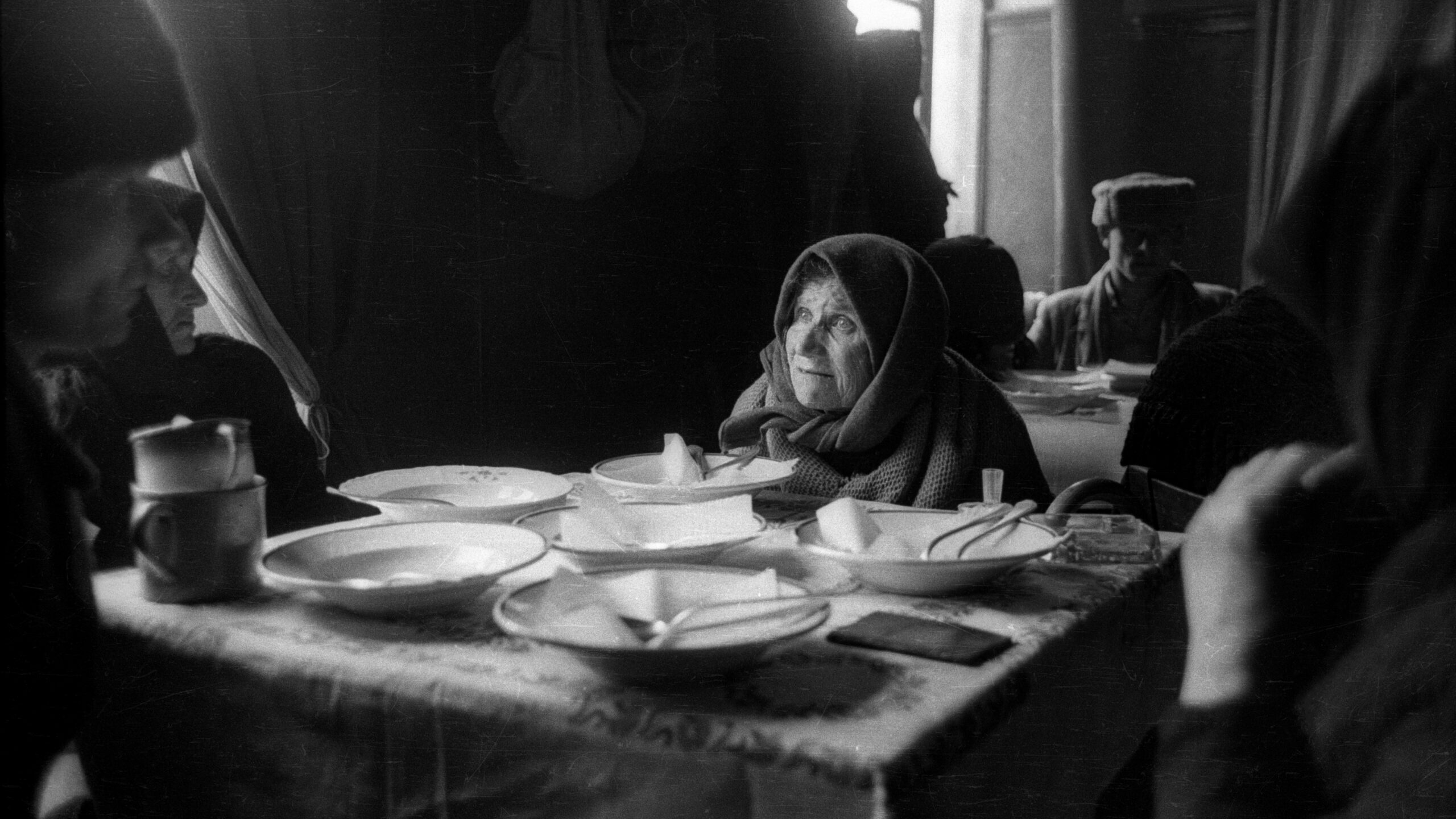
In our previous article, we detailed the deportation of small children as ‘class enemies’ from Budapest’s 1st District in 1951 by the Communist authorities. Here, we will explore the tragedies of another highly vulnerable social group, the elderly.
The 77-year-old Countess Gabriella Zichy was deported from 23 Táncsics Mihály Street, just like others, as a ‘landowner’. The lady, who came from a distinguished family—her parents were the aristocrats Ede Pallavicini and Etelka Mailáth—submitted a series of medical certificates stating that ‘I suffer from cerebral arteriosclerosis and senile cardiac weakness; I am a helpless old person, incapable of caring for myself, and I require constant nursing.’ For this reason, she wished to move to the village of Dióspuszta to live with her relatives. The Ministry of the Interior’s nameless bureaucrat scribbled a curt reply to the request: ‘I have reviewed it and did not find it feasible.’
The files of Samu Haltenberger and his wife, Mária Bárczy, similarly testify to the deportation of sick, elderly people. According to the documents, Haltenberger was a ‘landowner’, but in reality, he was one of the key figures of Hungarian automobilism, one of the founders of MAVART (today’s VOLÁN) and the ‘Grey Taxi company’ (today’s Főtaxi). The 72-year-old, ill man was deported from 4 Toldy Ferenc Street to the village of Kék in Szabolcs–Szatmár County. Haltenberger provided documentation stating that he was half-blind and unable to walk, while his wife was completely blind, diabetic, and suffered from high blood pressure. Despite this, the deportation was carried out; only later was Haltenberger permitted to move to the town of Szada to live with relatives. He essentially lived there until the end of his life, and only in his final months was he allowed to move back to Budapest, where he died in 1956.
‘I am a helpless old person, incapable of caring for myself, and I require constant nursing’
The story does not end there, however, because citing Haltenberger’s social status, the authorities also deported his daughter Klára and his grandson, Dénes Dlauchy, born in 1937 and then 14 years old, who lived nearby at 15 Batthyány Street. The boy submitted a petition asking to be allowed to finish his studies in the capital, which the Ministry of the Interior’s bureaucrat rejected as follows:
‘The named person was deported with his mother, Mrs Guido Dlauchy (widow), on 27 June 1951, to the municipality of Tiszasüly-Kolop because Mrs Guido Dlauchy’s parent, Samu Haltenberger, was a landowner and managing director. Dénes Dlauchy requested permission to pursue his studies privately through the Budapest Municipal Council…In view of the fact that the named person comes from a family alien to our social class [ie, the working class], and that general secondary schools exist not only in Budapest, I do not recommend granting the request.’ It should be added that ‘Tiszasüly-Kolop’ (Kolopfürdő) was in practice not even a real settlement, but a—by then already closed—spa in the middle of a marsh, without any meaningful infrastructure.
But it was not only the young Dlauchy who got into trouble because of his relatives. The 63-year-old Edit Luczenbacher, wife of István Bárczy, was deported from 4 Táncsics Mihály Street to Gyöngyössolymos in Heves County in July 1951. Her husband, István Bárczy, had been a state secretary and a recorder of cabinet meetings in the Horthy era; however, as Luczenbacher immediately pointed out in a letter, her husband had been living with his mistress since 1944, had been residing in the West for years, and thus they were married in name only.
‘With this act, my husband abandoned me unfaithfully, and all marital relations between us were thereby permanently severed. I was unable to carry out divorce proceedings against him because he constantly concealed his whereabouts from me. He has not supported me with a single penny since his departure.’
Moreover, she argued that after the Soviet takeover of the country, her husband had rendered great services to the Soviet-friendly system: ‘He did not actually defect, but left legally, with a passport, and…with his decisive testimony in the war crimes trials against [former PMs] [László] Bárdossy and [Béla] Imrédy, he bore witness to the fact that he is an enemy of reactionary movement.’ It appears that she was ultimately allowed to settle in Dombrád, in Szabolcs–Szatmár–Bereg County, although no petition or decision to that effect survives in the archival material.
Elderly, much like children, often need the power of the state for protection, but in this case, it was the state itself which saw them as ‘class enemies’. These old Hungarian citizens, whatever their political beliefs were, had trouble taking care of themselves, yet the Communist state, which loudly proclaimed its sensitivity to social issues all day long, branded them enemies of the people and forcibly removed them from their homes, often to places where the conditions for life were barely guaranteed—such as the middle of a desolate marshland. Their sad stories reflect yet another dark side of the Communist dictatorship, which the Hungarian people tried to shake off a few years later, with the revolution of 1956.
Related articles: