Deputy Chief Executive of Várkapitányság Ltd Krisztina Sikota described the exhibition at its opening as one of the final stages on the road to the handover of the Citadel. She said Gellért Hill and the Citadel are among the best known locations in the Hungarian capital and have undergone many changes throughout a history marked by turning points.
According to her, the exhibition guides visitors through the process by which the history of Gellért Hill and the Citadel became closely intertwined with decisive moments in Hungarian history.
Dániel Taraczky, the architect leading the renovation of the Citadel, said the site has been transformed into an open and accessible space, a park that is available to everyone. He added that the Citadel has thus evolved from a Habsburg fortress into a bastion of freedom. Based on this concept, an exhibition presenting the history of Hungary has also been created at the Citadella, showing the country’s past from a Hungarian perspective through images, installations, newly filmed scenes and historical paintings brought to life.
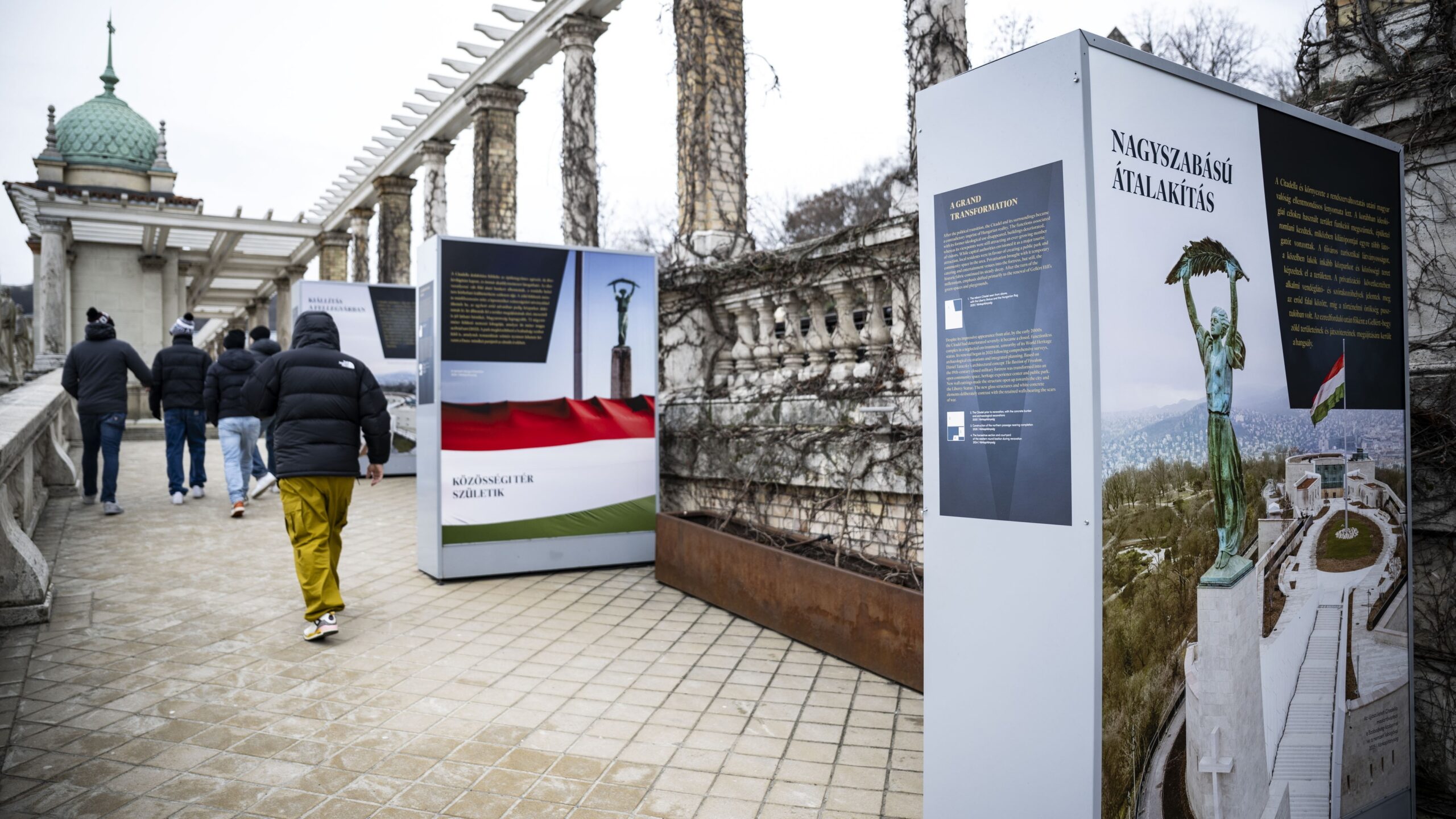
The outdoor exhibition at Várkert Bazaar presents not only the historical and religious traditions associated with Gellért Hill and the Citadel, as well as their military roles, but also the process by which the former stronghold gradually became part of the city and has now been renewed as a community space. Visitors can learn about the past and present of the Citadel and Gellért Hill through ten illuminated installations featuring a total of 20 panels.
Gellért Hill was already considered a cultic site in the Celtic era and later became a fortified centre. Since the Middle Ages, its history has been closely linked with decisive moments in Hungarian history. After the defeat of the 1848 to 1849 war of independence, the Citadel was intended by the Austrian imperial authorities as an instrument of control and as part of a planned military fortification system. By the end of the 19th century, however, its role began to be reconsidered and parts of its walls were symbolically dismantled.
By the turn of the 19th and 20th centuries, the Citadel had become a defining element of Budapest’s skyline and a popular destination for excursions. After the Second World War, however, the Soviet victory monument erected nearby once again served as a reminder of the ruling power. From the 1960s onwards, efforts were made to use the former fortress complex for tourism, although relatively little attention was paid to preserving its condition.
The Liberty Statue, visible from many parts of the capital, gradually became one of Budapest’s symbols and in 1987 the area received World Heritage status. However, the neglected complex continued to deteriorate in the decades following the political transition, and visitors arriving at the top of Gellért Hill were greeted by an inaccessible and deteriorating fortress building, making its closure unavoidable.
The Citadel is now being reborn as a 21st-century urban destination. Several new entry points have been opened in its walls, continuing the earlier symbolic dismantling, and alongside the fully renewed Freedom Statue and one of Budapest’s most famous panoramas, visitors will soon find a spacious park and an experience-focused exhibition. The renewed area will also include family friendly community spaces, a café and a gift shop.
The exhibition at Várkert Bazaar will be open to visitors until mid-April.
Related articles: