The following is an adapted version of an article written by Barnabás Leimeiszter, originally published in Hungarian in Magyar Krónika.
Egon Rónay was the scion of a famous hospitality dynasty. After the siege of Budapest, the Belvárosi Café he ran was the first to reopen its doors. He later emigrated to the United Kingdom, where he made a name for himself as a feared food critic.
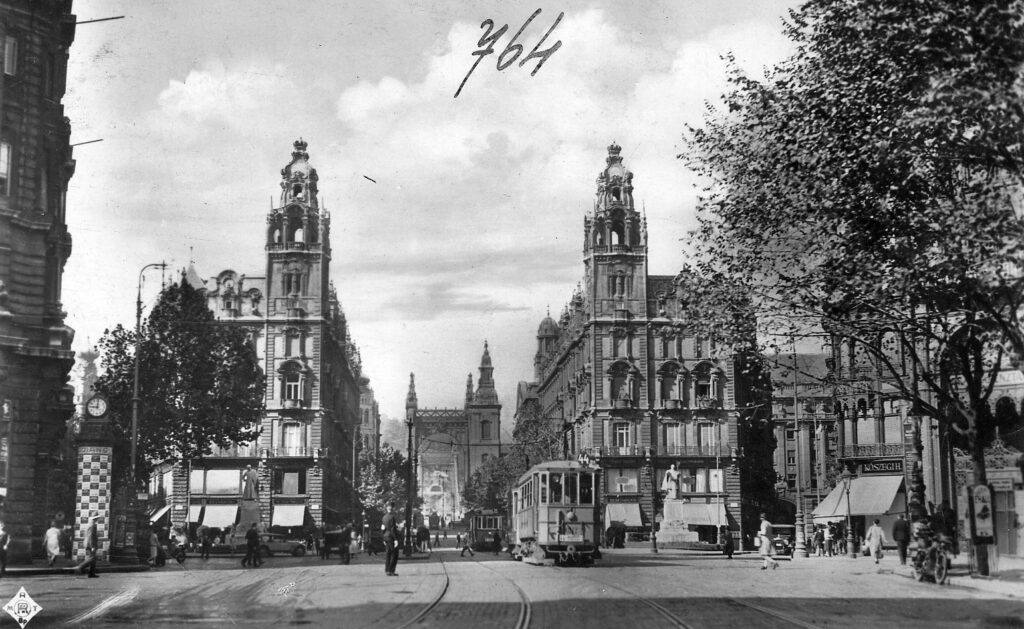
Once upon a time, there was a coffee house called Belvárosi Café, one of the largest and most prestigious cafés in Pest. It was opened in 1901 by Sándor Steuer in the palace affectionately known as Matild, located on the south side of what is now Ferenciek tere (Square of the Franciscans). In 1910 it was taken over by Adolf Rónai, who started out in Pöstény, built a grand hotel there, and then moved to Pest. Later, his son Miklós took over the business, and since he also had to manage many other restaurants, including the famous Hangli on the Danube Promenade, he brought his son Egon, born in 1915, into the management of the establishment.
Compared to the now legendary artists’ cafés, the Belvárosi Café had a more conservative reputation, but according to Egon Rónay (who already spelt his name with the letter ‘Y’), their establishment was characterized by an extremely democratic atmosphere:
‘Writers and all kinds of artists frequented our café, but we were neither a literary nor an artists’ café. Judges, military officers, merchants, scientists, high-ranking civil servants, and representatives of many other bourgeois professions frequented our café, but none of them left their mark on it. There really was a mix of all kinds of people here, representing all kinds of philosophical, political, and other trends. I don’t know of any other café that represented this mixed social situation to such an extent and which, as a result, had such a general bourgeois character. And it was always full, completely packed in the evenings. Both upstairs and downstairs.’ He added that even after the Jewish laws were passed, it happened that Samu Stern, president of the Jewish community, sat on the balcony, while Béla Imrédy and his family dined on the ground floor, directly below him.
There is a long list of stories and anecdotes connected to the Belvárosi Café. It is often mentioned, and a plaque on the wall of the Matild Palace also indicates, that this was the first café to open after the siege of Budapest, on 18 February 1945. Egon Rónay later revealed interesting details about the circumstances surrounding this to Gyula Zeke, who was filming a documentary about him. However, Rónay’s subsequent life story is no less interesting: from a young Budapest restaurateur, he became one of England’s leading food critics, playing a major role in the development of the culinary culture there.
According to his obituary in The Guardian, perhaps no one did more than Rónay to raise the standard of food served in English restaurants in the second half of the 20th century. The same article describes him as an extremely genial and humorous person in his personal relationships, but one who did not mince words when it came to gastronomy and was fond of engaging in debates to draw attention to certain issues. For example, he argued that a proper dining and restaurant culture cannot develop in a country where people are socialized on school canteen food of such appalling quality as in post-war England.
He left Hungary in 1946, as neither he nor his family could expect much good from the new regime. And indeed, Belvárosi Café was nationalized, and his parents were deported. He never saw his father again after his death in 1959, and although his mother was later allowed to visit her son in London, she too passed away shortly afterwards.
Rónay was already familiar with England, having spent every summer there since the age of eight. Before the war, he worked at the Dorchester Hotel in London and studied law at Cambridge. After emigrating, he initially worked for a relative in the textile industry, then as a restaurant manager in London, and later opened a small restaurant called Marquee near Harrods department store.
‘Perhaps no one did more than Rónay to raise the standard of food served in English restaurants in the second half of the 20th century’
Following praise from the blood-eyed restaurant critic Fanny Cradock, word quickly spread about the establishment’s excellent cuisine and the expertise of its owner, and The Daily Telegraph soon asked Rónay to become their food critic. ‘They liked me because I was very critical of bad food, which wasn’t common at the time. And they got used to the fact that what I said was reliable. Then, in my third year, I collected the articles and published them in a small book. It was an unexpected success, selling more than 30,000 copies. The following year, of course, the book got bigger, and then it got even bigger. At first, I published it myself, and an impoverished Hungarian landowner or something like that, who had nothing, took it from bookstore to bookstore and sold it. That’s how it started. Later, I sold my restaurant and switched completely to this business,’ Rónay recalled to Gyula Zeke, recounting the story of the first publication of his book Egon Ronay’s Guide in 1957.
The restaurant guide followed the concept of the French Guide Michelin, and as is customary at the entrances of Michelin-starred or recommended restaurants, the restaurants praised in Rónay’s guide also displayed a sticker indicating the Hungarian expert’s recommendation.
By 1980, the company publishing the guide employed 50 people, including six full-time tasters who had to try out 11 restaurants a week across the country. Rónay demanded strict professional ethics, with tasters working incognito and not accepting anything for free. In addition to various large and small restaurants and hotel restaurants, they also tested gas station cafeterias, train station restaurants, and airport buffets—the yearbook reported with brutal honesty on the horrors they encountered in the latter.
According to Tom Jaine, quoted in The Guardian obituary, when Rónay pilloried such cafeterias and snack bars, he targeted the most defenceless victims, but they deserved it; otherwise, they would never have gotten their act together. The nation owes him a debt of gratitude: although gas station and airport cafeterias are still terrible, without Rónay, they would be even worse.
All that said, as Jaine adds, the Rónay guide did have its blind spots, too: because its namesake, due to his upbringing, considered old-fashioned haute cuisine to be the gold standard, he was not very open to experimental amateurs and exotic cuisines. So those who followed the guide’s recommendations may have had fewer bad restaurant experiences, but perhaps also fewer special culinary delights.
Several videos about the Hungarian English food critic can be viewed on YouTube. A 1961 recording captures a lunch held at Café Royal, before which Rónay shared his views on improving English restaurant culture with chefs from the countryside. The reason for the lunch was that tourists visiting the countryside had complained a lot about the quality of the food served in hotels. Each course was prepared by a different chef and evaluated by an expert jury, including Rónay.
In a later video, he tried breakfast served at a restaurant at Heathrow Airport, which was a pleasant surprise—he particularly liked the sausage. He also visited a buffet, but there he was put off by the sight of the fried eggs. The video states that Rónay was such a notorious critic of airport restaurants that one of them even wanted to sue him.
Egon Rónay returned to Budapest for the first time in 1983. After arriving at the Hilton Hotel, the first thing he did was to get into a taxi and ask to be taken to the Buda end of the Erzsébet Bridge. He wanted to walk across the bridge and arrive at the Belvárosi Café, which was operating as a self-service restaurant at the time.
‘It was an incredible feeling. I set off, and when I reached the middle and saw the Belvárosi Parish Church, Eskü Square, and everything else in front of me, my feet were literally rooted to the ground, or rather, to the bridge. I could hardly believe my eyes. Once I crossed, of course, my first stop was the Belvárosi Café. I found terrible conditions, everything was turned upside down, completely transformed, one part had been turned into a bar, and there was some kind of dance floor in the middle of the ground floor space. I wanted to see the little room that had been my father’s and my office. I asked the lady who ran the business to let me go up. “What do you want to do there?” she asked. “Well, look, this place used to belong to my father,” I responded. “Oh, so you’re a private entrepreneur!” came the answer, to which I replied yes. So that was the conversation we had,’ Rónay recounted his reunion, adding that a few years later, the Hungarian ambassador in London conveyed an offer to him: to reopen the Belvárosi Café in its former glory. Rónay negotiated the matter, but when it became clear that he was expected to actually buy the café that had been taken from his own family earlier, he withdrew from the deal.
‘We should live and work until the very last moment as if we had a hundred years ahead of us’
He sometimes visited home later on, and in his opinion, the biggest change compared to Pest in the 1930s and 1940s was that interactions between people had become noticeably rougher. ‘Politeness has almost disappeared, and the pleasant feeling that an encounter used to evoke is virtually non-existent anymore.’ Of course, this is not unique to Hungary, he added.
‘Jung once said in an interview that we should live and work until the very last moment as if we had a hundred years ahead of us. I follow this example,’ Rónay replied to Gyula Zeke’s comment that, at 92, his vitality and work ethic put even 30-year-olds to shame. Around this time, The Standard also interviewed him, in which Rónay said that no matter how interesting his life story is, he has no plans to write his memoirs. However, if he did write them, he would title them The Chinese Curse. After all, what that curse says is basically ‘Live in interesting times’.
Egon Rónay passed away in 2010. His daughters also became famous: Edina Ronay worked as an actress and then continued her career as a costume designer—she was also Michael Caine’s girlfriend at one time. His other daughter, Esther Ronay, made a name for herself as a BBC editor and documentary producer.
Related articles:
Click here to read the original article.