

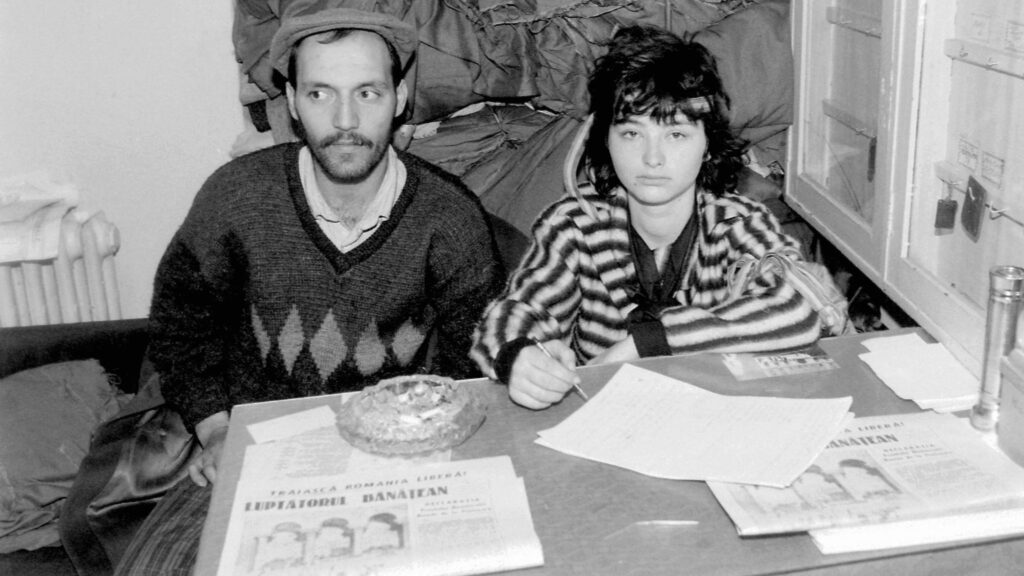




‘Taken together, the series offers a vivid snapshot of Brașov’s Hungarian community in the late socialist years…Yet one thing is conspicuously absent: the explicit acknowledgment that a Hungarian community existed at all…What emerged instead was a coded reality, in which familiar faces, schools, and cultural associations stood in for the community that could not be named.’
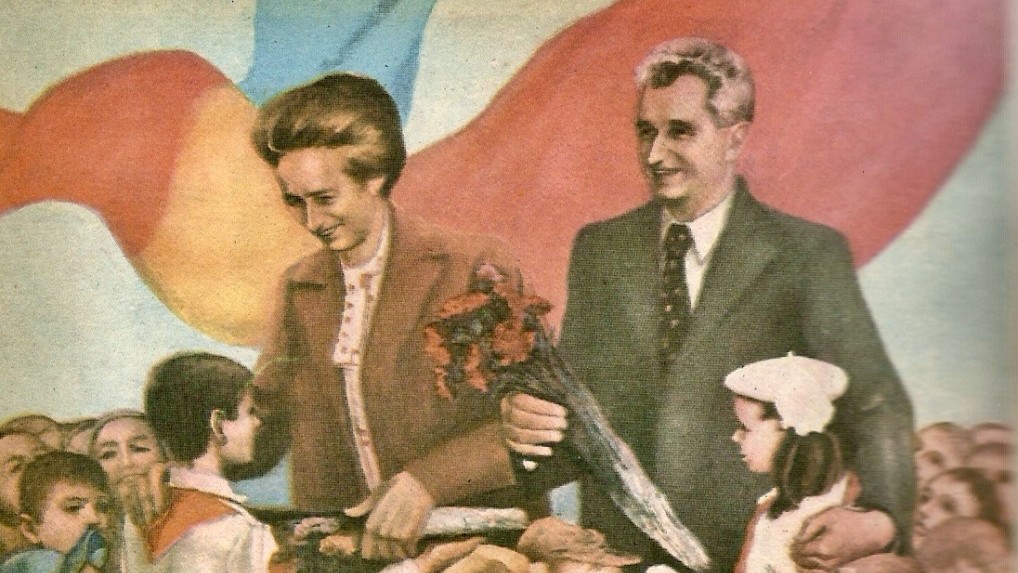
‘Even in December 1989, with the dictatorship collapsing, state television aired rallies staged in Ceaușescu’s support—only to have them interrupted by live images of his downfall. Journalists, tightly bound to the Party, had no autonomy; their function was transmission, not inquiry. The very system designed to preserve his rule ended up revealing…the fragility of a regime built on spectacle.’
As global urbanization and demographic shifts reshape societies, generational labels like Gen Z and Baby Boomer attempt to explain cultural divides. Yet these terms often fail to capture the complex, region-specific forces shaping identity, values, and social behaviour in an increasingly interconnected world.
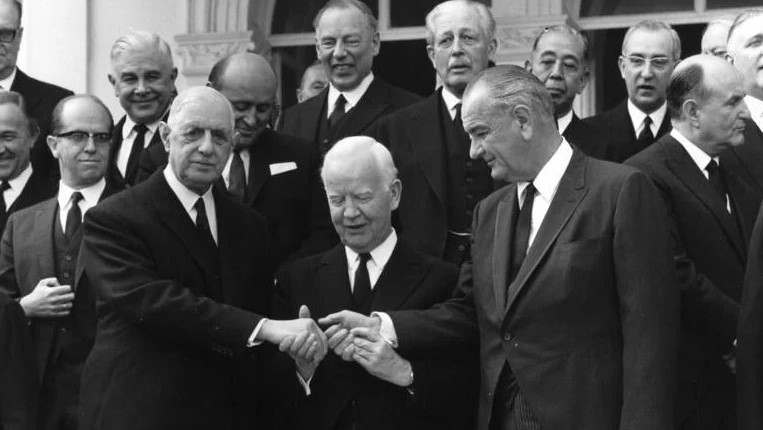
‘Hazel Erskine…published a series of polls in The Public Opinion Quarterly in 1969 based on previously classified reports from the USIA’s Research and Reference Service. While many of the issues surveyed are no longer politically relevant, they remain of historical interest. Most questions originate from the 1960s, with some earlier data included to examine trends related to NATO and defence.’
‘On the day the US temporarily halted military aid to Ukraine, Kellogg delivered a speech at CFR in Washington, DC. He emphasized that Ukraine had several opportunities to sign the US–Ukraine $500 billion Minerals Deal, including during his visit to Kyiv on 19 February and during Zelenskyy’s last trip to Washington, which is unlikely to be remembered as a successful diplomatic effort.’
‘Hungarian Minister for National Economy Márton Nagy recently visited Bulgaria and met with President Rumen Radev, Deputy Prime Minister and Minister of Transport and Communications Grozdan Karadjov, Minister of Economy and Industry Peter Dilov, and Minister of Tourism Miroslav Borshosh. The meeting marks a significant step forward in bilateral relations.’
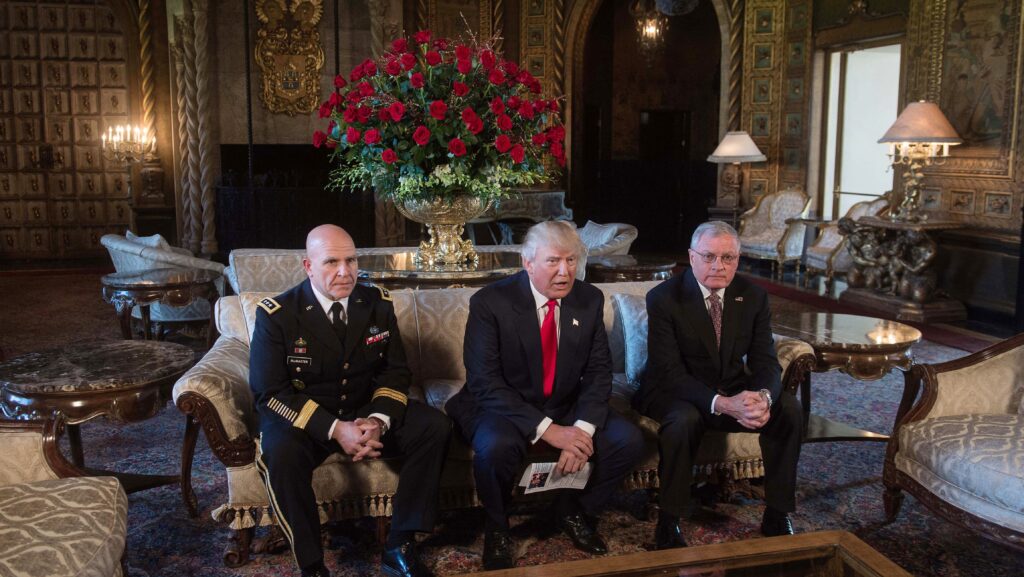
On 8 January European defence industry stock prices rose following Donald Trump’s press conference at Mar-a-Lago, where he declared the ownership and control of Greenland to be ‘an absolute necessity’. This came as a shock for many but in reality, America has been eyeing Greenland for more than a century.
Călin Georgescu, the independent candidate who garnered the most votes in the first round of the Romanian presidential election, is not unknown to the public. He has held important positions in the state bureaucracy and was the candidate for prime minister of AUR, the party that became notorious for its anti-Hungarian rhetoric. In the past years, however, Georgescu has become marginalized both in influential political circles and within AUR, after having referred to the founder of the Romanian fascist movement as a national hero.
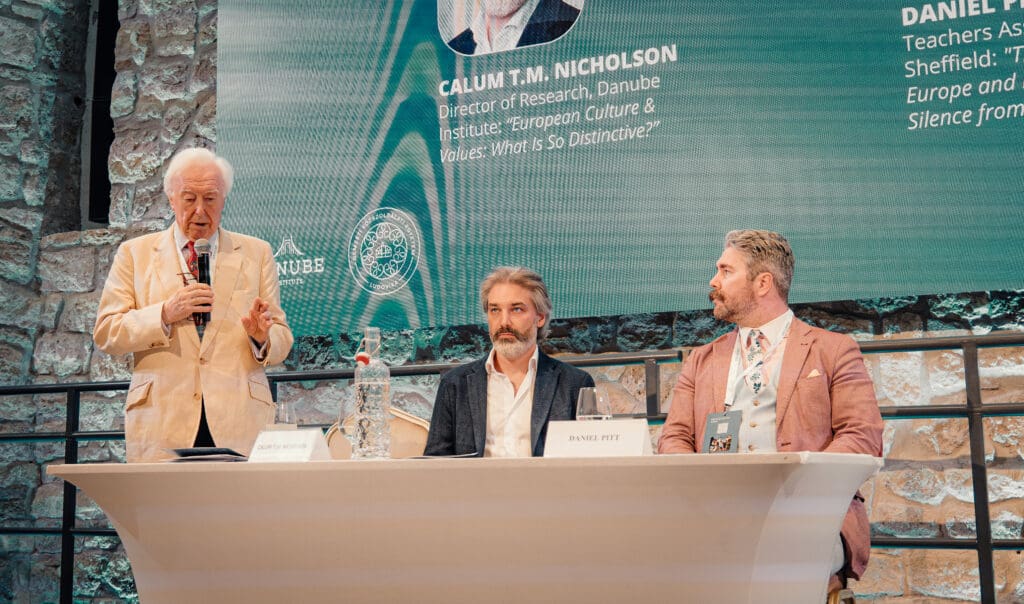
Conservative visions of the future of Europe after the European elections; the cultural crisis in the Western world as influenced by far-left movements including the ‘Woke’; and international security and geopolithical challenges—these were the main topics of the Free Speech and Freedom of Thought: British and European Conservative Visions of the Future of Europe conference held at the Danube Institute on 18 June. The all-day event aimed to bring together British, European, and American scholars and public figures to discuss how conservative political strategies can shape a world in flux.
‘A successful republic, according to Machiavelli, is characterized by laws that are lived by rather than frequently amended. While no system of governance can achieve absolute perfection, a stable republic can achieve a functional balance. For him Rome serves as a historical exemplar of such a system, where laws were respected and adhered to, placing communal benefits above personal gain, thus prudently managing both public and private affairs.’

At a time when public debate is increasingly polarized and superficial, Hungarian Conservative remains committed to depth and independent thought.
Donate Now
Please consider supporting our mission.