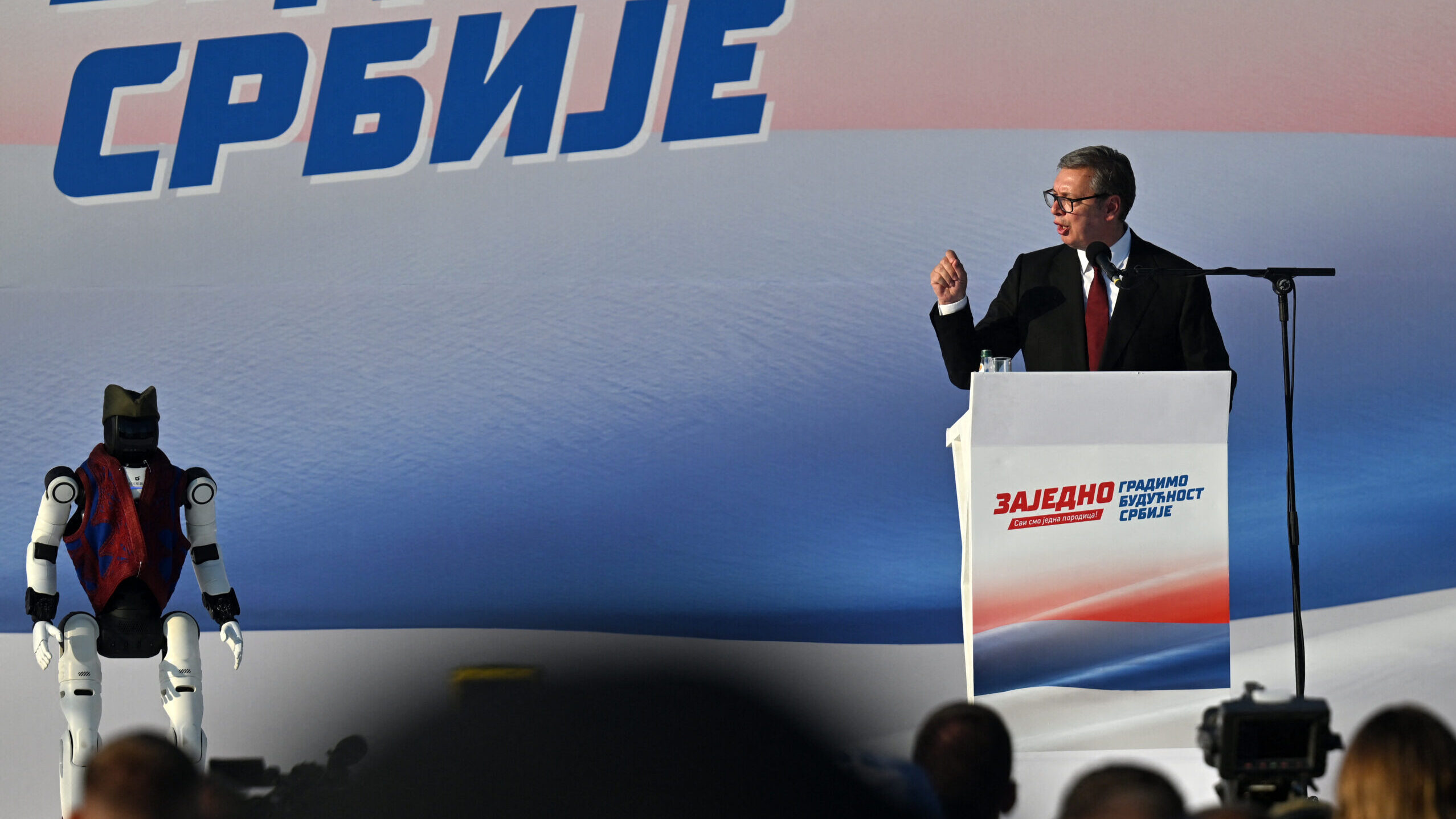
Serbia has launched mass production of humanoid robots in Šabac, opening a new high-technology industry that Belgrade says could supply Europe in the future. The investment was completed in cooperation with China, deepening an increasingly close defence relationship between Beijing and Belgrade.
The €20 million first phase, opened on 29 August at Minth Group’s Minth Metal Parts Majur plant, brings together Chinese automotive supplier Minth and Shanghai robotics company AGIBOT. Serbian President Aleksandar Vučić said he hopes the site will initially assemble more than 5,000 robots a year, with local production to follow. Serbian officials want the machines marketed as ‘Made in Serbia’, with the EU expected to be the main export market.
The factory is the first stage of a broader Chinese investment project in Serbia; Minth already plans a €200 million Robotics Industrial Park in Inđija, with work expected to start in mid-September and an estimated final annual capacity of up to 20,000 humanoid robots and robotic dogs. The park is intended to produce robots, unmanned aerial vehicles (UAVs) and batteries. Serbia on Monday also announced a separate €100.5 million investment by China’s Jiangsu Reliance Energy Tech in Inđija for batteries used in robots, drones and other UAVs.
While the investment is fundamentally described by the parties as a civilian-industrial project, Vučić said Chinese robotic dogs would be demonstrated by the Serbian Armed Forces within 15 days and would be seen ‘not only walking, but also using weapons, very serious weapons’. He said Serbian experts had connected software enabling weapons carried by the platforms to be controlled remotely.
That would fit into the rapidly expanding Serbian–Chinese defence cooperation. On 24 August, Defence Minister Bratislav Gašić told a delegation from China’s Central Military Commission that Chinese arms purchases had ‘significantly enhanced’ Serbian military capabilities and provided a basis for further cooperation. SIPRI data cited by RFE/RL show that China supplied 57 per cent of Serbia’s major-arms imports in 2020–24. Serbia operates Chinese CH-series combat drones and FK-3 air-defence systems and this year disclosed its acquisition of CM-400AKG air-launched missiles.
The project comes as relations between Serbia, one of the most advanced EU aspirant countries in the Balkans, and Brussels have deteriorated significantly. The accession process has effectively stalled, as on 8 July eight member states opposed opening Cluster 3 of the negotiations, preventing the unanimity required to proceed.
The European Parliament said the same day that the process had ‘effectively stalled’, specifically pointing to Serbia’s ‘deepening security and defence cooperation with China’ and saying it raised concerns over Belgrade’s strategic orientation. Full alignment with EU foreign and security policy remains a ‘non-negotiable’ accession requirement, MEPs said. Serbia has not opened a negotiation cluster since December 2021.
Analysts say the combination of Chinese robotics, remote connectivity and military use sharpens those concerns. Antonia Hmaidi of the Berlin-based Mercator Institute for China Studies (MERICS) told RFE/RL that the project could deepen existing EU concerns over Serbia’s relationship with China, while also giving AGIBOT an easier route into the European market through production in Serbia. Her colleague Altynay Junosova pointed to a different risk: humanoid robots carry cameras, microphones and other sensors and can receive remote software updates, potentially exposing sensitive data if those connections are compromised.
Related articles:
At a time when public debate is increasingly polarized and superficial, Hungarian Conservative remains committed to depth, intellectual honesty, and independent conservative thought.
Producing high-quality journalism requires resources. Your contribution helps us expand our coverage, reach new audiences, and keep our content accessible.

Please consider supporting our mission.