When Péter Magyar ended Viktor Orbán’s 16-year rule in April, Berlin treated the result as more than a usual Hungarian election. Chancellor Friedrich Merz later called the Tisza Party’s landslide victory ‘an inspiration for the whole of Europe’, saying the political pendulum could swing back from the ‘illiberal or even authoritarian’ direction. Die Zeit went further, arguing that Germany should learn from Orbán’s defeat in confronting the rise of Alternative für Deutschland (AfD).
Four months later, the lesson looks rather different. An INSA poll published on 23 August puts the AfD nationally at 29 per cent, eight points ahead of the Christian Democratic Union/Christian Social Union (CDU/CSU) at 21. In Saxony-Anhalt, which votes on 6 September, the latest pollytix survey has the AfD at 43 per cent against 23 for the CDU.
While the AfD’s rise is a nationwide phenomenon, Saxony-Anhalt cannot be explained without the party’s candidate for minister-president, the 35-year-old Ulrich Siegmund, and his campaign style, which increasingly resembles that of the man Germany’s establishment celebrated for removing Orbán.
Magyar did not defeat Fidesz by building a conventional ideological opposition bloc. Tisza brought together former opposition voters, disillusioned Fidesz supporters, previously inactive voters and conservatives for whom replacing the incumbent system became more important than traditional party identity.
Magyar himself hardly fits a neat liberal-versus-right-wing comparison: he has maintained Hungary’s restrictive position on illegal migration and migrant relocation, and in June warned Western European politicians that excluding insurgent parties behind political ‘firewalls’ only makes them stronger. ‘In many countries, the political, media and economic elite protects its own position,’ he told the Frankfurter Allgemeine Zeitung, instead of addressing voters’ fears and problems.
From Bürgerdialog to ‘Absolute Cinema’
His campaign was built around physical presence. Researchers counted 207 Tisza events between November 2025 and the April election, with Magyar deliberately concentrating on rural constituencies and Fidesz territory rather than traditionally opposition-aligned Budapest. Direct engagement with voters gave Magyar a national platform outside the Fidesz media environment and became one of his most important communication tools for reaching the rural electorate.
Besides his physical presence, Magyar used, and still uses, social media extraordinarily effectively, generating overwhelming engagement. Between 1 and 11 April, the final ten days before the vote, he generated 6.87 million Facebook interactions against Orbán’s 4.76 million, despite posting less frequently. He more than doubled Orbán’s number of shares, 419,000 to 196,000.
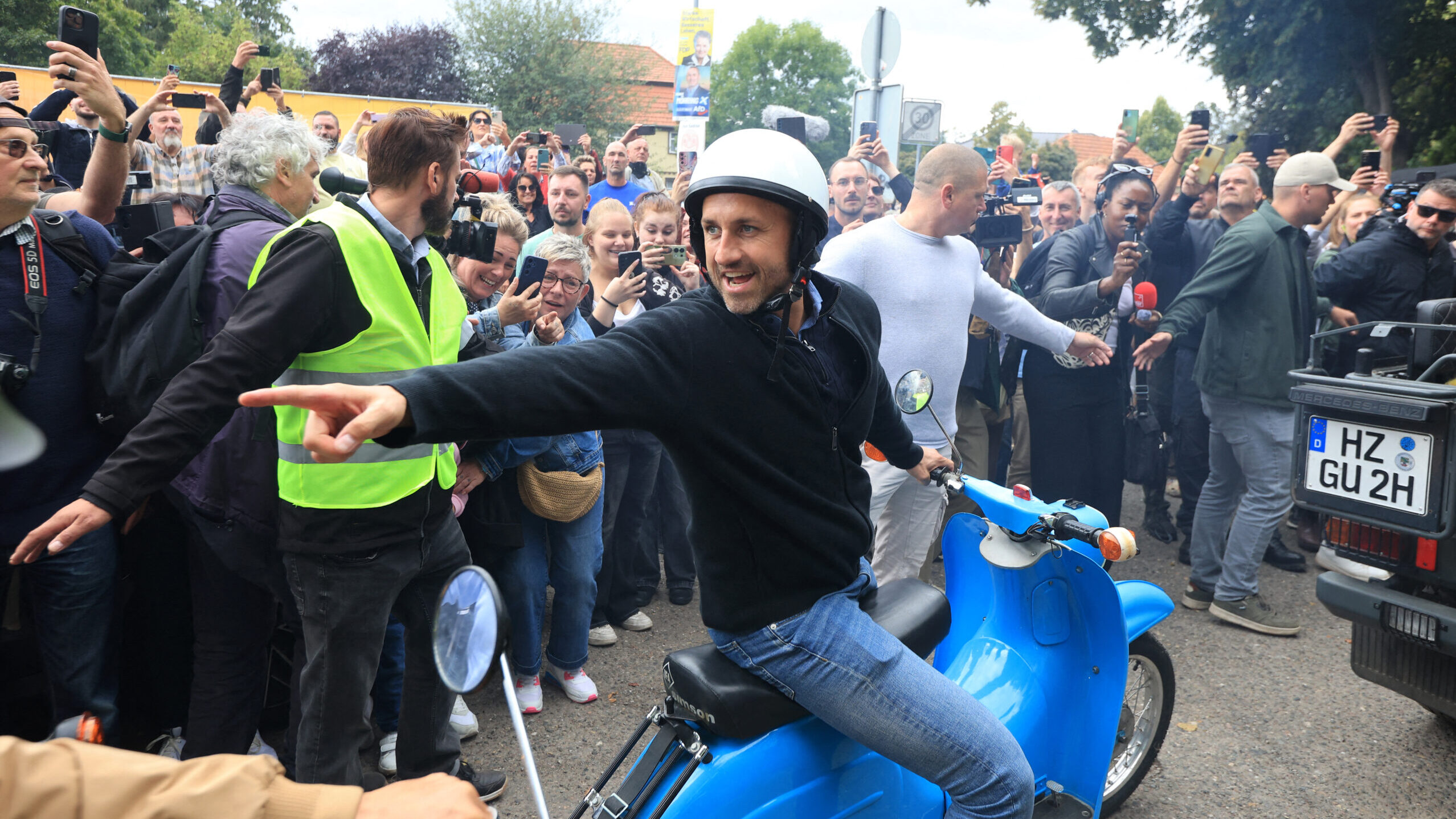
Siegmund is doing much the same in Saxony-Anhalt: Bürgerdialog meetings, small-town appearances, long sessions of selfies and autographs, and enormous social-media reach. Reuters described the AfD in May as deliberately going local to woo voters ignored by mainstream politics. The strategy reached another level on Sunday in Quedlinburg, where almost 5,000 people attended an AfD campaign event built around Simson motorcycles, an instantly recognizable symbol of East German popular culture. Siegmund led the motorcade himself.
It was politics designed to be experienced before it was explained: motorcycles, families, queues, selfies and regional identity, all immediately turned into digital content. Reuters noted that AfD support among roughly 18-to-34-year-olds in Saxony-Anhalt reached around 40 per cent in the 2025 federal election, up from about a quarter in 2021.
Magyar carried the same visual politics into government. After taking office, he personally began removing the barriers around the Carmelite Monastery, Orbán’s former government headquarters, on camera. The policy message—opening government after 16 years of Fidesz—was turned into a physical image of the new prime minister dismantling the old order. He uses parliamentary speeches to slam Fidesz MPs, acts unusually ‘offensive’ for a traditional prime minister, interrupts, stands up and calls out the opposition during sessions. Most recently, Magyar transformed crisis management into a series of spectacular live streams.
This is a deliberate strategy to produce clippable content for social media, extending the momentum of electoral victory and, most importantly, giving supporters a sense that they are participating in governance itself. It also helps an insurgent government avoid appearing to become the detached establishment it defeated. Magyar calls it ‘absolute cinema’.
Losing the Narrative
The similarities between Magyar and Siegmund become even sharper when their opponents attack. Magyar entered the election after more than a year of sustained attempts by Fidesz, government communications, public and pro-government media and aligned campaign groups to define him as dangerous, ridiculous, foreign-controlled or economically threatening. International observers later described the 2026 Fidesz campaign as ‘divisive and fear-mongering’, documented extensive overlap between government and ruling-party messaging and noted the use of manipulative AI content to discredit opponents.
Fidesz portrayed Magyar as Zelenskyy’s ally, Weber’s puppet, a tax-raiser and a threat of war through numerous billboards, AI videos and digital advertising. Magyar repeatedly turned the smear back against its creators, including by posing with the billboards himself. Rather than hiding from the caricatures, he circulated them to his own audience and turned the attempted humiliation into an attack on the resources being spent to discredit him.
On 14 August, Der Spiegel put Siegmund on its cover as ‘Germany’s most dangerous man’. Siegmund called it ‘very good advertising’. He began signing copies for supporters and posting videos of himself doing so; one signed issue reportedly sold for €1,010. At the Quedlinburg motorcade, Reuters photographed supporters wearing shirts carrying the same ‘most dangerous man’ message.
The failure of Germany’s mainstream media to hurt AfD by repeatedly telling voters that the party is dangerous, far-right and unacceptable—only to continue doing so even more forcefully—is strikingly similar to what happened in Hungary. Fidesz equally retained enormous communications and institutional power compared with Tisza, but increasingly struggled to make its attacks and narratives define its challenger. Magyar could instead present each new denunciation as evidence that an entrenched system was frightened of losing power.
A recent survey conducted by INSA on 20–21 August is particularly telling from this perspective: it found 49 per cent of Germans saying they were not afraid of AfD, compared with 42 per cent who were. At the same time, 53 per cent described the party as right-wing extremist. A proposed party-ban application split respondents exactly 42–42. The label has therefore not disappeared, but for a large part of the electorate it is evidently no longer producing automatic political deterrence.
Germany’s response has nevertheless continued to rely heavily on exclusion and institutional warnings. The firewall against cooperation remains in place, while arguments over a possible AfD ban, state-security surveillance and how institutions should respond to an AfD government continue.
The AfD’s Saxony-Anhalt organization has been classified by the state Office for the Protection of the Constitution as a confirmed right-wing extremist organization since 2023. The agency says the party attacks human dignity and democratic principles and cites racist, ethnonationalist and anti-democratic rhetoric.
Siegmund and the AfD reject the political legitimacy of that judgment. They argue that a domestic intelligence service sitting under a CDU-led Interior Ministry is being used against a democratic opposition party and have accused it of political interference; Siegmund has proposed restructuring the service if elected. The Interior Ministry denies political influence and says the agency operates under law.
Whether that classification is legally justified and whether voters regard the classifier as politically neutral are two different questions. If institutions are not seen as credible, surveillance only reinforces the narrative it is intended to counter.
Some of the German mainstream is starting to realize the grave strategic errors made in how the AfD has been treated, asking whether the firewall is failing and whether it has produced the opposite effect, mainly strengthening the AfD. Former CDU chairman Armin Laschet still rejected governing with the hard-right party, but attributed its growth partly to distrust of established parties, economic insecurity and voters feeling politically misunderstood.
The credibility problem reaches the government itself. A YouGov survey of 2,091 voters found that only 29 per cent expect Merz to remain chancellor until the scheduled 2029 election, while 54 per cent expect him to be replaced earlier.
When the Insurgent Starts Reshaping the System
Hungary offers Germany another lesson, this time about what happens after the insurgent wins.
Magyar did not simply replace Orbán’s ministers. His two-thirds majority has imposed an eight-year prime-ministerial limit counting previous service, effectively preventing Orbán from returning as premier; abolished the Orbán-era Sovereignty Protection Office; created a powerful new asset-recovery authority; removed President Tamás Sulyok through constitutional amendment; changed rules affecting Constitutional Court personnel; and imposed a 12-year cumulative term limit on MPs, affecting around one third of opposition politicians sitting in the current parliament.
These are the same categories of institutions that the German establishment fears an AfD government might seek to reshape: Siegmund has already promised to terminate public-broadcasting treaties, restructure the state administration, change education and migration policy, cut funding for democracy programmes, and reconsider the future of the state Verfassungsschutz, which currently monitors his own party. His 100-day programme also includes reducing the number of ministries and withdrawing support from programmes associated with the present political order.
That leads us to the assumption that an insurgent victory can be followed by the argument that institutions inherited from the previous political order are not neutral checks but remnants of that order—and therefore should be dismantled.
Europe has largely interpreted Magyar’s overhaul through the language of democratic restoration, even while individual measures have attracted criticism. The European Commission’s July Rule of Law report praised Hungary’s ‘intense reform efforts’ and described the speed of change as ‘impressive’, while EU governments approved a revised recovery plan tied to judicial, anti-corruption and transparency reforms.
‘An institution can retain constitutional authority; it is worth nothing if it loses political legitimacy in the eyes of voters’
Sulyok’s removal shows why this is not simply an elite debate. Before he was forced out, 67 per cent of Hungarians wanted him gone. Afterwards, 60 per cent rejected the claim that removing him through constitutional amendment represented an authoritarian or rule-of-law danger, although only 45 per cent regarded the method itself as fully acceptable.
That leaves Germany with the harder lesson from Orbán’s defeat. An institution can retain constitutional authority; it is worth nothing if it loses political legitimacy in the eyes of voters. If the AfD wins and its supporters already regard public broadcasters, the Verfassungsschutz or parts of the state apparatus as political actors of the old establishment, simply insisting that those institutions are independent will not settle the argument.
Hungary offers a glimpse of what might come after Siegmund’s now almost certain victory: the contest over who governs turns into a contest over which institutions deserve to survive unchanged after the electorate has rejected the political order around them.
Germany currently presents that possibility as one of the main dangers of an AfD government. Magyar’s Hungary shows that the same process can also be presented—and accepted abroad—as democratic reconstruction.
Related articles:
At a time when public debate is increasingly polarized and superficial, Hungarian Conservative remains committed to depth, intellectual honesty, and independent conservative thought.
Producing high-quality journalism requires resources. Your contribution helps us expand our coverage, reach new audiences, and keep our content accessible.

Please consider supporting our mission.