Péter Magyar’s first St Stephen’s Day as prime minister has been overshadowed by allegations that the company organizing the national celebrations had begun discussing the project weeks before the state formally launched the procurement—a controversy that cuts directly against the Tisza Party’s promise of a clean break with what it frequently describes as the defining ‘patronage network’ of Viktor Orbán’s 16 years in power.
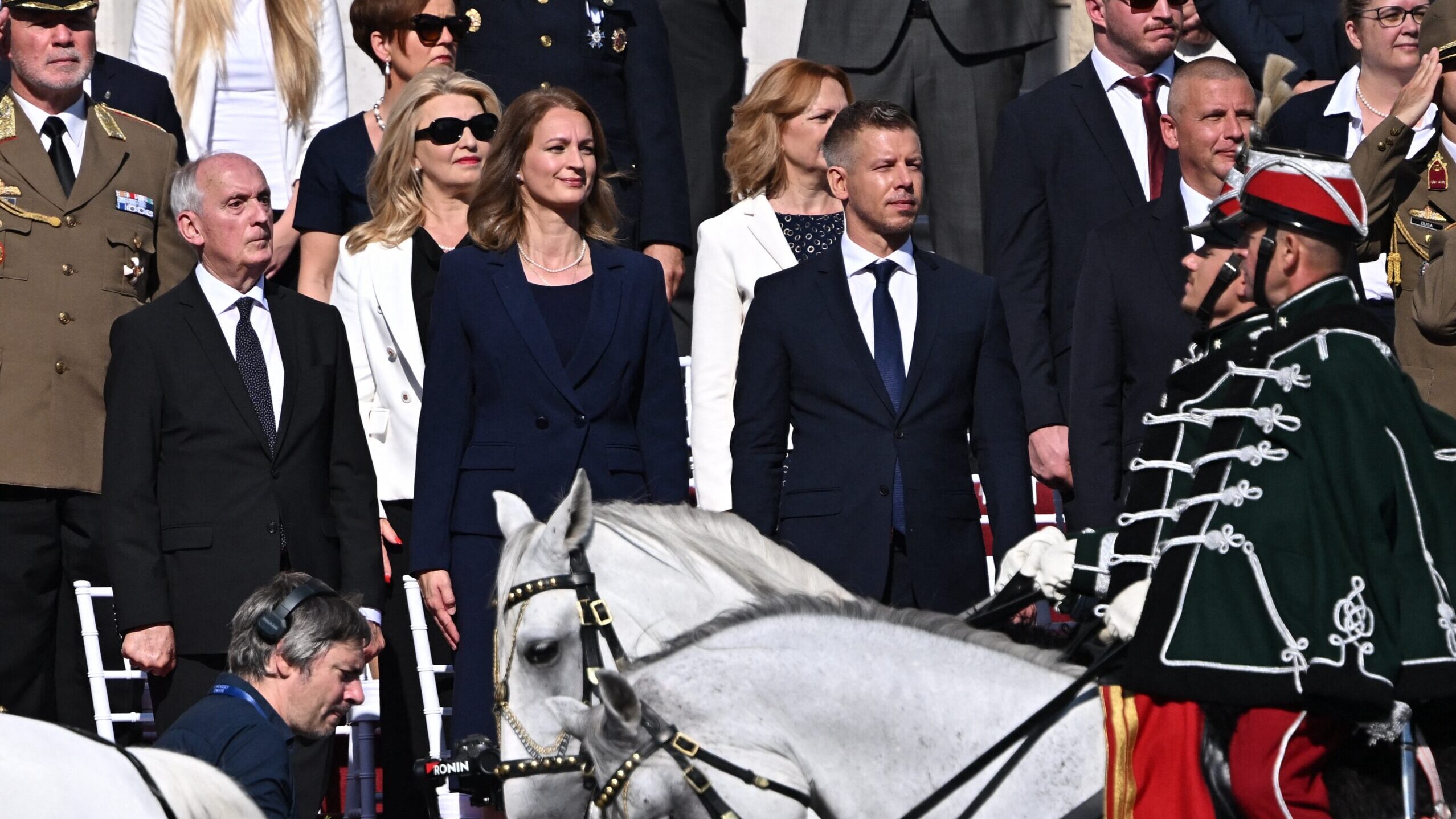
As Magyar hailed the inauguration of President András Baka as the beginning of a new era for the country on 19 August, the following day—20 August, marking the foundation of the Christian Hungarian state 1,026 years ago—turned into something entirely different from what the Tisza Party had expected.
On Thursday, G7 sparked the controversy with an investigation finding that Hardrock, which eventually secured the HUF 3.085 billion (around €8.5 million) net contract to organize the drone show accompanying the traditional fireworks in Budapest, was involved in discussions about the details of the celebrations before the tender officially began on 7 July.
Former Tisza event director Miklós Zelcsényi contacted the previous organizer, Lounge, owned by Fidesz-linked communications tycoon Gyula Balásy, on 16 June, saying he was seeking information at the request of government commissioner and Tisza vice president Márk Radnai. Hardrock managing director Dániel Besnyő subsequently joined the discussions and received information concerning budgets, subcontractors, and preparations.
The chronology is particularly sensitive because the National Event Organizing Agency (NRÜ) terminated Lounge’s existing contracts only on 23 June. Hardrock was therefore discussing the project before the previous arrangement had formally ended. When the state eventually opened a negotiated procedure without prior publication, three companies were invited, but Hardrock was the only one to submit an offer. The other two companies told G7 that the available preparation time was too short. Hardrock had meanwhile already discussed using experienced Lounge personnel and later requested 8–10 of its staff.
‘Sources familiar with the process described it to G7 as a “fake procurement”’
Sources familiar with the process described it to G7 as a ‘fake procurement’ and said the procedure resembled practices under Fidesz: no open tender, tailor-made criteria for competing companies, competitors pulling back so that only one remained to win the procurement, and so on. Orbán and Fidesz–KDNP were accused for years of favouring businessmen close to them with massive public and EU-funded contracts. Péter Magyar and Tisza won a constitutional majority promising specifically to break with these practices, dismantle the patronage network, and hold those involved accountable.
Independent MP Ákos Hadházy, one of Hungary’s most prominent anti-corruption politicians, said the allegations could have serious consequences if the correspondence is authentic. ‘Just because they steal less, it is still theft,’ he wrote, arguing that the lower cost of this year’s celebrations would not excuse an improperly arranged procurement.
He said the reported circumstances could raise suspicion of a criminal agreement restricting competition in a public procurement procedure, an offence punishable by one to five years in prison, and promised to examine the case further. Hadházy also framed the government’s response as an early test of whether the promised regime change would extend to accountability inside the new system.
Part of Tisza’s supporter base was also furious. On Reddit’s r/Hungary, where Magyar recently held a Q&A and received overwhelmingly positive questions and messages, several users accused the government of doing the same as Fidesz, arguing that if such practices became normalized during the new government’s first months, they could become part of its governing culture.
The government might nevertheless have an evident practical defence. Lounge’s accounts had been frozen amid an investigation, forcing the state to replace an organizer that had already spent months preparing Hungary’s largest annual state celebration. With only weeks remaining, officials used an emergency negotiated procedure rather than a normal open tender.
The new contract is also far cheaper than the previous one agreed under the former government: Lounge had originally been contracted for HUF 17.5 billion (around €48 million), while Hardrock’s offer was HUF 3.91 billion (around €10.7 million) gross, although the replacement programme has reduced technical content and the two figures are not directly comparable.
Yet, at the time of writing, there has been no government reaction to the controversy. That is indescribably unusual. Magyar and Tisza built their political success on an extensive and intense social media presence. The prime minister himself usually comments on every major media report that sparks even a small controversy within minutes. Several hours have passed since G7’s report, and there has been no reaction.
That is despite the fact that the government already knew about the story, as the outlet had reached out for comment. Radnai claimed that state event organization did not fall under his responsibilities, but the explanation left unanswered why Zelcsényi had invoked his name during the June approach to Lounge.
The timing gives the procurement controversy added political weight because Tisza had deliberately turned 20 August—Hungary’s state-foundation day and one of its most important national holidays—into a showcase for the change of government. Since taking office, Magyar has repeatedly used highly visible gestures to demonstrate the end of the 16-year Orbán era, including opening the former prime ministerial headquarters in the Carmelite Monastery to the public and ordering the removal of the Orbán-era National Creed from public institutions.
‘Despite the growing scandal dominating domestic coverage throughout the day, Magyar remained conspicuously silent’
The presidential transition was arranged around the same date. Parliament elected András Baka on 11 August so that he could take office before the national holiday. Baka’s choice carried particular symbolic value for the new government: as president of Hungary’s Supreme Court, his mandate was cut short during Fidesz’s constitutional restructuring, and his return to one of the country’s highest offices was framed as part of Tisza’s institutional break with the previous system. Magyar had made having a new president in office by 20 August an important element of that broader ‘regime change’ narrative.
The government also chose 20 August for the full return of the suspended public media, which, in its reorganized form, was promised to be fully independent. Magyar also brought the Tisza Islands to Budapest for their first major national meeting on Margaret Island.
Now all that preparation has been overshadowed by the procurement controversy, corruption allegations, and the flickering of a narrative that there was no regime change at all—only that those in power had changed. Despite the growing scandal dominating domestic coverage throughout the day, Magyar remained conspicuously silent on the allegations while posting frequently about 20 August on social media.
Related articles:
At a time when public debate is increasingly polarized and superficial, Hungarian Conservative remains committed to depth, intellectual honesty, and independent conservative thought.
Producing high-quality journalism requires resources. Your contribution helps us expand our coverage, reach new audiences, and keep our content accessible.

Please consider supporting our mission.