This is a translated and edited version of the original article.
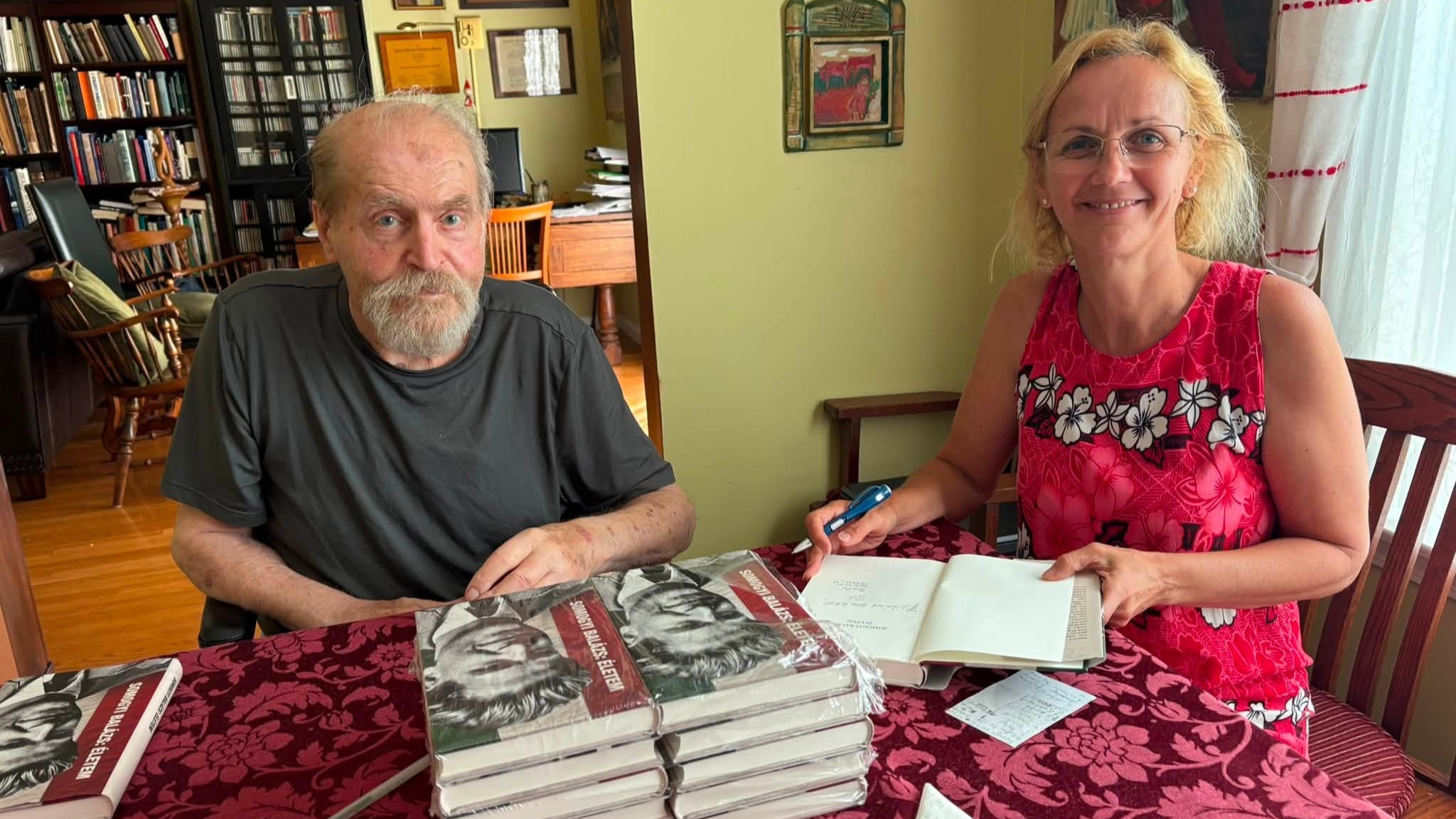
Balázs Somogyi’s name is probably unfamiliar to many people in the Carpathian Basin, while lots of Hungarian Americans know and respect him across the USA, especially those who are active in the Hungarian community life in the diaspora. It’s not only his 56er past and his medical expertise that are well known, but also his legendary ability to build communities, his peaceful cheerfulness and his characteristic humor. He produced an autobiographical manuscript written in his distinctive style a few years ago that he shared with me at last year’s ITT-OTT Conference at Lake Hope, OH. After skimming through a few of its pages, I promised him that I’d do everything to make it available to the wider community. In this project, I received professional and financial assistance from the Pro Minoritate Foundation, founded by Zsolt Németh, and Méry Ratio Publishing House.
I first heard about Balázs Somogyi from his sister, Marika Koller, when, a few months after our moving to the U.S., my husband and I organized a film club event at the Scout House in Garfield. After the screening of The Boys of Nap Street, a lively discussion developed among the audience; and Marika mentioned that we had to meet her 56er brother, who lived in the neighboring state of Connecticut.
A few months later, Kálmán Magyar, the chief judge of the Pontozó folk-dance competition—whom I interviewed after that event—recommended him to me as one of his best and oldest friends. In 2023, we visited the Hungarian Festival in Wallingford, CT, but I didn’t manage to have a proper conversation with him, because every organizer and guest was willing to tell or ask him something. After a while I gave up on the idea of doing an interview with him at that event and simply watched him, while he was receiving everyone approaching him with a polite, patient, but sometimes mischievous smile, and then, after a few brief exchanges, allowing them to move on—like a kind of wise local Don. We continued our conversation by telephone later, and that’s how my interview with him could finally appear in the 23 October 2023 issue of Magyar Nemzet also commemorating the 67th anniversary of the revolution and freedom fight.
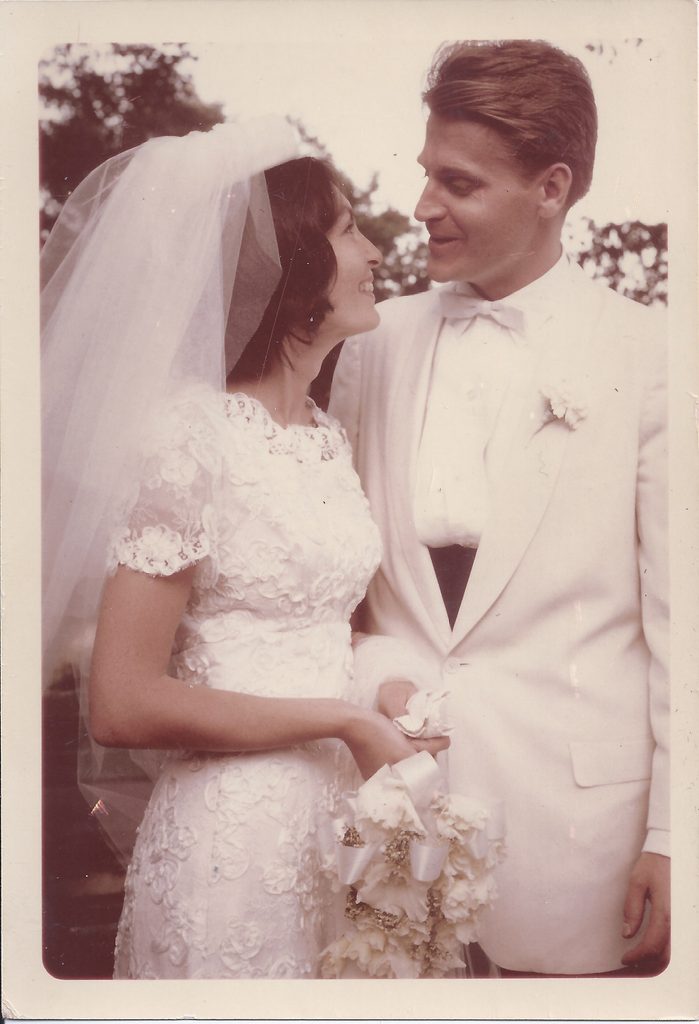
PHOTO: courtesy of Balázs Somogyi
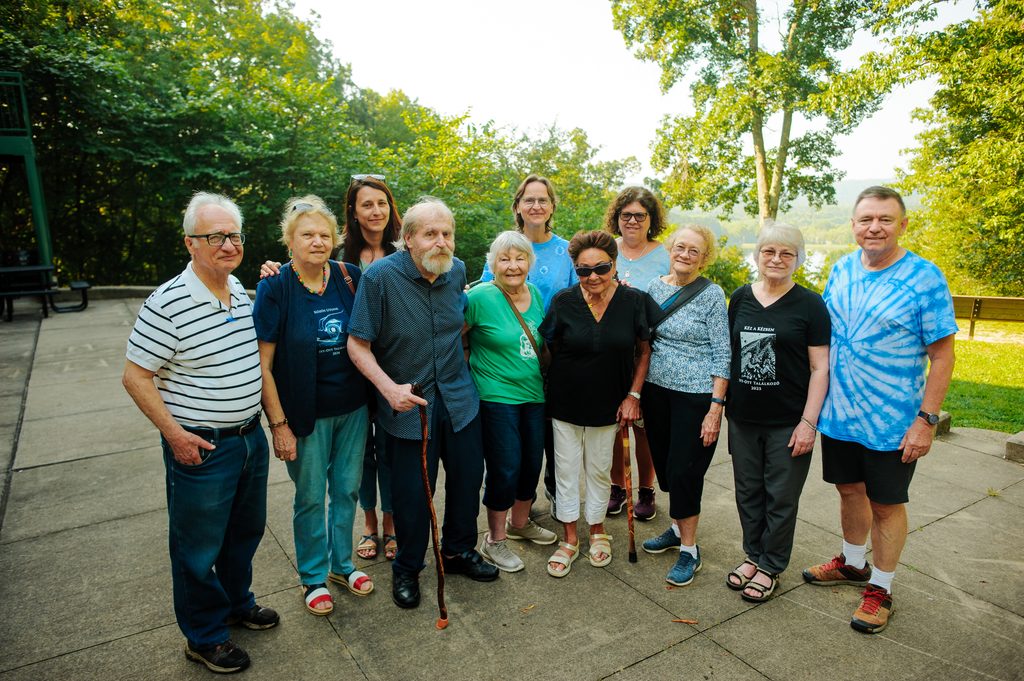
After that we met twice at the ITT-OTT Conference organized by the Hungarian Communion of Friends (MBK) since 1967, and once at the presentation in Wallingford of my Being Hungarian in America book series, which he and his wife, Csilla organized, with their usual personal commitment: they didn’t merely send out the invitation: she called everyone in their circle individually to make sure they came. On that occasion I had a glimpse into the workings of their male-strategist and female-operator partnership, too…
Even when I included the above-mentioned interview in my book, I hinted that it would be good to talk more, at greater length and in greater depth with him, so that we could present his entire life and community work. Nevertheless, this only became a firm determination when, at the 2025 ITT-OTT Conference at Lake Hope—of which he has been a defining personality for more than 50 years—Balázs unexpectedly showed me several pages of the autobiographical writing he had begun producing a few years earlier. At my request, he subsequently sent me the whole work, and later, in his characteristic casual manner, mentioned that he had also written an autobiographical poem and, if I wanted, he’d send me that, too. Of course, I was curious about that one as well! At Balázs’s suggestion, I contacted Zsolt Németh, the founding president of the Pro Minoritate Foundation, and it turned out that he, too, had previously promised Balázs that he would publish the autobiography, but had been waiting for him to revise and finish it.
Once the care of the autobiography thus became a joint undertaking, Zsolt Németh insisted that we should not alter or complete the original manuscript, but only proofread it stylistically and grammatically, and asked me to expand the earlier interview with another long conversation as a supplement about what had been omitted from Balázs’s autobiography because of his modesty: his multifaceted community work in the service of the Hungarian American community, first in New York and Connecticut and ultimately, through the MBK, throughout the entire Hungarian–American diaspora in North America—for which he was also awarded the Commander’s Cross of the Order of Merit of Hungary in 2016.
Thus, I contacted Balázs again so that we could continue our conversation, which finally took place in January 2026. And when it emerged around that time that he had also put his life into verse, I decided that I’d also contribute another piece to the book: with his agreement, I approached key figures in the local and diaspora community life and asked them to put their personal thoughts about Balázs in writing. Thus, the book, produced as a joint effort, came together in these four chapters; its introduction was written by Zsolt Németh, while Christopher Ball, Hungarian Honorary Consul of the State of Connecticut, contributed a heartfelt foreword.
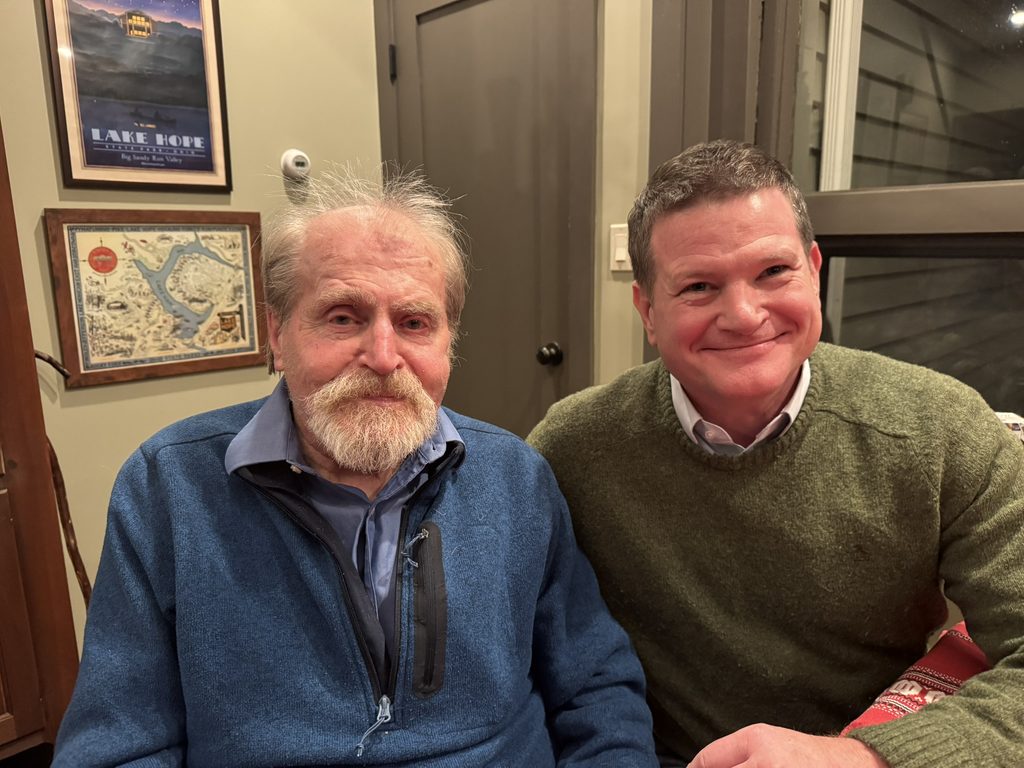
It’s not customary to write about the circumstances surrounding the creation of a book in a review, not even as its editor, yet I shall do so, and it’s easy to understand why: I feel I must share these details in order to introduce Balázs to those who don’t know him at all. While talking for several hours online—him in his home in Cheshire, CT, me in Budapest, Hungary—Balázs, approaching 88 and visibly not always in the best physical shape, was nevertheless able to remember almost every detail of his long and adventurous life, recalling people, places and dates, with astonishing mental freshness during our conversations—holding his phone in his hand and, as a result, occasionally creating amusing situations, such as the time I spent several long minutes looking at his unshaven chin from close range. He not only remembered every detail, but recounted so many individual stories I asked about with his characteristic, distinctive humor. When he couldn’t recall a particular fact, name or date, he just announced with elegant ease: let us come back to it in 20 minutes, so that he could gather his thoughts in the meantime…
The result: a candid, cheerful conversation interwoven by gentle humor with one of the leading characters of the Hungarian–American diaspora, still active and influential. I’ll never forget his words: ‘In the hope of seeing you again, I’ll try to stay alive until our next conversation…’ He succeeded and thus his memoir could be completed and published, but neither of us imagined that, during its proofreading, he’d end up in hospital. Another unforgettable shared experience was receiving his answers to the editor’s questions while he was lying in his hospital bed… When he then said goodbye in his previously mentioned style, I started to be truly afraid we might not meet again. Thanks finally to God and his doctors, that did happen—unfortunately not at this year’s 50th ITT-OTT Conference at Lake Hope, where I ultimately had to present the book without him, with the help of one of his old friends András Ludányi—but during a personal visit paid to their house in Cheshire, CT where we chatted with him so cheerfully over the little bites prepared by Csilla as if he had never spent months in hospital and wasn’t sitting in a wheelchair. Taking on his style of humor, I made him promise that he’d wait to remain alive until Zsolt Németh also visited him personally—expectedly on 23 October, as part of a commemorative event of the 70th anniversary of the Hungarian revolution and freedom fight.
Finally, a few personal thoughts from the person without whom this book could not have been published, namely Zsolt Németh:
‘This book shows how Balázs Somogyi preserved and recreated the unity of the nation among Hungarians who emigrated, those who remained at home, and Hungarians living in the Carpathian Basin beyond the borders of Hungary. He is not a professional politician, but a responsible, broad-minded, good-humored Hungarian intellectual who, inspired by the freshly pulsating force of Hungarian culture, created a communion of friends, because culture and community have the power to sustain us—among other things, this was what he fought for in 56.
Today, the world of Hungarians living in the diaspora is an obvious part of our national policy. But let us not forget that this too had to be fought for separately here at home, because there was and still is a position and an interest that sought to drive a wedge between those who emigrated and those who remained at home. It’s not a question of who integrated the Western diaspora into our national policy, but rather of recognizing those who sustained the nation by courageously taking on the task and carrying it out through decades of persistent work, without compensation. They were the ones who immediately established contact with the mother country and the communities of the Carpathian Basin as soon as the opportunity arose, and who, in time, handed the baton on to the participants in institutionalized relations. Without them, we couldn’t speak of a national policy in the Western diaspora today. As for the summer universities, perhaps it’s worth adding that while by now the best known among them may be the Bálványos Summer University—Tusványos—it isn’t the oldest; before it stand the slowly centenary-old Gombaszög in Felvidék [Upper Hungary, now Slovakia] and Lake Hope in Ohio, which has more than fifty years behind it. I’m glad that, as an invited guest, I was able to spend time with them on several occasions; I owe it to them that, back then, the Hungarian–American world also opened up before me. I’m proud that I was already there at Lake Hope in 1987, where Hungarian identity and the connection with living Hungarian culture are so carefully preserved. Congratulations to Somogyi Balázs and the truly friendly community that has formed around him!’
And a few lines from Christopher Ball as well:
‘In the early years, Balázs’s mother—whom everyone simply knew as Grandma—lived with them. She attended the events, but usually stood at the back so that she could easily go outside or sit down if she became tired. Being somewhat introverted, and since I was not a native Hungarian speaker either, I often stood at the back myself. During the many events, I became good friends with Grandma; we’d quietly talk to each other, and I was happy to help her whenever she needed it. Looking back, I think she was my “way in” to the Somogyi family. Balázs and Csilla once told me that Grandma had remarked how much she enjoyed talking to me at the events. Perhaps that was also one of the reasons why, over the years, they welcomed me into their family. I should have thanked Grandma. It was a real blessing to have known her and to see her friendly, familiar face at every event…Balázs and Csilla also helped us reach the wider Hungarian community for the university lectures. Since these were held in English, participants could bring along their friends and colleagues, and altogether we attracted a very good audience. Over the years we brought several prominent political leaders and distinguished academics to Connecticut, and I soon realized that most of the speakers were happy to meet Balázs and Csilla. They had generally known them for years, had visited their home, given talks at HCSC [Hungarian Cultural Society of Connecticut] events, or taken part in the ITT-OTT Conferences as early as the 1980s. The Somogyi family—together with a few other key Hungarian–American families—enjoys an almost “royal” status among Hungarians. On the one hand, this is impressive; on the other, it bears witness to their open hearts and to their decades-long commitment to quality Hungarian culture, dialogue and maintaining connections during the long years of communist separation. I must admit that Balázs and Csilla made a deep impression on me as I got to know them better during this period. They were tireless…I was thirty years younger than them, and when I was already completely exhausted, they simply carried on relentlessly.’
And finally, a few lines from Balázs himself, to give a glimpse into the distinctive style mentioned several times above:
‘Our studies were undeniably characterized at the time by a certain degree of schizophrenic quality. We learnt one kind of history at school, and then, upon returning home, our parents informed us of another set of facts that was diametrically opposed to what we heard in school. Generally speaking, the version heard at home was much closer to reality than the official one. It often happened that the whole class would burst out laughing derisively when a Soviet scientist’s or inventor’s name was mentioned, because we all knew that the discovery or scientific milestone had become known earlier and had not come from a Soviet Russian, but for instance from an Italian inventor. We felt sorry for our teachers, who obviously knew and were ashamed that they had to teach untruths. We picked up the Russian language from a so-called “re-education” teacher, Mr O., and were fully aware that he was perhaps only one chapter ahead of us in his knowledge of the language.
…[In October 1956] We witnessed a series of tragedies. They brought in a very beautiful sixteen-year-old girl whose left leg had suffered severe crush injuries. The blood supply to the limb was already showing hopelessly fatal changes; there was no way out: the leg had to be amputated from mid-thigh. I shall never forget the desperate screaming with which the girl reacted to the terrible conclusion. A young woman of around forty had suffered a tragic injury near the hip caused by a hand grenade. The injury had resulted in enormous, cavity-like tissue loss. The packing had to be changed every day. It was impossible to reduce the pain associated with this adequately, and the daily procedure proved to be an incredibly distressing experience, primarily for her, but to a certain extent for all of us. I still remember the spine-chillingly painful cries during the dressing change.
Naturally, there were other, less tragic moments as well. They brought in an attractively provocative woman of around 35–40 who had suffered multiple fractures, but none of them involved an open wound. We put her in a plaster cast from the waist down; she could move only her right leg. That was enough for her to provide certain very much sought-after services to the hungry and not entirely incapacitated male patients. As it later turned out, the lady was doing all this in return for appropriate financial compensation. I was there when my father reprimanded the woman and pointed out to her that a hospital environment was not an appropriate place for carrying out such activities. My impression was that my father’s words didn’t have the hoped-for effect…’
SOURCE: https://meryratio.hu
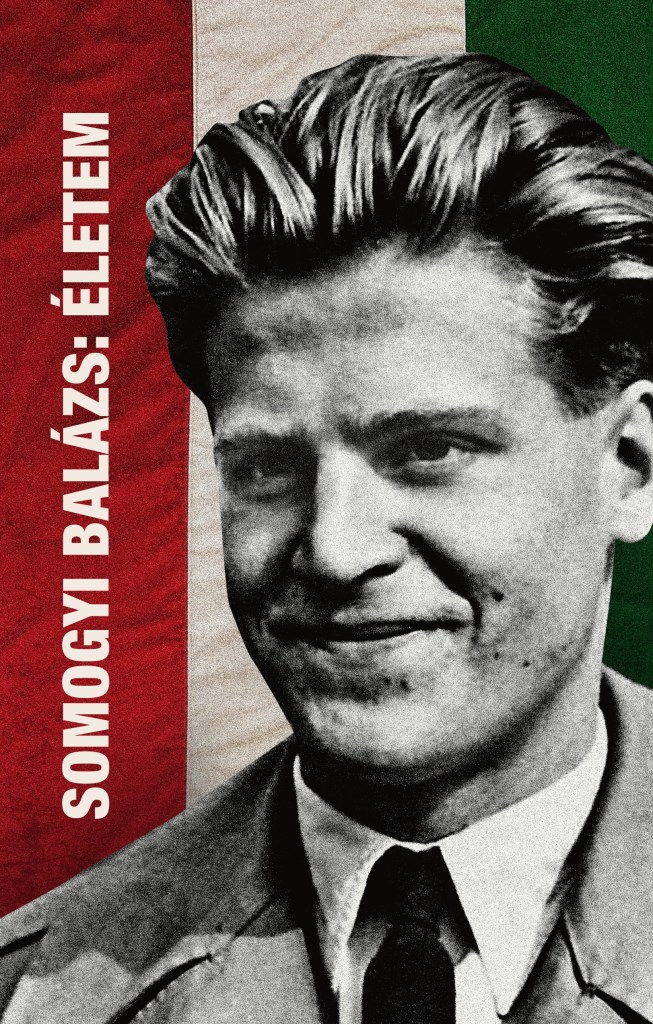
The memoir written by Balázs Somogyi titled Életem (My Life) published by Méry Ratio Publishing House in 2026 can be ordered here.
Related articles:
At a time when public debate is increasingly polarized and superficial, Hungarian Conservative remains committed to depth, intellectual honesty, and independent conservative thought.
Producing high-quality journalism requires resources. Your contribution helps us expand our coverage, reach new audiences, and keep our content accessible.

Please consider supporting our mission.