This article was originally published in Vol. 6 No. 2 of our print edition.
During the summer of 2015, hundreds of thousands of asylum seekers from almost 100 countries trekked through the Western Balkans towards the southern border of Hungary. Since it was impossible to conduct security checks on such a vast number of people, Hungarian Prime Minister Viktor Orbán—going against the Wilkommenskultur characteristic of the era—adopted a hardline, restrictionist approach and moved to close the border to asylum seekers and economic migrants. A fence was constructed and later upgraded multiple times, while laws were amended that together successfully halted migration flows across Hungary’s southern border by the end of 2015. More than a decade after the start of the crisis on the Serbian border, however, the struggle to keep the border secure is not over. Since 2015, more than 1 million illegal border-crossing attempts have been detected along the fence.1 Therefore, rather than a one-off infrastructure and legal project, the ever-changing situation on the Western Balkan migration route—as well as the interventions of EU institutions—requires constant vigilance and adaptation on the part of the Hungarian actors involved in securing the southern border from irregular migration flows.
The aim of this article is to assess in detail the evolution of the physical and legal barriers set up by the Hungarian governments between 2015 and 2025 on the southern border, with a particular focus on the driving forces behind the changes, which are often ad hoc and based on trial and error, as is only natural for newly devised methods. It will also assess the interventionism of EU institutions—especially the Commission and the European Court of Justice (ECJ)—and finally the evolution of migration flows themselves, not excluding the cunning of people-smuggling organizations. It is not the aim of this article to examine the societal reception of the Hungarian government’s migration policies, the migration policy of the new Tisza government, or to analyse the evolving political discussion surrounding them in the EU. Finally, it is likewise beyond the scope of this paper to trace the reception of these policies in Europe.
How Events in Syria, Türkiye, and Germany Converged on Hungary
From 2011 onwards, millions of Syrians were displaced as a result of the Syrian Civil War. Between the onset of the conflict and 2014, around 4 million people left the country, half of them finding refuge in Türkiye, while around a million fled to Jordan and about the same number to Lebanon. Owing to a complex interplay of several factors— the German government’s halving of financial contributions to refugee camps, bleak economic prospects in Jordan, Lebanon, and Türkiye, and the Russian intervention in Syria making resolution of the civil war a distant prospect—by the year 2014 refugees started leaving for Europe through Türkiye, Greece, and the Western Balkans.2 In 2015 alone, around 885,000 irregular migrants left Türkiye for Europe. Ankara did little to prevent this exodus.3
Since Bulgaria had already started constructing a fence on its border with Türkiye, most of these people crossed into Greece. The Greek authorities did little to stop the flow, and in early 2015, they also stopped registering the migrants arriving in small boats in the common European asylum system. In EU law, the Dublin Regulation stipulates that responsibility for processing an asylum application lies with the first EU member state where the applicant is registered. In early 2015, as thousands of migrants began passing through Greece, it became evident that most did not intend to remain there. Instead, their destinations were ‘honeypot’ countries like Germany and the Netherlands. By choosing not to register individuals in the European asylum system, Greek authorities tacitly ensured that other EU countries could not later return the migrants to Greece under the Dublin rules.4 Non-EU countries in the Western Balkans also did little to stop the flow of migrants; in certain cases, they even chose to actively aid their quick transition through their territory.5
‘It does not matter how high you build a castle’s walls if a backdoor is left open’
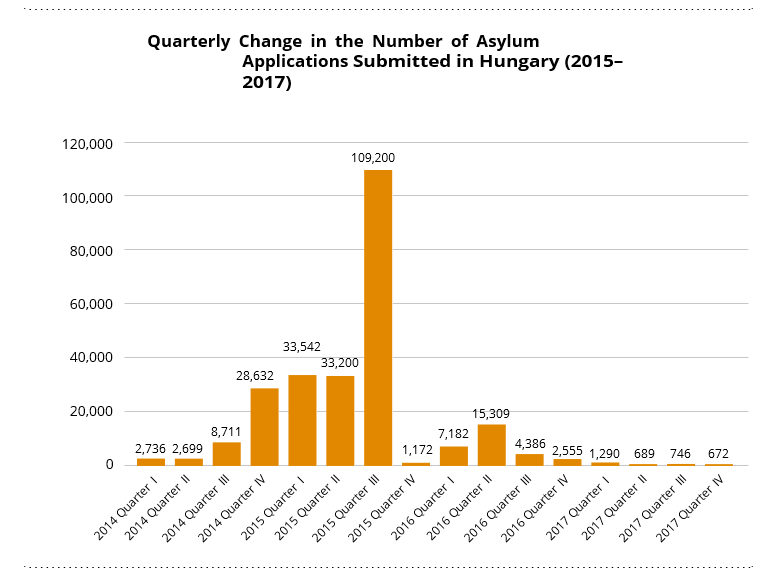
For the Hungarian authorities, the first clear signs of the migration and refugee crisis began to appear in 2013 on the Western Balkan migration route. That year, Hungarian authorities registered 18,900 asylum seekers, a 776 per cent increase compared to 2012 (2,157 individuals). The vast majority of asylum seekers were already entering Hungary irregularly at this point. In 2014, the Hungarian authorities registered 42,777 asylum seekers, and in 2015 a staggering 177,135. That year, more asylum applications were submitted than in the preceding 23 years combined, with Hungary having the highest number of asylum seekers per 100,000 inhabitants in Europe. The actual number of those crossing the border was much higher than this, however, as not every migrant filed an asylum application: according to the International Organization of Migration (IOM), in 2015, more than 441,000 people crossed the border irregularly.6 Importantly, the Hungarian authorities—unlike other European nations—made a significant effort to register those entering the country, in fulfilment of their EU obligations.7
Erecting the Fence
Although the migration and refugee crisis in Hungary became the focus of public attention and political discourse in the spring of 2015, the political decision to take a hardline, restrictionist approach towards migration may have been made earlier. On 11 January 2015, in Paris, Prime Minister Viktor Orbán declared the following: ‘Economic migration is a bad thing in Europe; we should not consider it beneficial in any way because it only brings trouble and danger to Europeans. Therefore, migration must be stopped—this is the Hungarian position.’8
In order to halt irregular migration flows from Serbia, a significant transformation of the nature of the national border was necessary. The goal was the complete elimination of permeability along the borderline—that is, between the official border crossing points. Step one was the construction of a physical border barrier.
On 17 June 2015, as thousands of migrants were crossing into Hungary across open fields, making their way on foot to Budapest and then to Austria, the Hungarian government decided to construct a temporary border fence, approximately 175 kilometres long and 4 metres high, along the Hungarian–Serbian border, to prevent unauthorized crossings. By mid-September, it was decided that a physical barrier would also be built along a short section of the Hungarian–Romanian border, from the triple border point with Serbia to the Maros River, as well as along the Hungarian–Croatian border. Before construction could start, the legal framework had to be altered. By amending the law on the state border, the Hungarian state obtained the right to public use of land within a ten-metre strip from the borderline along the external Schengen borders, enabling the installation and maintenance of the border fence without lengthy expropriation processes.9
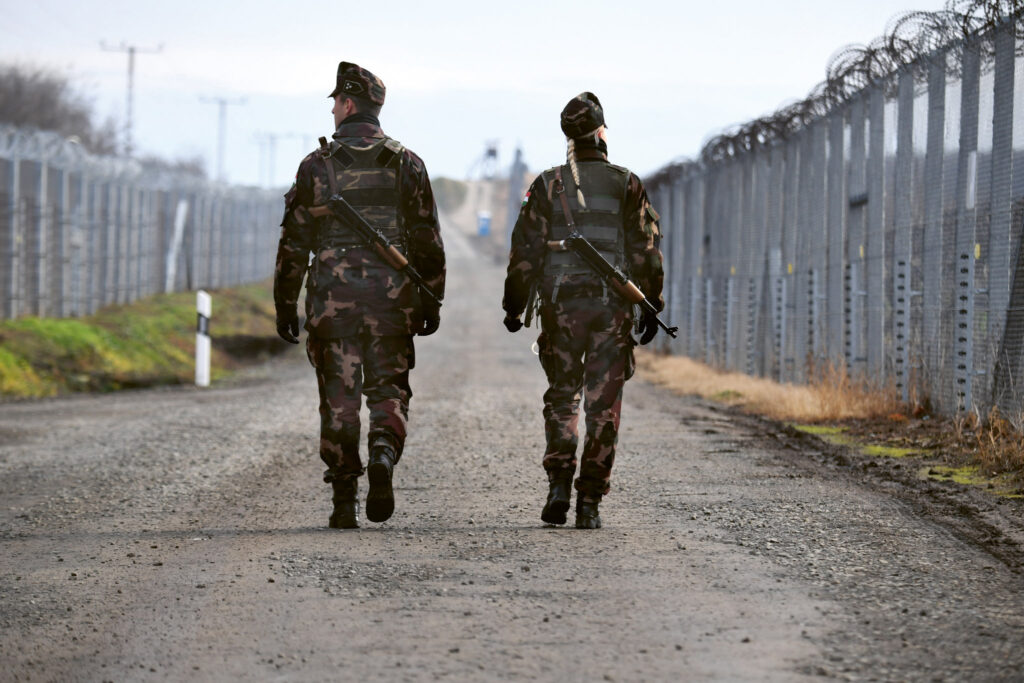
Construction commenced in July with the deployment of the Hungarian Defence Force. In order to swiftly erect a barrier along the whole Serbian border, the army first began installing a rapidly deployable concertina wire obstacle at the border, behind which the four-metre-high fence was gradually constructed. The concertina-wire obstacle was much ridiculed in the Western mainstream press, as it could be traversed with relative ease: individuals only needed to place a sleeping bag on top of it to cross. Nevertheless, we should not forget that the primary objective of any barrier is not to render passage impossible, but rather to ensure that crossing is slower and more challenging.
‘It can prove very difficult to remove rejected claimants if they decide to stay in the vast Schengen area’
Construction of the four-metre-high fence on the Serbian section, with the involvement of the Hungarian Defence Forces, was completed by 17 September and on the Croatian section by 21 October. Similar to the simple concertina wire obstacle, migrants and human traffickers quickly identified its weak points: to make crossing easier, they used ladders, cut through the wire mesh, and, to avoid injuries caused by the sharp blades, they threw clothes and sleeping bags over the top.10 Later on, the police also discovered a number of tunnels that ran underneath the border barrier, some as long as 25 metres.11 Sometimes migrants, in order to distract the personnel responsible for guarding the border barrier, spread rags over the top of the fence and set them on fire, so that their companions could cross more easily at another section of the barrier.12
Thanks to the physical barrier, the number of illegal border crossings fell sharply. In August 2016, Prime Minister Viktor Orbán announced the construction of a second fence which would run behind the manoeuvring road parallel to the first barrier. Unlike the border barrier built a year earlier, the new fence was equipped with an intelligent signalling system, as well as thermal and conventional cameras. Construction was completed by April 2017.13 In 2022, the fence was reinforced with additional concertina wire obstacles, as well as with the addition of a one-metre-high, V-shaped security element (the so-called ‘swan neck’), to prevent migrants from climbing over the fence using ladders. In 2023, certain sections of the fence were also supplemented with underground barriers designed to prevent the use of tunnels dug by human traffickers.14
The Hungarian Defence Force participated in manning the barrier until the end of 2022.15 The involvement of the Army in handling the crisis caused by mass immigration was made possible by a new legal regime,16 under which soldiers could guard and maintain order along the state border—tasks that included the right to use weapons. Following the outbreak of the war in Ukraine, however, the priorities of the Defence Forces changed, and they focused primarily on strengthening defensive capabilities and conducting training exercises. The withdrawal of the soldiers from the border barrier was made possible by the continuous technical modernization of the barrier and by increasing the staffing levels of the police. A government decree issued in July 2022 provided for the establishment of an independent Border Hunter Regiment within the Rapid Response Police.17
According to the Ministry of the Interior, by June 2022, total spending on protecting the southern border had reached €1.8 billion.18 As early as 2017, Hungary requested that the EU reimburse half of the costs of constructing the border barrier. By 2019, however, the European Commission had offered only a fraction of this amount—approximately €20 million—toward partially covering border protection expenses.19
The Legal Barrier
Constructing a physical barrier is not enough in itself to halt migration flows. If there remains an incentive whereby crossing the border means you ‘have made it’, then would-be asylum seekers will continue to attempt the crossing. The Hungarian government’s measure to legally ‘close’ the border to irregular entries on 15 September 2015, as well as the subsequent criminalization of illegal border crossing, and the introduction of severe penalties for damaging the fence, did not on their own fundamentally alter this reality.20
A quick look at the south-western border of the United States21 under the Biden administration helps us understand the calculus of asylum seekers. Large groups of migrants would often walk alongside the partially constructed border wall, and then willingly surrender themselves to the federal authorities—only to be processed and oftentimes released into the country after submitting their asylum claims. In order to prevent such anomalies, the Hungarian government needed to devise effective legal barriers, too.
An amendment adopted by the Hungarian Parliament in 2016 created an eight-kilometre-wide security zone along the state borders. Within this zone, anyone who could not verify their identity was escorted by the authorities to one of the official border crossing points and expelled from the country without being allowed to submit an asylum application. It is important to note, however, that irregular migrants expelled in this manner could still submit an asylum application through the procedures laid down in Hungarian legislation.22
Under further legislative amendments that entered into force in March 2017,23 the eight-kilometre-wide ‘legal fence’ could be extended to the entire territory of the country in the event of a mass migration crisis situation—a state that the Hungarian government has continuously maintained since 2016.24 As a consequence of extending the eight-kilometre-wide border zone, all irregular migrants, regardless of where they are apprehended within the country, are escorted to the outer side of the physical border barrier and then informed about the ways in which an asylum application may be submitted under Hungarian law.
Thus, the legal fence reached its final form in the spring of 2017, around the same time as the physical border barrier—not counting subsequent smaller upgrades to the latter. By extending the security zone to the entire territory of the country, the Hungarian legislature erected a quasi-impassable invisible barrier in the path of irregular migrants, since even if they manage to overcome the physical border barrier while avoiding the authorities, in legal terms, they will still be outside the country. And no possibility exists to change this: any formal interaction with Hungarian authorities would result in automatic physical expulsion from the country, with no appeal. With this amendment, the physical and legal fence on Hungary’s southern border was completed.
Closing the Asylum Loophole
Yet no matter how elaborate and impassable these physical and legal barriers might be, in themselves they would have proved insufficient to achieve the government’s objective of halting irregular migration flows. It does not matter how high you build a castle’s walls if a backdoor is left open. In a migration-policy context, one of the most infamous backdoors is the asylum system itself. As long as the authorities allow asylum seekers to enter through official border crossing points, as well as allowing them to wait—often for months—for their applications to be assessed while moving freely within the country, the border is not really secured. As other countries’ examples teach us, it can prove very difficult to remove rejected claimants if they decide to stay in the vast Schengen area.
For example, in Germany, at the end of 2025, around 232,000 people were required to leave the country; the proportion of rejected asylum seekers among them was just under 60 per cent. Around 82 per cent of these could have their deportations suspended for a plethora of technical and legal reasons: lack of identity documents, illness, or even ongoing vocational training.25 But even if all technical and legal hurdles are cleared, enforcing the final order of removal can prove very difficult. In 2024, in the EU, 453,840 deportation orders were issued, yet the number of actual returns was only 119,155. In France, only around 10 per cent of these orders were actually carried out.26
Closing the asylum loophole is not easy. In the case of Hungary, it proved to be a very ponderous and costly process. The Hungarian government commenced the transformation of the legal framework of asylum in August 2015 by simplifying and accelerating the assessment process.27 To prevent asylum seekers from moving freely within the country while awaiting the adjudication of their applications, the Hungarian government established two transit zones on the Serbian–Hungarian border at Röszke and Tompa in September 2015. Starting on 15 September 2015, individuals arriving from Serbia were required to submit their applications and wait for the results within these facilities. Concurrently, the reception centres located in Budapest and the countryside were closed. The transit zones, which also included medical and social facilities, were open towards Serbia; asylum seekers were free to leave them in a southerly direction at any time.28 From March 2017—with the extension of the security zone to the entire country, as mentioned above—asylum applications could only be submitted in person at the transit zones. During the asylum procedure, hearings had to be conducted either in person at the transit zone or via a ‘videophone’ connection. If the applicant left the transit zone, the authorities automatically terminated the procedure.29
If not for the intervention of the EU, this analysis could have reached its conclusion here. However, decisions by EU courts determined that certain elements of Hungary’s new legal framework were incompatible with EU law. Importantly, EU regulations generally do not allow for the extended detention of asylum seekers during the assessment of their applications. Although the Hungarian authorities did not prevent asylum seekers from leaving the transit zones toward Serbia, the Serbian authorities did not implement the official procedure to take back migrants. As a result, migrants entering the transit zone could find themselves unable to leave without violating the laws of one of these neighbouring countries. Due to this anomaly, the Court of Justice of the European Union classified the conditions in the transit zones as akin to deprivation of liberty in its judgment delivered on 14 May 2020. Following the judgment, the Hungarian government swiftly announced the closure of the transit zones on 21 May 2020.31
The Hungarian government provided the following solution to the dilemma of ‘detention’ in the transit zones and the ‘pushbacks’ to Serbia. According to a government decree32 published on 17 June 2020, a declaration of intent to submit an intention for asylum application may only be filed at a Hungarian foreign mission operating in a non-EU country bordering Hungary—namely in Kyiv and Belgrade. The solution, comparable to the American ‘Remain in Mexico’ programme, has one key element: a decision declaring the application inadmissible can be issued even before the asylum seeker sets foot on Hungarian territory. In this way, the dilemmas of detention and deportation can be bypassed.
The main legal tool to render most asylum applications inadmissible was the very broad application of the safe third country concept. The Hungarian regulation allowed an application for international protection to be rejected as inadmissible if the asylum seeker transited through a state in which they were not exposed to the risk of persecution, or where an adequate level of protection was ensured. The Hungarian authorities consider Serbia such a country. Yet, in a decision handed down on 16 November 2021, the ECJ ruled that this interpretation of the safe third country concept was incompatible with EU law.33
In the EU, the safe third country concept was regulated by the asylum procedure directive in 2013. Until June 2026, a key element in this legislation was the so-called ‘connection criteria’. When applying the safe third country concept, authorities need to be able to establish a strong connection between the asylum applicant and the safe third country in question—for example, previous residence, history of employment, or family ties there. Transiting through was not enough to establish this connection.
In a separate judgment, on 22 June 2023, the ECJ also found that making an application for international protection subject to the prior lodging of a declaration of intent at a Hungarian embassy located in a third country and to the granting of a travel document enabling them to enter Hungarian territory was also incompatible with EU law, since it unjustly restricted applicants’ access to the Hungarian asylum system.34
Unlike in the case of transit zones, the Hungarian government refused to comply with the decisions handed down by the courts, and consequently, in June 2024, Hungary was ordered to pay a lump sum of €200 million and a penalty payment of €1 million per day for continued non-compliance.35 This gridlock might be broken soon in the future, however. In December 2025, a political agreement was reached between the European Parliament and the Council scrapping the aforementioned connection criteria between the asylum applicant and the safe third country.36 In February 2026, both the European Parliament and the Council formally adopted the change in EU law, so technically, the Hungarian government’s application of the safe third country concept will be in line with EU law from June 2026 onwards.37
An Ongoing Struggle
As we have seen, even a decade later, the evolution of the Hungarian legal framework governing migration policy is far from complete, as shifts in EU laws and regulations indirectly affect it, too. On the other hand, the evolving policies of Serbia and other countries on the Western Balkan route directly affect what the Hungarian policemen guarding the border have to face. The year 2023 is a perfect example of this close correlation. Due to increasing restrictions on the Western Balkan routes, from 2016 onwards, the role of people-smuggling networks gradually increased.38 In 2020, their activities in the Serbian–Hungarian–Romanian border region recorded an annual turnover between €8.5 and €10.5 million.39 As a result of the coordinated actions of smugglers, in the summer of 2023, there was a night on which as many as 1,200 crossings of the Hungarian border took place. In fact, on one occasion Hungarian police detected 300 migrants crossing the border at a single point in just one hour.40
Along the increasingly busy routes, smuggling groups—often organized along ethnic lines41 and competing with each other—have since 2022 frequently engaged in armed clashes, mostly along the Serbian–Hungarian and the Serbian–Bosnian borders. The firearms and assault rifles used by these groups were mainly sourced from organized criminal groups in Kosovo and Albania. In September 2023, a shooting broke out between Afghan and Syrian migrants in the car park of a grocery shop in the centre of Subotica, a Serbian town close to the Hungarian border, resulting in one death.42 In October 2023, on the Serbian side of the border with Hungary, a firefight lasting several hours broke out in an abandoned building on a former agricultural estate, resulting in the deaths of three migrants.43 In response, the Serbian police, together with the gendarmerie and border guards, began an aggressive crackdown, dismantling the gangs and transporting migrants to the southern part of the country. Consequently, the migratory pressure on the Serbian–Hungarian border decreased significantly.44
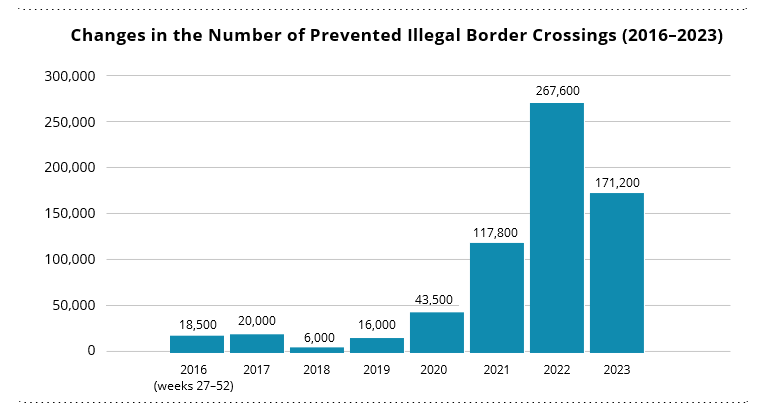
Contrary to some narratives that physical barriers do not work,45 as part of border protection, the Hungarian experience proves that this is not true. Since fences slow down illegal crossings, hundreds of thousands of illegal migrants were prevented from entering the Schengen area. Compared to 2022–2023, when more than 440,000 illegal border crossings were prevented, the number has now declined significantly, but remains in the thousands, so the immigration pressure is still there.
However, it remains uncertain when another spike in migration pressures will occur. Immigration flow persists in the Western Balkan region, and as the numbers decrease on the Hungarian–Serbian border, we can observe a surge in the Romanian–Bulgarian and the Bosnia–Croatian context. In addition, a change of policy in Serbia or any other unforeseen event may radically alter the flow of migrants reaching the Hungarian border, which in turn may necessitate further upgrades to the physical barrier or adaptations to the legal framework.
NOTES
1 ‘Az illegális migráció alakulása heti bontásban’ (A Weekly Breakdown of Illegal Migration), Police.hu (January 2021), www.police.hu/hu/hirek-es-informaciok/hatarinfo/illegalis-migracio-alakulasa?weekly_migration_created%5Bmin%5D=2021-01-01+00%3A00%3A00&weekly_migration_created%5Bmax%5D=2022-01-01+00%3A00%3A00.
2 Paul Collier, and Alexander Betts, Refuge: Rethinking Refugee Policy in a Changing World (Oxford University Press, 2017), 72–83.
3 Nikolett Pénzváltó, ‘Törökország belső és külső válságai’ (The Internal and External Crises of Türkiye), Nemzet és Biztonság, 9/6 (2016), 157–189, www.nemzetesbiztonsag.hu/cikkek/nb_2016_6_08_penzvalto_torokorszag_belso_kulso_valsagai.pdf; Nikolett Pénzváltó, ‘Törökország: a migrációs hullám meghatározó hullámtörője és/vagy hídországa?’ (Türkiye: A Definitive Breakwater and/or Bridge Country of the Migration Wave?), in Viktor Marsai, and Nikolett Pénzváltó, eds, Sodrásban. Pillanatképek az európai migrációs válságról (Drifting: Snapshots of the European Migration Crisis (MCC Press, 2023), 169–193.
4 Collier and Betts, Refuge: Rethinking Refugee Policy in a Changing World, 79–83.
5 Dimitris Skleparis, The Greek Response to the Migration Challenge: 2015–2017 (Konrad Adenauer Stiftung Greece, 2017), www.kas.de/c/document_library/get_file?uuid=9ca070c8-b546-01ac-e85a-df93ea2e5297&groupId=252038; Frontex, ‘General Report 2015’, Frontex.europa.eu (2016), www.frontex.europa.eu/assets/Key_Documents/Annual_report/2015/General_Report_2015.pdf; Árpád Párducz, and Márk Vargha, ‘Az Európa Erőd szakaszai: a vén kontinens néhány határkerítése’ (Sections of Fortress Europe: A Few Border Fences of the Old Continent), in András Imre Kóczán et al., eds, DT60: Tanulmányok Dezső Tamás hatvanadik születésnapja alkalmából (DT60: Studies on the Occasion of Tamás Dezső’s Sixtieth Birthday (Migrációkutató Intézet, 2023), 296–307.
6 International Organization for Migration, ‘Migration in Hungary’, https://hungary.iom.int/migration-hungary, accessed 7 June 2026.
7 Attila Juhász, and Csaba Molnár, ‘Magyarország sajátos helyzete az európai menekültválságban’ (Hungary’s Unique Role in the European Refugee Crisis), in Tamás Kolosi, and István György Tóth, eds, Társadalmi Riport 2016 (Social Report 2016) (Tárki, 2016), 263–285.
8 ‘Hungary’s Orbán Warns Economic Migration Endangers Europeans’, Euronews (16 January 2015), https://www.euronews.com/2015/01/16/hungary-s-orban-warns-economic-migration-endangers-europeans.
9 ‘2015. évi CXXVII. Törvény az ideiglenes biztonsági határzár létesítésével, valamint a migrációval összefüggő törvények módosításáról’ (Act CXXVII of 2015 on the Establishment of the Temporary Security Border Fence and the Amendment of Laws Related to Migration), https://mkogy.jogtar.hu/jogszabaly?docid=a1500127.TV, accessed 7 June 2026.
10 ‘18 migráns átvágta a déli határon épülő kerítést’ (18 Migrants Cut Through Fence Under Construction on the Southern Border), Magyar Nemzet (7 August 2015), https://web.archive.org/web/20160819132124/http://mno.hu/belfold/18-migrans-atvagta-a-deli-hataron-epulo-keritest-1299039; ‘Ismét átvágták a drótakadályt, százával jönnek Röszkénél’ (The Wire Obstacle Has Been Cut Again: They Are Coming by the Hundreds at Röszke), Híradó (24 August 2015), https://web.archive.org/web/20150924041847/http://www.hirado.hu/2015/08/24/ismet-atvagtak-a-drotakadalyt/.
11 ‘25 méter hosszú alagutat találtak a rendőrök Ásotthalomnál’ (Police Have Found a 25-Metre-Long Tunnel near Ásotthalom), HVG (23 October 2020), https://hvg.hu/itthon/20201023_alagut_asotthalom_magyar_szerb_hatar_menekultek.
12 György Balavány, and Márton Mohos, ‘“Amelyik migráns a családomat veszélyezteti, azt kinyírom” – Ásotthalom környéke hadszíntérré változott, a kerítésnél kövek repültek felénk’ (‘Any Migrant Who Endangers My Family Will Be Killed’—The Area Around Ásotthalom Has Turned into a Battlefield, Stones Were Flying Toward Us at the Fence), 24.hu (9 October 2023), https://24.hu/belfold/2023/10/09/asotthalom-hatarvedelem-bevandorlas-migracio-osszecsapas-riport/.
13 László Kui, ‘A határőrizeti célú ideiglenes biztonsági határzár továbbfejlődése, avagy a második kerítés mindent megold?’ (The Further Development of the Temporary Security Border Barrier for Border Control Purposes—Will the Second Fence Solve Everything?), Hadmérnök, 12/4 (2017), 67–75, http://hadmernok.hu/174_07_kui.pdf; Government Decree 1401/2017. (VI. 28.) on the Operation of the Intelligent Signaling System to Be Installed on the Hungarian–Serbian Border, https://net.jogtar.hu/jogszabaly?docid=A17H1401.KOR&txtreferer=00000001.TXT.
14 Ádám Bráder, ‘Hungary’s Southern Border Fence Reinforced’, Hungarian Conservative (7 June 2023), www.hungarianconservative.com/articles/current/border_fence_hungary_protection_defence_reinforcement_migration/; ‘Csöndben mélykerítés épült a déli határnál’ (A Deep Border Barrier Has Been Built in Silence at the Southern Border), Telex (31 October 2020), https://telex.hu/belfold/2020/10/13/csondben-melykerites-epult-a-deli-hatarnal.
15 ‘A határvadászok átvették a katonák feladatát a déli határon’ (The Border Hunters Have Taken Over the Tasks of the Soldiers on the Southern Border), Kormány.hu (29 December 2022), https://kormany.hu/hirek/a-hatarvadaszok-atvettek-a-katonak-feladatait-a-deli-hataron.
16 Act CXLII Of 2015 on the Amendment of Certain Laws Related to the More Efficient Protection of the State Borders of Hungary and the Management of Mass Migration), https://mkogy.jogtar.hu/ jogszabaly?docid=a1500142.TV.
17 Government Decree 244/2022 (VII. 8.) On the Rules for Contracted Border Hunters Belonging to the Staff of the Body Established for the Performance of General Police Tasks, https://njt.hu/jogszabaly/2022-244-20-22.3#SZ16@PO1.
18 ‘Befejeződött a déli határzár megerősítése’ (The Reinforcement of the Southern Border Barrier Is Complete), Kormány.hu (6 June 2023), https://kormany.hu/hirek/befejezodott-a-deli-hatarzar-megerositese.
19 ‘Egy százalékát fizeti ki Brüsszel a határvédelmi költségeknek’ (Brussels Pays One Per Cent of the Border Protection Costs), Magyar Nemzet (27 August 2019), https://magyarnemzet.hu/belfold/2019/08/egy-szazalekat-fizeti-ki-brusszel-a-hatarvedelmi-koltsegeknek.
20 Section 352/A-B of the Hungarian Criminal Code.
21 On the parallels between the American and Hungarian border barriers see Éva Eszter Szabó, ‘Fence Walls: From the Iron Curtain to the US and Hungarian Border Barriers and the Emergence of Global Walls’, in Virginia R. Dominguez, ed., Walls, Material and Rhetorical. Past, Present, and Future. Review of International American Studies, RIAS, 11/1 (Spring–Summer 2018), 83–85, www.journals.us.edu.pl/index.php/RIAS/article/view/6385/5347.
22 Section 71/A (1) of Act LXXX of 2007 on Asylum.
23 Section 5 (1b) of Act LXXXIX of 2007 on the State Border.
24 ‘Marad a tömeges bevándorlás okozta válsághelyzet’ (The Crisis Situation Caused by Mass Migration Remains), Kormány.hu (21 February 2023), bevandorlas-okozta-valsaghelyzet.
25 ‘Confronted with a Refused Asylum Application. What to Do? Legal Bases and Strategies on How to Handle Notices of Refusal and Threats of Deportation’, FlüchtlingsRAT, https://share.google/NzUigW3i1LM9YbfeN, accessed 7 June 2026.
26 ‘Immigration: 119,155 Returns in the EU in 2024 out of 453,840 Deportation Orders’, EUNews (31 March 2025), www.eunews.it/en/2025/03/31/immigration-119155-returns-in-the-eu-in-2024-out-of-453840-deportation-orders/#:~:text=If%20one%20 considers%20the%20whole,returns%20were%20recorded%20as%20voluntary.%E2%80%9D.
27 Act LXXX of 2007 on Asylum, www.kozlonyok.hu/nkonline/MKPDF/hiteles/mk15106.pdf.
28 Section 15 of Act CXL of 2015 on the Amendment of Certain Laws Related to the Management of Mass Migration, which modified Section 71/A of the Asylum Act effective 15 September 2015.
29 Section 7 of Act XX of 2017 on the Amendment of Certain Acts Related to the Strengthening of the Procedure Conducted in the Border Area (effective from 28 March 2017).
30 Központi Statisztikai Hivatal (KSH), www.ksh.hu/stadat?lang=hu&theme=nep, accessed 10 June 2026. 31 Joined Cases C-924/19 PPU and C-925/19 PPU, decided by the Grand Chamber of the Court of Justice of the European Union (CJEU) on 14 May 2020; ‘Bezárják a tranzitzónákat’ (The Transit Zones Will Be Closed), Infostart (21 May 2020), https://infostart.hu/ belfold/2020/05/21/kormanyinfo-igy-indul-ujra-az-elet-bejelentesek-percrol-percre.
32 Government Decree 292/2020 (VI. 17.) On the Designation of Embassies in Connection with the Declaration of Intent to Submit an Asylum Application, https://net.jogtar.hu/jogszabaly?docid=a2000292.kor.
33 Case C-821/19, https://curia.europa.eu/jcms/upload/docs/application/pdf/2021-11/cp210203hu.pdf.
34 Case C-823/21, https://infocuria.curia. europa.eu/tabs/affair?lang=EN&sort=AFF_NUM-DESC&searchTerm=%22C-823%2F21%22&publishedId=C-823%2F21.
35 Case C-123/22, https://infocuria.curia.europa.eu/tabs/affair?sort=AFF_NUM-DESC&searchTerm=%22C- 123%2F22%22&publishedId=C-123%2F22.
36 European Commission, ‘Commission Welcomes Political Agreement on New Rules to Facilitate the Application of the Safe Third Country Concept’, ec.europa.eu (18 December 2025), https://ec.europa.eu/commission/presscorner/detail/en/ip_25_3056.
37 ‘EU Asylum Overhaul Adopts “Safe Countries” List’, Etias (26 February 2026), https://etias.com/articles/eu-asylum-overhaul-adopts-%E2%80%98safe-countries%E2%80%99-list.
38 Bodo Weber, ‘The EU–Turkey Refugee Deal and the Non Quite Closed Balkan Route’, Friedrich Ebert Stiftung (2017), https://library.fes.de/pdf-files/bueros/sarajevo/13436.pdf.
39 Walter Kemp et al., ‘Spot Prices: Analyzing Flows of People, Drugs and Money in the Western Balkans’, Global Initiative (10 May 2021), https://globalinitiative.net/analysis/western-balkans-crime-hotspots-3/.
40 ‘A szerb–magyar határtérségben tapasztalható illegális migráció nemzetbiztonsági vetületei’ (National Security Implications of Illegal Migration in the Serbian–Hungarian Border Region), Nemzeti Információs Központ (25 October 2023), www.parlament.hu/documents/d/nemzetbiztonsagi-bizottsag/nb_tajekoztato_megszuntett_min?fbclid=IwAR3idYUxWfpB8LWx2ZiLkRE6_ BoeeZWTDE6gHxLc6XbRB-EpU_L6Iq80mwQ.
41 Meszár Tárik et al., ‘Az embercsempész- maffiák okozta kihívások a Nyugat-Balkánon és Magyarországon’ (The Challenges Caused by People-Smuggling Mafias in the Western Balkans and Hungary), Horizont, 14 (2023).
42 Tárik et al., ‘Az embercsempész-maffiák okozta kihívások a Nyugat-Balkánon és Magyarországon’; Árpád Párducz, ‘Albánok látják el fegyverekkel az embercsempészeket Szerbiában’ (Albanians Are Supplying Human Traffickers with Weapons in Serbia), Fókuszpont, 44 (2023), https://migraciokutato. hu/wp-content/uploads/2023/09/20230913_mki_fokuszpont_2023_44_h.pdf.
43 Bálint Szántó-Nagy, ‘Lövöldözés volt a szerb–magyar határ közelében, hárman meghaltak’ (Three Killed in Shooting near Serbian–Hungarian Border), Telex (27 October 2023), https://telex.hu/ kulfold/2023/10/27/horgos-lovoldozes-migransok-harom-halott; ‘Órákon át ropogtak a fegyverek a hajnali migránsleszámoláson (Gunfire Sounded for Hours During Migrant Showdown at Dawn), Hiradó.hu (27 October 2023), https://hirado.hu/kulfold/cikk/2023/10/27/orakon-at-ropogtak-a-fegyverek-a-hajnali-migransleszamolason.
44 Géza Dobó, ‘Változások a nyugat-balkáni irreguláris migrációs útvonalon’ (Changes on the Western Balkan Irregular Migration Route), Horizont, 3 (2024), https://migraciokutato.hu/wp-content/uploads/2024/02/20240208_HORIZONT_2024_3_dobo_geza_valtozasok_a_nyugat_balkani_irregularis_migracios_utvonalon.pdf.
45 Walter Ewing, ‘History Shows that Border Walls Don’t Work’, American Immigration Council (18 October 2016), www.americanimmigrationcouncil.org/blog/will-a-border-wall-work/.
46 See the data for various years in ‘Illegális migráció alakulása – heti bontásban’ (2016–2023) (Trends in Illegal Migration—Weekly Breakdown [2016–2023]), Police.hu, www.police.hu/hu/hirek-es-informaciok/hatarinfo/illegalis-migracio-alakulasa, accessed 7 June 2026.
Related articles:
At a time when public debate is increasingly polarized and superficial, Hungarian Conservative remains committed to depth, intellectual honesty, and independent conservative thought.
Producing high-quality journalism requires resources. Your contribution helps us expand our coverage, reach new audiences, and keep our content accessible.

Please consider supporting our mission.