Prime Minister Péter Magyar announced on Saturday, 11 July, that Parliament would approve the 17th amendment to the Fundamental Law on Monday during an extraordinary summer session, marking a significant development in implementing the Tisza Party’s main campaign promise of holding businessmen and officials described as linked to Viktor Orbán accountable for alleged systemic corruption and misuse of public funds.
The amendment, which establishes and gives constitutional status to the so-called National Asset Recovery and Protection Office (NVVH) and removes President Tamás Sulyok and other public officeholders appointed under previous Orbán governments from their positions, is highly likely to pass, as Tisza controls far more than two-thirds of the seats in the legislature. ‘We will free our country from the captivity of the political and economic mafia that has ruled for the past 16 years,’ Péter Magyar announced earlier, when unveiling the anti-corruption package he described as ‘Operation Purgatory’.
Former governing coalition Fidesz and KDNP describe the package as political cleansing rather than reform. Group leader Gergely Gulyás described the amendment as the ‘beginning of tyranny’, particularly because it would terminate President Sulyok’s mandate.
Audit, Investigation, Prosecution and Asset Recovery under One Roof
While the constitutional conflict involving Sulyok and Magyar is clearly the most visible and symbolic issue continuing from the day Tisza defeated Fidesz on 12 April, in practical terms, the most important and consequential part of the package is the creation of the NVVH, an anti-corruption super-agency endowed with unprecedentedly wide powers for an institution of its kind.
According to the final proposal, submitted on 10 July after public consultation, the NVVH would formally be a central budgetary institution. Its practical mission, however, would be far more expansive: to follow public money from the moment the state awards a contract or transfers an asset until the money, property, or ownership rights reach their final destination. Investigators could trace transactions through subcontractors, investment funds, lenders, intermediaries, and beneficial owners, examining procurement, concessions, subsidies, state-backed loans, EU projects, public companies, and former state assets.
Its investigators would not be confined to spreadsheets. They could enter relevant offices, archives, warehouses, and server rooms, inspect contracts and accounts, copy electronic data, and obtain information protected by banking, tax, or commercial secrecy. Public bodies, companies, and individuals would have to cooperate, while the office could draw on state registers and request assistance from the police, prosecutors, and tax authorities.
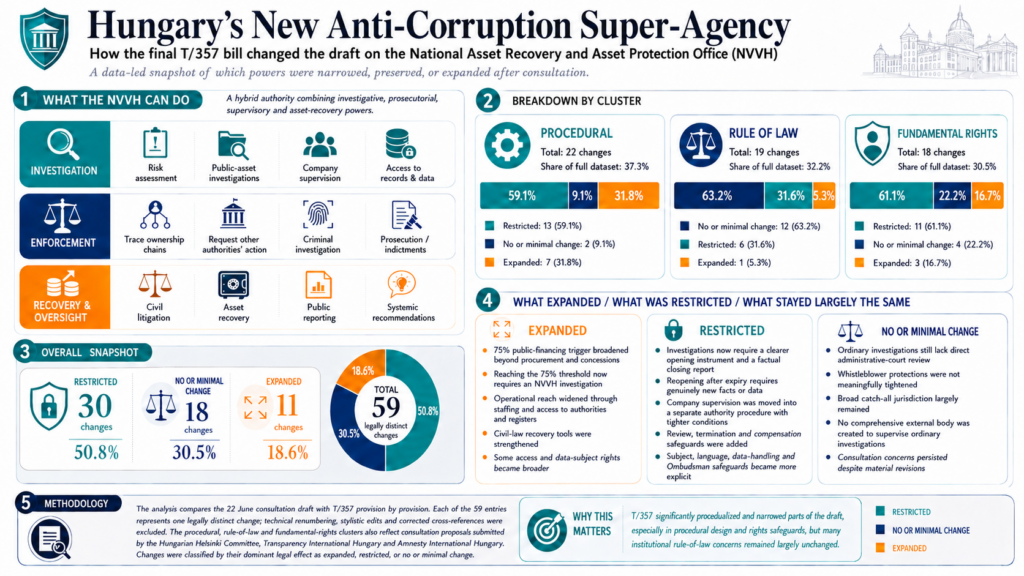
What makes the NVVH both exceptional and controversial is that the trail would not end with an audit report gathering dust or being referred to another institution. Within its jurisdiction, it could conduct or direct criminal investigations, take over eligible cases, bring charges, and represent the prosecution in court. It could also initiate administrative action and pursue civil claims seeking the annulment of damaging contracts or the return of assets. The office would therefore bring under one roof functions traditionally divided among auditors, investigators, prosecutors, and state litigators, giving it an unusually powerful position within Hungary’s post-Communist political system. Courts would still decide guilt, confiscation, and the final consequences of invalid contracts.
Businesses heavily dependent on public money could face mandatory scrutiny. If at least 75 per cent of relevant revenue came during any of the previous five years from public contracts, concessions, grants, or state-funded or state-guaranteed loans, the NVVH would be required to open an inquiry. That threshold would trigger investigation, not establish wrongdoing.
‘The sharpest unresolved weakness concerns ordinary investigations’
Placing a company under supervision—the most substantially moderated part of the submitted proposal after consultation—would require a separate administrative proceeding, indications that criminal or asset-preservation action might be justified, a need for further fact-finding, and a finding that no less intrusive measure would suffice. The supervisor’s powers would have to be specified, reviewed every six months, and could be challenged in court, with compensation available if an unlawful decision caused damage.
The sharpest unresolved weakness concerns ordinary investigations. The final submission sets an effective 18-month limit and introduces proportionality, data security, and reporting duties. Yet these inquiries would not count as administrative-authority proceedings and—except for fines—could not be challenged directly before an administrative court. Cooperation orders would carry no immediate appeal, meaning judicial scrutiny might come only after premises had been searched or sensitive records disclosed. That gap remains the proposal’s most serious rule-of-law vulnerability.
A provision-by-provision comparison conducted by Hungarian Conservative identified 59 legally distinct changes from the original draft, published for public consultation on 22 June. 30 adjustments, or 50.8 per cent, restricted or proceduralized the proposal; 18, or 30.5 per cent, produced no or minimal substantive change; and 11, or 18.6 per cent, expanded reach or powers. Restrictions predominated among procedural and fundamental-rights provisions, while most of the rule-of-law concerns pointed out by several rights-advocacy groups submitting their own proposals to adjust the amendment were left unaddressed. These include broad residual jurisdiction, parliamentary dominance over appointments, and the absence of comprehensive independent supervision.
The government has also altered the scale of the problem it says the office must confront. On 30 June, during consultation, it estimated that HUF 60 trillion had been lost through corruption and unlawful diversion of public assets over two decades. When T/357 was submitted, the official figure was reduced to HUF 30 trillion, described as a conservative estimate. No transaction-level methodology accompanied either number, so neither should be treated as a verified recoverable sum.
‘Orbán’s former governing party claims that the office is, in essence, an “authoritarian instrument of political revenge”’
In their respective proposals, the Hungarian Helsinki Committee and Transparency International Hungary supported stronger asset recovery but sought narrower jurisdiction, direct remedies, clearer supervision, civil-recovery tools, data safeguards, and stronger whistleblower protection. The final submission responded substantially on supervision, civil litigation, reporting, data governance, and Ombudsman oversight, but not on direct judicial review, closed jurisdiction, or comprehensive external supervision.
These are the characteristics that make the NVVH’s legal foundation uncomfortably open to criticism, which Fidesz has already raised several times. Orbán’s former governing party claims that the office is, in essence, an ‘authoritarian instrument of political revenge’. The government, on the other hand, argues that concentrated powers are needed because ‘existing institutions failed against systemic corruption’.
Public Backing, Early Targets and the Test of Independence
Public opinion, however, is more supportive than the partisan dispute suggests. A 23 June Europion poll of 1,800 respondents found that 58 per cent supported establishing the NVVH, including more than 80 per cent of Tisza voters, 47 per cent of Our Homeland (Mi Hazánk) voters, and 26 per cent of Fidesz voters. However, 18 per cent thought the wider institutional changes were proceeding too quickly, while 22 per cent viewed them as part of a Tisza revenge campaign.
If Parliament approves the amendment, most provisions would enter into force the day after promulgation; justice-system amendments would generally follow on the 61st day, with specified provisions due on 26 August 2026, 1 October 2026, and 1 January 2027. Parliament must elect the president and four deputies of the office within 30 days. They would serve single six-year terms; three deputies must be prosecutors, while staff may include seconded police officers, tax investigators, and prosecutors.
Although there is no official ‘target list’ linked to the NVVH, Prime Minister Magyar has already named three likely early ‘priority clients’: Ádám Matolcsy, a businessman and the son of former central-bank governor György Matolcsy; Lőrinc Mészáros, Hungary’s wealthiest businessman and a long-standing ally of Viktor Orbán; and István Tiborcz, Orbán’s son-in-law and the owner of a large property, tourism, and financial group.
‘Prime Minister Magyar has already named three likely early “priority clients”’
Minister Bálint Ruff, responsible for the broader asset-recovery process, has said completed government audits could lead to referrals concerning Antal Rogán, Orbán’s former Cabinet Office minister; former construction and transportation minister János Lázár; and former defence minister Kristóf Szalay-Bobrovniczky.
These statements identify political priorities, not established wrongdoing: any NVVH case would still require transaction-specific evidence and a lawful basis for investigation or recovery. This already highlights the fundamental contradiction and conflict surrounding the super-agency.
Recovering unlawfully diverted public assets is a legitimate and necessary objective, yet an office combining information gathering, investigation, prosecution, coordination, and recovery must be judged by more than the assets claimed. From its first day, the NVVH’s independence, proportionality, case selection, transparency, due process, and treatment of political opponents will determine whether it becomes a durable anti-corruption institution or an instrument of political retaliation.
Related articles:
At a time when public debate is increasingly polarized and superficial, Hungarian Conservative remains committed to depth, intellectual honesty, and independent conservative thought.
Producing high-quality journalism requires resources. Your contribution helps us expand our coverage, reach new audiences, and keep our content accessible.

Please consider supporting our mission.