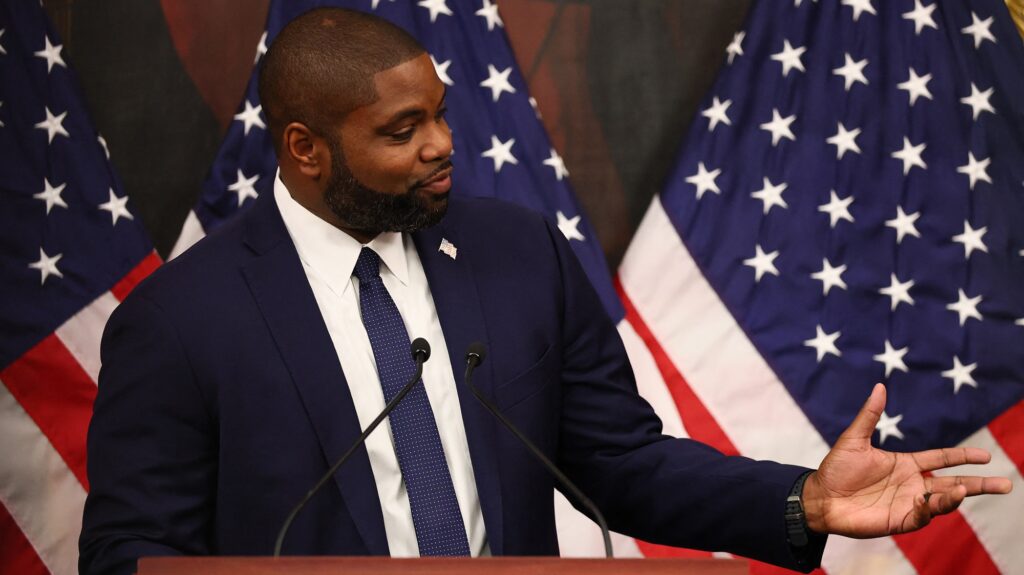
Who gets the endorsement of President Trump in a Republican primary can make or break a campaign—as Congressman Thomas Massie of Kentucky and Senator Bill Cassidy of Louisiana have learnt this month, it also ‘trumps’ the incumbency advantage.
In the case of Senator Cassidy, he even failed to make the run-off after finishing third in the contest.
The Iran war, started by the US–Israeli strikes on the Middle Eastern country on 28 February, certainly has not been popular with the American public. Gas prices are now nearing all-time highs set under President Biden in the summer of 2022. Yet the Trump spell has still worked its charm, even against Representative Massie who was explicitly critical of the Iran operation.
This is not the first time President Trump’s unique grip on the Republican electorate has been showcased for the world to see.
In 2020, as President Trump was gearing up for his re-election battle, the COVID-19 pandemic hit the United States and upended the lives of Americans. The mandated lockdowns pushed the country into a recession and made unemployment surge.
Yet President Trump cleared the Republican primary field with ease, getting 94 per cent of the popular vote and winning all 50 states. Former Massachusetts Governor Bill Weld did put up an opposing primary campaign, and the left-aligned mainstream media such as CNN was happy to give him a platform to make his case, but he was only good for 2.5 per cent of the popular vote.
Then, as the primary contest was winding down, mass riots hit cities across the country following the murder of George Floyd by Minneapolis police officer Derek Chauvin. The wave of riots lasted all throughout the summer—by the time they subsided, a second wave of COVID infections came along with the fall weather.
Yet, among these conditions, and against a historically hostile media, President Trump ended up getting 74.2 million votes, more than any incumbent President in US history. He also gained about 11.2 million votes since 2016, which goes against the idea of his appeal being limited to GOP hardliners in the country.
‘Yet, among these conditions, and against a historically hostile media, President Trump ended up getting 74.2 million votes, more than any incumbent President in US history’
Evidently, Joe Biden ended up winning the election, getting a record 81.3 million votes. However, the election was not called until Saturday on election week; with multiple swing states tilting in favour of the Democrats under dubious circumstances days after voting ended.
President Biden also had to navigate a 50–50 Senate for the first two years of his presidency. One of the 50 Senators on the Democrat side was Joe Manchin from West Virginia, one of the most conservative states in the Union, who thwarted all of Biden’s most ambitious progressive agenda points.
However, after the 6 January 2021 Capitol riots, many in the GOP felt the need to distance the party from President Trump. Seven Republican Senators even voted for his conviction at his second impeachment trial in February 2021—of the seven, only two remain in Congress for the next term. Senator Cassidy was the latest casualty.
Keeping the 45th POTUS at arm’s length worked for his party initially. In the state of Virginia, which President Biden carried by 10 points in 2020, Republican Glenn Youngkin won the governorship the next year. GOP candidate Jack Ciattarelli also got very close in deep blue New Jersey.
Things seemed to get only worse for President Biden and the Democrats the next year. The Russian invasion of Ukraine made energy prices skyrocket across the world, adding to the already massive post-COVID inflation in the country. Inflation topped out at 9 per cent, and the Federal Reserve was forced to raise interest rates, which sent the stock market into a free fall.
In the meantime, the Supreme Court, mainly consisting of justices appointed by Republican presidents, decided to overturn Roe v Wade, doing away with the constitutionally protected abortion right in the US. This gave the Democrats a boost during the summer of 2022.
On the GOP side, the party leadership was iffy on how to handle their relationship with President Trump—who, by the way, remained banned on all major social media platforms at the time.
One of the staunchest advocates in his efforts to overturn the results of the 2020 US presidential election, Doug Mastriano, was completely disavowed and denied any funding by the Republican Governors’ Association after he won the Republican primary for Pennsylvania Governor.
Mastriano ended up losing his race in the swing state of Pennsylvania by 15 points. What’s more, in the same state, GOP candidate Mehmet Oz, who was already a well-known TV personality, lost his bid for an open Senate seat to John Fetterman, an opponent who was recovering from a stroke during the campaign.
Overall, Democrats gained a Senate seat and two governorships. The GOP also got blown out in another swing state, in the gubernatorial race in Michigan. Republicans did win the national generic ballot vote in the House by 2.8 points, and took back a narrow majority in the House as well, but it was undeniably a disappointing time for Republicans.
Whether the underperformance was caused by too much or too little involvement by President Trump in the midterm campaign was unclear at the time. However, what was clear was where the GOP leadership was leaning on that matter: they did not want another Trump nomination for the party.
The more hardline GOP caucus did take the extraordinary move and removed Kevin McCarthy as Speaker of the House in October 2023, replacing him with Mike Johnson of Louisiana. This shows that there were elements within the Republican Party that thought moving the party’s agenda further right was the correct move after 2022.
However, some, even the ‘Freedom Caucus’ were not convinced that President Trump was the man to take on—as it was presumed then—President Biden in the 2024 election.
The growing anti-Trump faction of the GOP placed their bets on Governor Ron DeSantis of Florida. Florida was one of the only bright spots for the Republicans in the 2022 midterms. DeSantis won re-election in a landslide, by a bigger margin than what Democrat Governor Gavin Newsom won by in deep blue California on the same night. Taking Governor DeSantis' appeal from once-swing state Florida to the national stage seemed to be the most logical move.
Most likely, all our readers know how that story ended.
Governor DeSantis dropped out of the race after a poor performance in the Iowa caucus, the first primary contest of 2024, and endorsed President Trump. Trump went on to win the largest share of the popular vote for a non-incumbent candidate in a primary contest for a major party, 76.4 per cent. Former South Carolina Governor Nikki Haily, however, stopped him just short of clearing all 50 states.
Trump became the first US President to seek a non-consecutive term since Theodore Roosevelt in 1912. He is also the first person to secure a major American political party's nomination three times in a row in the legally binding primary era that started in 1972—and he did so despite historic legal challenges, having been indicted in four separate criminal cases for 94 counts combined.
In the general election, he faced off against Vice President Kamala Harris from the Democratic Party. President Trump not only won, but delivered the Republicans their first popular vote victory in a presidential election since George W Bush in 2004 as well.
That is how we got to here and now, where President Trump's grip on the Republican Party seems as strong as ever, even amidst political challenges. But, given his track record of overcoming major challenges in his political career, it is nothing more than what should be expected at this point.
Related articles:
At a time when public debate is increasingly polarized and superficial, Hungarian Conservative remains committed to depth, intellectual honesty, and independent conservative thought.
Producing high-quality journalism requires resources. Your contribution helps us expand our coverage, reach new audiences, and keep our content accessible.

Please consider supporting our mission.