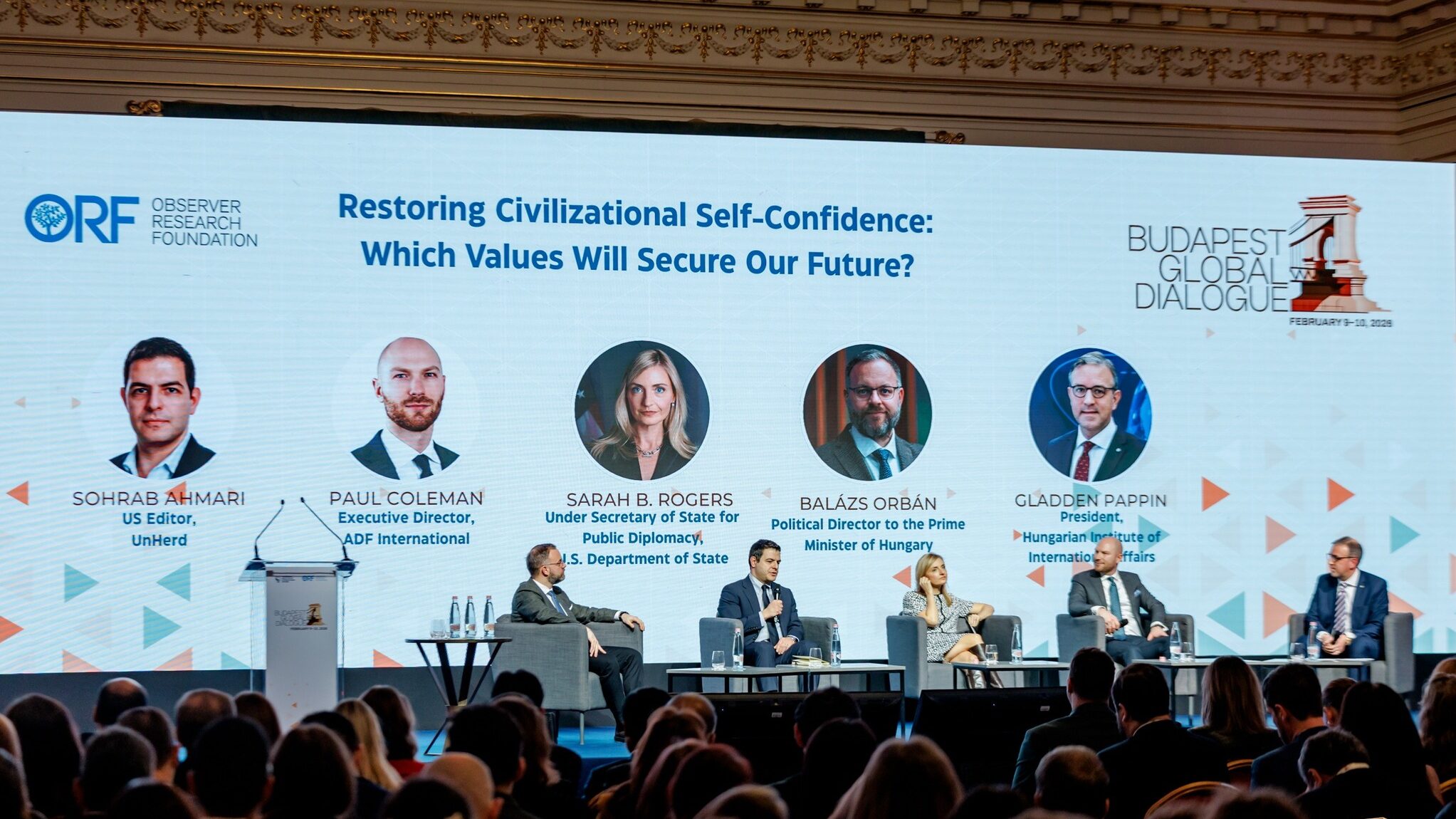
The third Budapest Global Dialogue, organized by the Hungarian Institute of International Affairs (HIIA), has just begun in the Hungarian capital on 9 February with a panel discussion on values, censorship, and the future of the transatlantic alliance, bringing together US Under Secretary of State for Public Diplomacy Sarah B Rogers; Political Director to the Hungarian Prime Minister Balázs Orbán; UnHerd editor Sohrab Ahmari; and ADF International Executive Director Paul Coleman.
Moderated by HIIA President Gladden Pappin, the discussion explored the state of democracy, free speech, and sovereignty in both Europe and the United States. Speaking about a ‘life-and-death struggle’ between elites and ordinary citizens in Europe, Balázs Orbán warned that political, legal, and media pressure is increasingly used to ‘silence those who are fighting to represent’ the will of the people.
He framed the issue not merely as one of free speech but of democracy itself, pointing to ‘unelected transnational European bodies with enormous regulatory power’ acting in concert with unpopular national leaders. From Hungary’s perspective, he added, foreign political financing and ideological pressure represent unacceptable infringements on sovereignty. ‘The future of a country should be decided by its people, not by money—especially not foreign money,’ he stressed.
‘Censorship in Western societies often operates indirectly through regulatory pressure and government-linked NGOs’
Orbán also criticized Brussels for punitive measures against Hungary’s migration, gender, and Ukraine policies, noting that ‘80 per cent of society opposes illegal migration…gender ideology…and further financial support for the war in Ukraine’. Interference against such clear public sentiment, he said, ‘is unacceptable’, arguing that democratic victory at the ballot box remains the only legitimate response.
Sarah B Rogers highlighted the centrality of free expression to democratic self-government, stating that ‘you do not have self-governance without freedom of speech’. She warned that contemporary censorship in Western societies often operates indirectly through regulatory pressure and government-linked NGOs rather than overt state repression.
Referring to the EU’s Digital Services Act, Rogers explained that ‘trusted flaggers’ can report allegedly problematic content through priority channels, creating ‘an opaque system’ capable of narrowing democratic debate. Similar coordination between government actors and intermediaries has also emerged in the United States, she noted, raising concerns about transparency and accountability.
Paul Coleman likewise warned that values detached from their civilizational roots risk becoming tools of power. Citing Ayaan Hirsi Ali, he said Western civilization today resembles ‘a cut flower’—still outwardly vibrant but severed from the foundations that once sustained freedom and equality.
Sohrab Ahmari described himself as ‘an exile… from the old liberal consensus’, arguing that social breakdown, mass migration, and secularization have prompted a democratic return to ‘religion, family, and political community’. He warned that suppressing dissent through censorship or legal manoeuvres could radicalize public backlash rather than stabilize politics.
Looking ahead, Ahmari said Europe faces a decisive fork in the road: either democratic change will surface, or ‘digital censorship will prevail and usher in an age of AI-fuelled…surveillance dystopia’. The coming electoral cycle across the continent, he suggested, will determine which path prevails.
‘Suppressing dissent through censorship or legal manoeuvres could radicalize public backlash rather than stabilize politics’
Speakers also reflected on the future of the Hungarian–American relationship within a broader civilizational framework. Sarah B Rogers argued that restoring ‘civilizational self-confidence’ across the transatlantic alliance depends on allowing genuine democratic self-government to function, noting that American policy positions on migration, sovereignty, and family issues often align more closely with European publics than with certain European elites.
Balázs Orbán similarly portrayed the current US administration as a partner that ‘takes democracy and the will of the people seriously’ and approaches Hungary ‘as friends’, in contrast to earlier periods marked by ideological pressure and political funding.
Closing the discussion, Balázs Orbán declared that ‘the age of the neoliberal world order is over’ and that a new ‘age of nations’ is emerging, in which success depends on sovereignty, strategic realism, and national self-determination. Every country, he argued, must now develop its own path to security and prosperity while balancing great-power relations.
Events such as the Budapest Global Dialogue demonstrate that Hungary and the broader West can still form ‘a shared space’ for civilizational renewal, Orbán concluded, offering cautious optimism amid mounting geopolitical and cultural tensions.
Related articles: