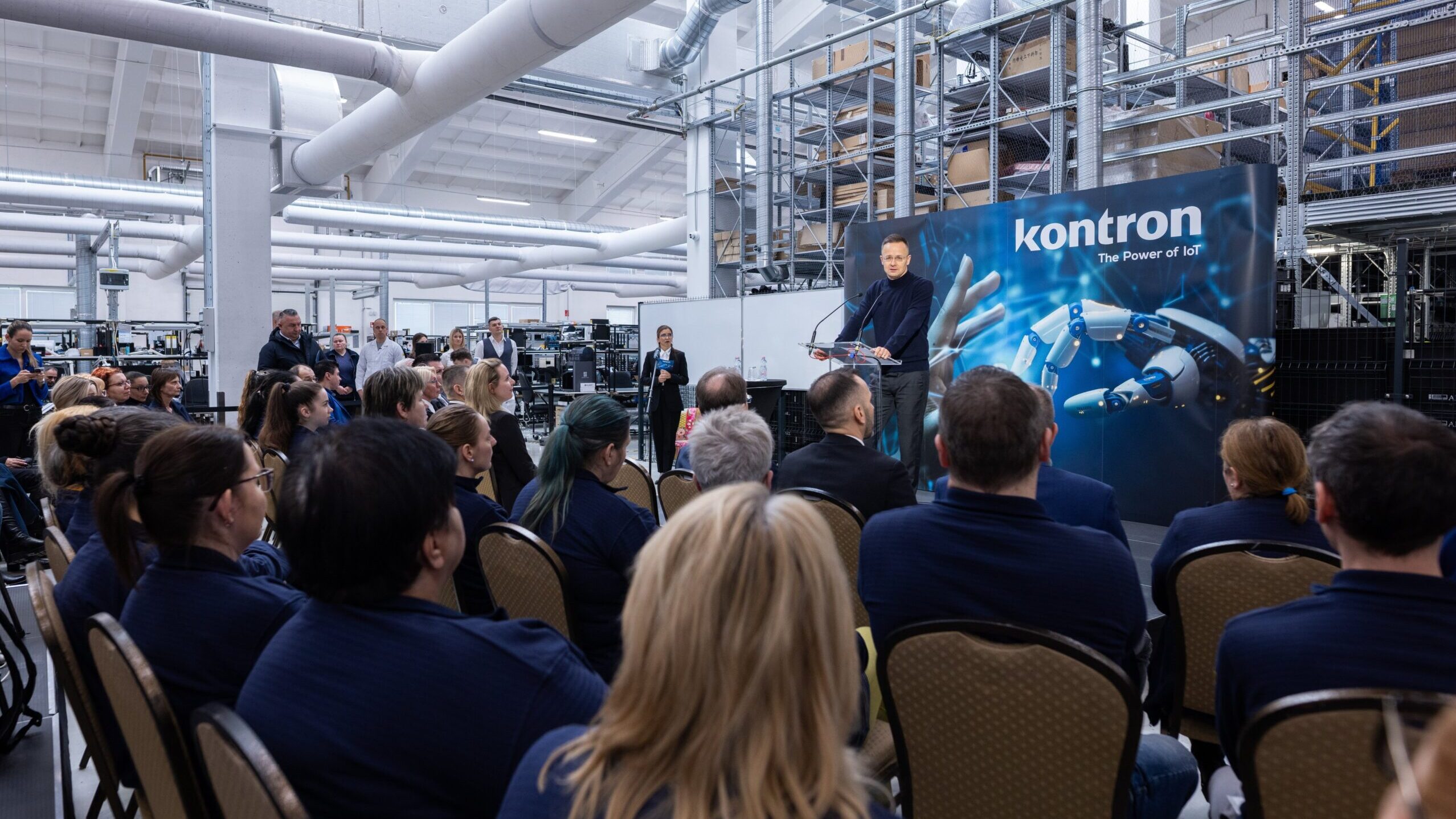
Leading industrial IT company Kontron Electronics will relocate its manufacturing operations from China to Hungary. The move, which is part of a HUF 2 billion investment, was announced by Hungarian Minister for Foreign Affairs and Trade Péter Szijjártó on Tuesday.
According to a statement from the ministry, the government is supporting the project with HUF 400 million, enabling the creation of 30 new jobs while safeguarding a further 300 existing positions. The investment will bring the production of complex electronic components and automated control solutions to Hungary, serving high-tech sectors such as medical technology, aviation, and robotics.
Szijjártó described the decision as a major achievement, emphasizing that manufacturing capacity is being transferred from China to Hungary. He added that the investment will not be limited to production alone, but will establish a full-service value chain domestically.
The minister noted that 99 per cent of the products manufactured in Hungary will be exported, underlining Kontron Electronics’ international competitiveness. The company operates in more than 20 countries worldwide.
Kontron Electronics is part of the Kontron Group, a Germany-headquartered global technology company specializing in embedded computing and industrial IT solutions. The group develops and manufactures hardware and software used in mission-critical applications across sectors such as healthcare, transportation, aerospace, defence, energy, and industrial automation.
‘Szijjártó described the decision as a major achievement, emphasizing that manufacturing capacity is being transferred from China to Hungary’
Reflecting on the crises of the past 15 years, Szijjártó said Hungary has continued to deliver strong economic performance despite persistent challenges. He pointed out that around one million more people are employed today than 11–12 years ago, that Hungary has some of the lowest taxes in Europe, and that the government has maintained reduced household utility prices despite volatile global energy markets.
At the same time, the minister warned that the economic environment remains fragile and that past achievements could easily be put at risk. In times of crisis, he argued, stability, predictability, security, and experience become especially important.
He stressed that Hungary’s recent economic successes would not have been possible without the steady inflow of foreign direct investment, noting that international companies place particular importance on security and predictability when making investment decisions.
Finally, Szijjártó said that despite an adverse global environment, the past four years have been the most successful period in Hungary’s economic history in terms of investments. He added that never before have so many factories been built, production lines installed, or new jobs created in the country within such a short timeframe.
Related articles: