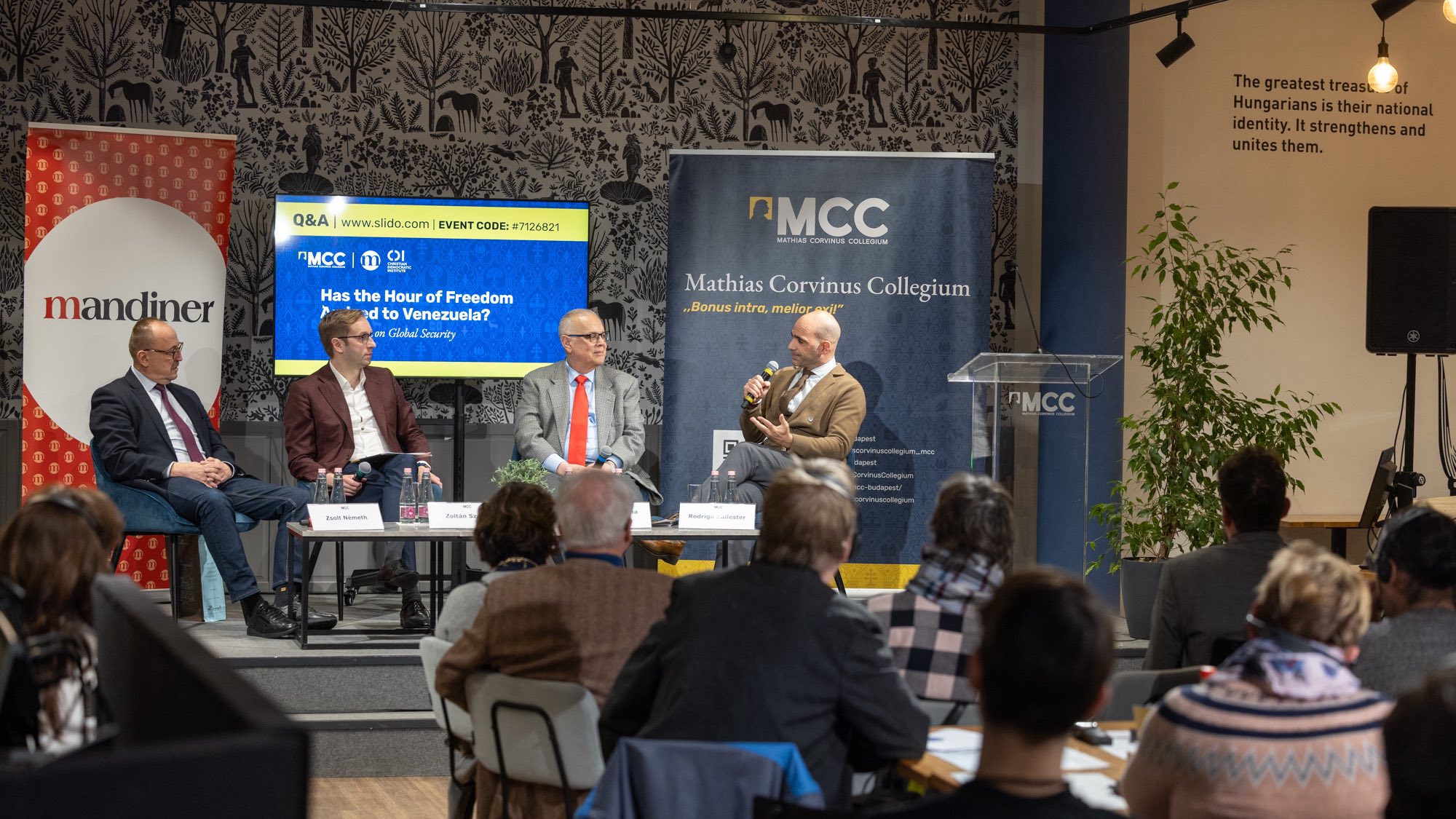
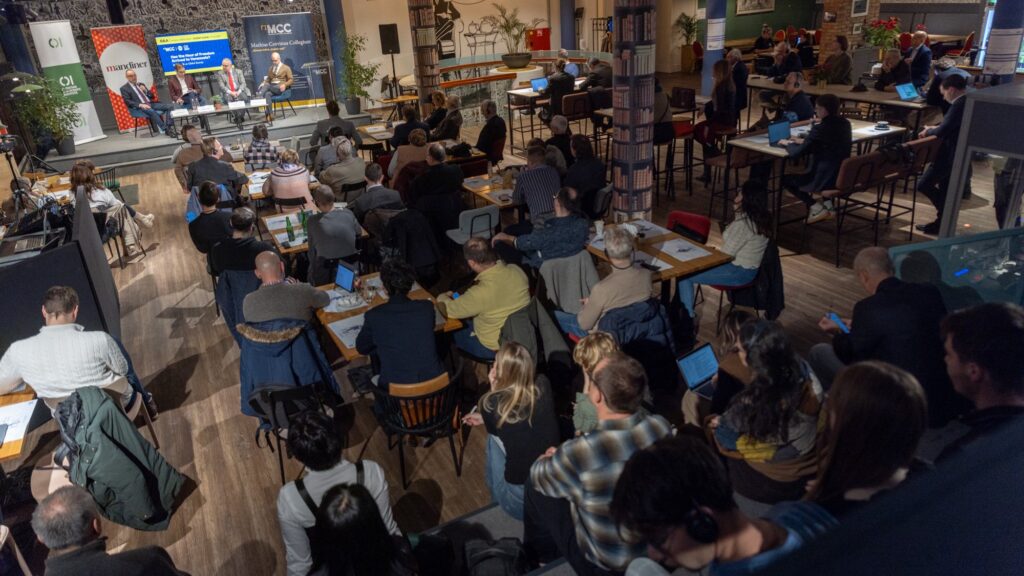
On 3 January, the US military captured Venezuelan President Nicolás Maduro and escorted him to the United States to stand trial on charges including narco-terrorism and drug trafficking. The operation—carried out in open disregard of the foundational principles on which the liberal world order was built—sparked intense global debate over sovereignty, great-power interventionism, and even forms of 21st-century colonialism. Against this backdrop, the Budapest-based Mathias Corvinus Collegium (MCC) and the Christian Democratic Institute (CDI) organized a panel discussion featuring former Venezuelan presidential candidate Alejandro Peña Esclusa to examine the crisis unfolding in Latin America and its broader global implications.
The panel, held on 12 January, included Zsolt Németh, President of the Foreign Affairs Committee of the Hungarian Parliament, MCC Director-General Zoltán Szalai, and was moderated by Rodrigo Ballester, Head of MCC’s Centre for European Studies.
Participants largely agreed that Maduro’s capture should be understood not as an isolated event but as part of a broader transformation of the international system. Zoltán Szalai argued that what is often described as a ‘new world order’ is, in reality, a return to an older logic of great-power politics. International relations, he said, are increasingly shaped by powerful states reorganizing the global system according to interests rather than rules. While the United States remains central, China and India are rising, and Russia continues to exert influence.
Zsolt Németh was even more direct, stating that the liberal world order has effectively ended. In his view, global politics are no longer driven by norms but by interests—a shift that predates the Venezuela operation. The war in Ukraine, he noted, has already undermined key institutions such as the UN Security Council. In this environment, power, personal diplomacy, and the ability to engage multiple global actors matter more than ever. Hungary, Németh argued, recognized this shift earlier than most and adjusted its foreign policy accordingly.
Németh described the capture of Maduro as ‘unbelievable’, both in its execution and in its geopolitical implications. He linked the operation to a renewed US focus on its own hemisphere, suggesting that the Monroe Doctrine is effectively back, making Latin America far more central to Washington’s strategic calculations. While regime change has begun in Venezuela, he cautioned that the process is far from complete, expressing hope for a peaceful and democratic transition. Hungary’s challenge, he added, is to identify opportunities in this rapidly changing global environment.
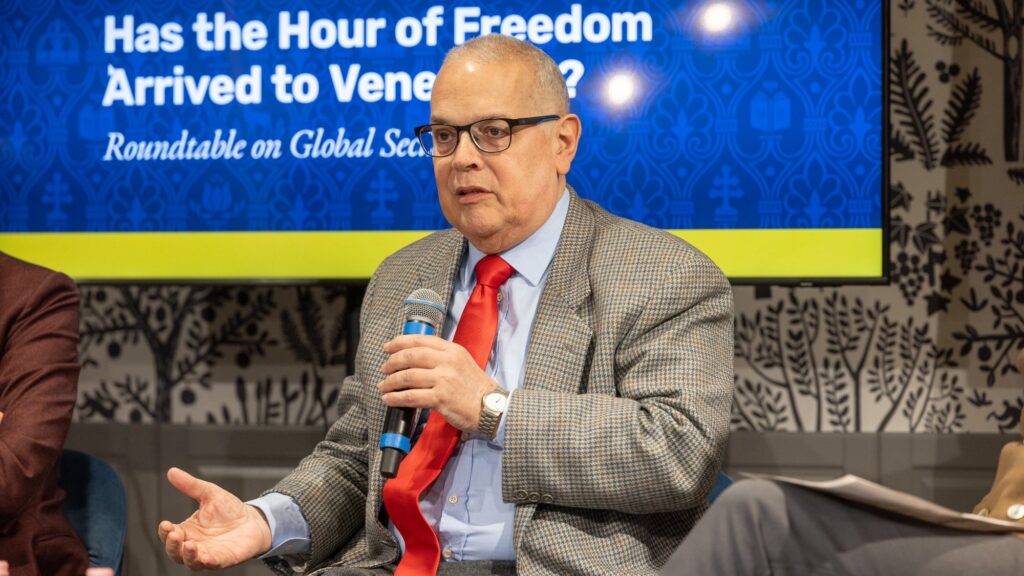
Alejandro Peña Esclusa offered a stark assessment of conditions inside Venezuela. He described the Maduro system as a violent dictatorship sustained by foreign-backed security structures, particularly Cuban operatives. According to Esclusa, Maduro himself was guarded by Cuban personnel, and despite his removal, the regime’s deeper power structures remain intact. While many Venezuelans feel quiet relief at recent developments, he stressed that public celebration remains impossible.
Esclusa praised Donald Trump for authorizing the operation but warned against expectations of an immediate democratic takeover. Venezuela, he said, has long hosted armed networks linked to Cuba, Iran, Russia, and Hezbollah, making a rapid transfer of power to opposition leaders both unrealistic and dangerous. The current phase, he explained, is focused on dismantling these structures. Maduro’s vice president remains in office under intense US pressure, which Esclusa described as a forced capitulation aimed at completing the transition.
According to Esclusa, the immediate priority is restoring basic security and protecting citizens’ rights. Only after this stabilization phase can a genuine democratic transition begin. He added that he hopes to return to Venezuela once that process is complete.
The panel also addressed whether the world was safer under the previous international order. Szalai argued that functioning rules and institutions are preferable—but only when they actually work. In his view, liberal global governance structures have become outdated and incapable of managing the rise of new powers, necessitating a new style of leadership. Hungary’s strategy, therefore, is to maintain strong political and economic ties with all major centres of power, while the European Union remains trapped in moralizing and virtue signalling.
Responding to accusations of ‘21st-century colonization’, Németh argued that there was no other realistic alternative to removing the Venezuelan dictatorship. He said Maduro had been offered a negotiated exit but rejected it. The United States, he said, stands to benefit most from the new order simply because it is the strongest actor, but its interests in Venezuela extend beyond power politics. These include curbing migration, controlling oil markets to prevent Russian and Chinese dominance, and combating drug trafficking and narco-terrorism—objectives he described as fundamental Western interests. The ultimate aim, he added, is democratization, which he argued gives the intervention moral legitimacy. He also suggested that Central Europe’s own experience with democratic transition could offer valuable lessons for Venezuela.
Esclusa strongly rejected claims that Venezuela’s status as a narco-state is exaggerated. He argued that Cuban operatives effectively control key state institutions and that drug trafficking is deeply embedded in the regime. He claimed that roughly 20 per cent of the cocaine consumed in the Western Hemisphere passes through Venezuelan networks, with severe consequences beyond the country’s borders.
Finally, the discussion turned to Europe’s role. Szalai contrasted the decisiveness of great-power governance with the European Union’s slow, consensus-based decision-making, arguing that whether the EU can survive the transition to a new international order—and in what form—remains an open question. Németh warned of a widening rift between the EU and the United States and stressed that Europe urgently needs stronger military capabilities. He also pointed to a broader rightward political shift across Latin America, citing recent developments in countries such as Chile, Argentina, and Ecuador.
Related articles:
At a time when public debate is increasingly polarized and superficial, Hungarian Conservative remains committed to depth, intellectual honesty, and independent conservative thought.
Producing high-quality journalism requires resources. Your contribution helps us expand our coverage, reach new audiences, and keep our content accessible.
Please consider supporting our mission.