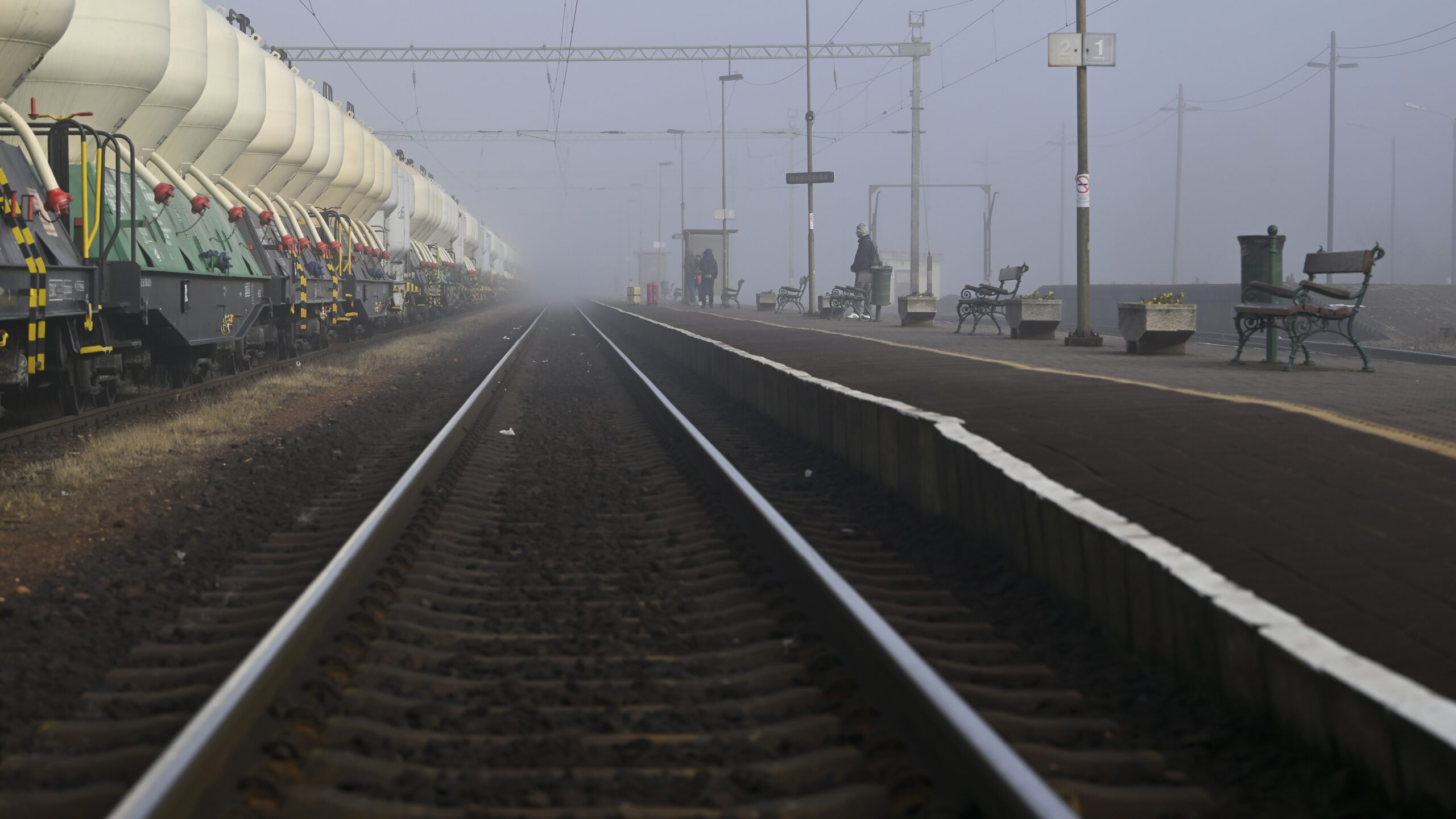
Hungary is preparing to begin the renovation of 1,000 kilometres of railway track, with all necessary financing in place, Minister of Construction and Transport János Lázár said during his hearing before the Economic Committee of Parliament on Tuesday.
He explained that Hungary’s rail network totals 8,000 kilometres, of which 6,000 kilometres are actively used. Since 2010, the country has completed 103 rail projects worth 2,091 billion forints, enabling the renewal of 1,800 kilometres of track. Although 55 per cent of EU transport funds earmarked for Hungary remain suspended, part of this shortfall is being offset by favourable loans from the European Investment Bank, and Lázár said the withheld EU funds are also expected to arrive.
The minister highlighted key improvements in public transport, noting that rail punctuality has increased to around 80 per cent, minimum service standards have been set by law, and annual ridership in public transport has risen from 600 million to 1.2 billion since 2022. With this growth alone, the MÁV Group has met Hungary’s entire national emissions-reduction obligation, he said, while offering one of the EU’s five cheapest transport services. After decades of decline, Lázár believes Hungary’s railways are now on a path of development, with visible results expected in the coming years.
Lázár also outlined the scale of road infrastructure efforts. The state manages 31,000 kilometres of domestic roads, and the 305 ongoing road projects represent an investment of 1,327 billion forints. Since 2010, nearly 5,000 billion forints have been spent on road development. Among the major projects underway or planned, he named the continuation of the M44 toward Nagyszalonta, the construction of the M49 connecting Hungary to Satu Mare, the road link to Budapest Airport, and the new Danube bridge at Mohács.
‘Hungary’s railways are now on a path of development, with visible results expected in the coming years’
Only three major Hungarian cities still lack motorway access, compared with 22 in 2010. Today, 11 motorways reach the country’s borders, creating significant economic benefits, as most of the roughly 880 billion forints in annual motorway revenue is paid by international freight operators. Strengthening cross-border links brings Hungary strategic advantages and boosts regional economic output, the minister said, adding that ongoing road maintenance will continue to require substantial funding.
He noted that the Ministry of Construction and Transport employs 1,930 people, while the 27 state-owned companies under its supervision employ 61,000, including 49,000 in transport. In 2025 the ministry will manage a budget of 1,700 billion forints, and the companies under its authority will operate with 2,000 billion. The ministry is currently responsible for 566 projects worth 3,056 billion forints. Of the nearly 5,500 billion forints’ worth of previously suspended projects, those now restarted total nearly 3,300 billion. Investment plans already ordered amount to 553 billion forints.
According to Lázár, major transport investments span multiple government cycles, with rail projects taking around eight years to complete and motorways around six. The ministry aims to provide new economic opportunities for domestic firms and to improve both the quality of Hungary’s infrastructure and the standard of public services.
Responding to questions, Lázár described the political dispute over Budapest’s finances as regrettable, saying all residents would benefit from cooperation. He added that the government will pay all contractually owed funds. However, he expressed concern that EU funds may no longer be available for rail and road development in the next budget cycle unless such projects are reclassified as military investments, which would make them eligible for off-budget financing under EU rules.
‘Lázár described the political dispute over Budapest’s finances as regrettable, saying all residents would benefit from cooperation’
He also warned that MÁV will be unable to finance the complete renovation of major railway stations from its own budget in the foreseeable future, though he noted that this is unnecessary, as in other European countries the non-rail sections of major stations typically operate as shopping centres run with private partners.
At a press briefing after the hearing, Lázár commented on his recent talks in Moscow, reiterating that Hungary cannot give up Russian gas in the near future, as it provides a 25–30 per cent price advantage, with Hungarian households paying only a third or a quarter of the energy costs of neighbouring countries.
He concluded that the 2026 election will be decisive: ‘Either things return to how they were before 2010, or they remain as they have been since.’ Based on the Tisza Party’s programme, he argued that a future opposition government would gradually dismantle family support schemes and low tax rates.
Related articles:
At a time when public debate is increasingly polarized and superficial, Hungarian Conservative remains committed to depth, intellectual honesty, and independent conservative thought.
Producing high-quality journalism requires resources. Your contribution helps us expand our coverage, reach new audiences, and keep our content accessible.

Please consider supporting our mission.