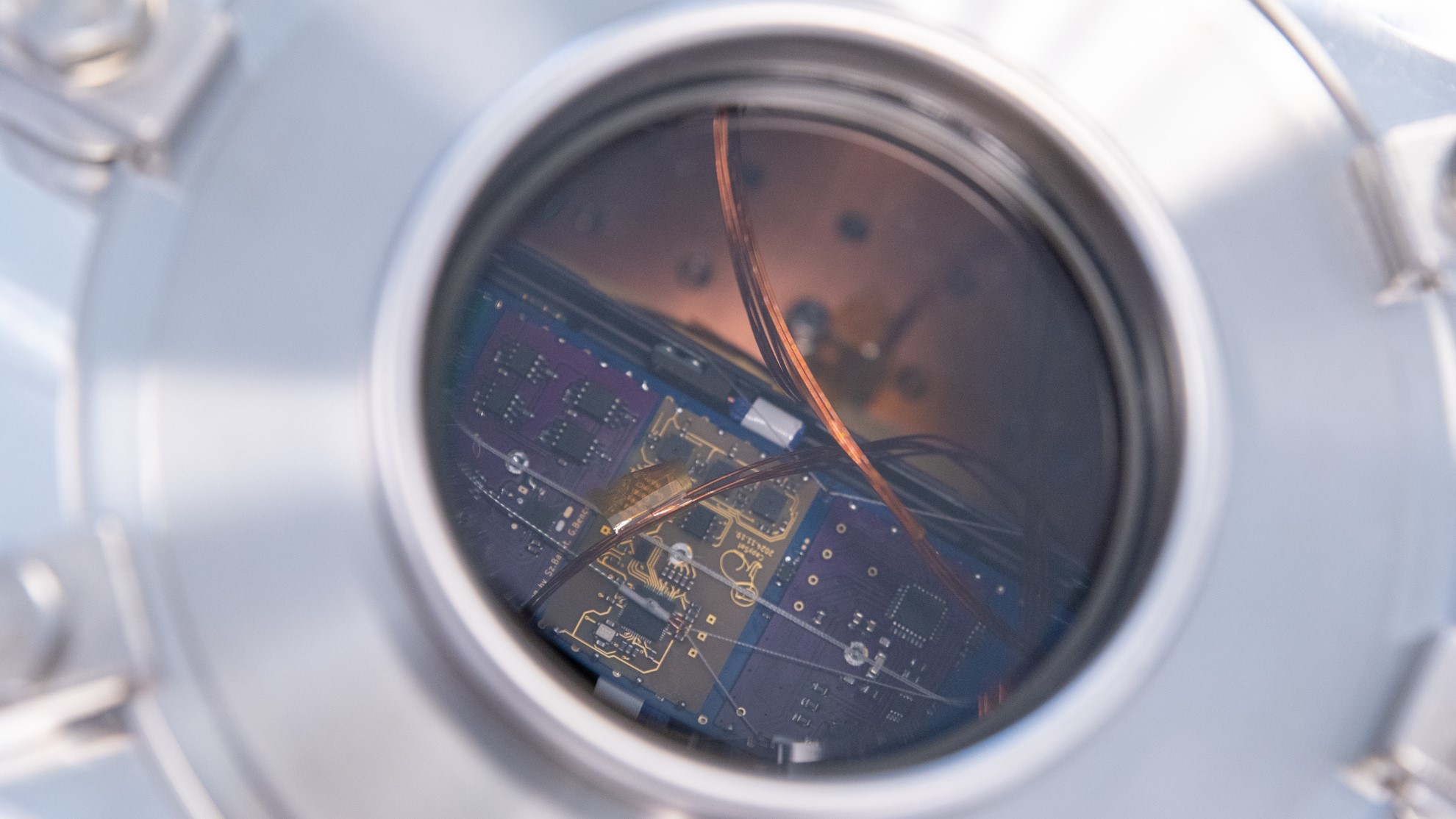
The Hunity small satellite, the sixth student-built spacecraft of the Budapest University of Technology and Economics (BME), has successfully entered orbit, the university announced on Sunday. The satellite carries a range of scientific instruments and experiments designed by university researchers and high school teams.
Hunity was launched on Friday evening aboard SpaceX’s Falcon 9 as part of the Transporter-15 mission from the Vandenberg Space Force Base in California. Built in cooperation between BME’s Microwave Remote Sensing Laboratory, the University Radio Club and the National Media and Infocommunications Authority, the satellite was deployed alongside about 100 other payloads. The development team received the spacecraft’s first signals on Saturday at the ground station.
Measuring 5×5×15 centimetres and weighing 868 grams, Hunity introduces two key innovations: deployable solar wings that provide increased power, and a fold-out panel carrying experiments created by high school students. The satellite’s payload includes several scientific sensors, a high-resolution onboard camera and magnetic and motor-based attitude control systems.
A variety of solar cells will also undergo in-orbit testing. Strengthening inter-university cooperation, four experimental panels developed at Széchenyi István University in Győr are onboard. In addition, six panels created by teams of secondary-school students—formed from last year’s Cansat Hungary finalists—were mounted on the deployable side unit.
Hunity communicates on amateur radio frequencies, with its primary ground station located on the roof of BME’s Building E and a secondary station in Érd. With this successful launch, BME’s development team now holds the world record for the most completed PocketQube satellite missions.
Related articles:
At a time when public debate is increasingly polarized and superficial, Hungarian Conservative remains committed to depth, intellectual honesty, and independent conservative thought.
Producing high-quality journalism requires resources. Your contribution helps us expand our coverage, reach new audiences, and keep our content accessible.

Please consider supporting our mission.