POLITICO Brussels, a mouthpiece of the Brussels mainstream, published an in-depth analysis of the upcoming Hungarian election, labelling it ‘the most important’ and consequential election taking place in the European Union in 2026.
The article itself does not bring much new to the table; however, it does contain some revealing insights into how Brussels views the vote and what it believes is at stake. At the outset, the authors repeat the left’s familiar allegations: Orbán’s tight grip on the media and state companies, the weakening of judicial independence, and authoritarianism.
POLITICO Brussels presents Orbán’s opponent, Péter Magyar, as a ‘former ally’ of the Hungarian prime minister. To put this into proper context, Magyar was nowhere near a ‘former ally’ of Orbán. He was indeed an insider within Fidesz circles; however, he was primarily known as the ex-husband of former Justice Minister Judit Varga. He did lead some smaller state companies—one of which he bankrupted—but he was nowhere close to having a confidential relationship with Orbán, certainly not one that would justify calling him an ‘ally’. Magyar is an opportunist without a clear ideological background, and will hopefully go down in history as such.
EU Elites Pray for Péter Magyar to Win
That, however, is not how the Brussels establishment sees it, as the article makes clear. ‘The Brussels establishment is praying for Magyar to win,’ the authors write, citing liberal-progressive Renew leader Valérie Hayer, who said her party supports ‘any candidate…who will be able to beat’ Orbán. The article continues by stating that European People’s Party (EPP) leader Manfred Weber ‘quickly welcomed’ Tisza into their political family ‘to secure influence over Budapest’ and to ‘give them resources’ to defeat the Hungarian prime minister and his party.
Brussels’ attempts to influence the election’s outcome are already a highly debated topic in Hungarian political discourse. As the divide between Orbán’s government and the European Union’s leadership has deepened over the past decade, Brussels has increasingly used its power to undermine the Hungarian government. The European Commission froze EU funding due to the country in 2022, with billions of euros lost in the period that followed.
‘Manfred Weber “quickly welcomed” Tisza into their political family “to secure influence over Budapest”’
The Article 7 procedure—which could result in Hungary losing its vote in EU decision-making—remains ongoing on biased grounds, and the country has faced a daily penalty of €1 million since 2024 for not complying with EU migration policies—meaning strict border control and zero tolerance towards illegal migrants.
The contradiction here is crystal clear: while the EU establishment supports Magyar and Tisza politically and with resources, it withholds funding that the Hungarian economy needs and rightfully deserves. Not exactly a level playing field, is it?
Imbalanced System — But for Who?
Yet it is POLITICO Brussels that cries about the ‘unfair’ electoral system in Hungary, allegedly designed to ‘favour Fidesz’. ‘One side enjoys access to the full resources of the state, while the challenger receives no public campaign funding and has virtually no presence in state-controlled media,’ the article quotes political scientist Rudolf Metz.
Hungary’s electoral system is a mixed one, with 106 MPs elected in individual constituencies and 93 from national party lists. Fractional votes from the constituencies are added to each party’s list via the D’Hondt method. While it does favour the largest party, gerrymandering is an established practice in Western democracies such as the United States as well. It is not an authoritarian characteristic.
Like Metz, Orbán’s opponents often complain about the imbalance of the media landscape in Hungary. Just to set the record straight: among the top five online news outlets in the country, there are three opposition sites, one neutral outlet, and none that are pro-government. Telex, the most popular online news outlet in the country, is essentially the mouthpiece of Tisza and Péter Magyar. The opposition leader makes sure that the outlet republishes his social media content by literally commenting on every single one of its articles, mobilizing his online fanbase to harass journalists and effectively gaslighting the outlet into covering the topics he favours. I know this sounds insane, but here is some recent proof:

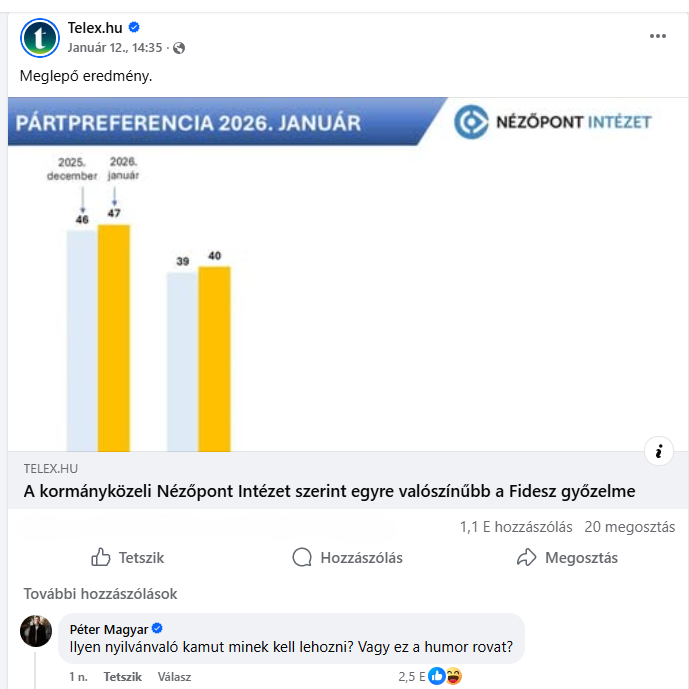
And that is just the tip of the iceberg; there are countless similar comments, and their number is rising day by day.
At this point, it must also be mentioned that Orbán has governed for a decade amid extremely strong international media headwinds. Mainstream outlets like Bloomberg, Financial Times, CNN, and POLITICO Brussels itself have repeatedly engaged in smear campaigns against the Hungarian prime minister and his government. POLITICO Brussels even manipulated its Poll of Polls recently to show Tisza ahead, despite several pollsters in Hungary clearly reporting a Fidesz lead. It still shows Péter Magyar’s party on 49 per cent, while Fidesz trails on 37 per cent. Meanwhile, a recently published survey by Nézőpont Institute puts Fidesz first on 49 per cent, with Tisza trailing on 41 per cent. So much for authenticity, I guess.
The Brussels Resistance
Recently published leaked documents suggest that Brussels has been trying to influence Hungarian politics long before Péter Magyar entered the scene, effectively working for years to build up Orbán’s opposition. As early as 2019, a top Hungarian official in the EU Commission—Márton Benedek—allegedly put together a secret plan to get rid of Prime Minister Viktor Orbán. Back then, Benedek worked as the EU’s International Coordinator in the Directorate-General for Migration and Home Affairs. Now, he’s in charge of Brussels’ cooperation with Libya.
According to Zerohedge, which says it reviewed the documents through The Grayzone, Benedek wrote a proposal in January 2019. The goal? Set up a permanent forum to organize resistance against Orbán, unite the opposition, and turn scattered protests into a real, lasting political movement that could actually take on the government. Benedek claimed that, even in the early days, about 30 leaders from politics, trade unions, and civic groups started meeting to coordinate, set shared goals, work out funding, and plan next steps together. Out of that, he said, came an “ad hoc coordination forum” that could grow into a real political body—something that could seriously challenge ‘Orbán’s grip on power.’
The files make it clear: this wasn’t just about organizing street protests. The project aimed to build a full-on political structure—a parallel force, basically. Benedek’s own words hint at a much bigger picture: he wrote that, over time, the non-profit they set up could lay the groundwork for a united political front against Orbán, maybe even with its own ‘shadow cabinet.’ So, this wasn’t just a loose group of activists. It was a playbook for a shadow government.
‘The project aimed to build a full-on political structure’
Money was a big part of the plan. The proposal stressed the need for solid funding, pointing out that even a single large protest in Budapest could cost around $11,000—not exactly pocket change for a so-called grassroots movement. Benedek suggested creating a non-profit in Hungary for day-to-day operations, plus a financial arm in Austria, all overseen by a board with people from political parties, unions, and NGOs.
This organization would handle everything—mobilizing supporters, running information campaigns, political coordination, and fundraising. Some of the NGOs involved have been accused of taking money from George Soros’ Open Society Foundations. That group moved its Hungarian office to Berlin back in 2018, after the Orbán government cracked down on foreign-funded NGOs. The latest numbers show Soros’ network sent $8.9 million to Hungary in 2021 alone. The source who leaked the files said the proposal was submitted to OSF, though there’s no proof it was ever received or approved.
The allegations have sparked a strong response from the Hungarian government. Hungarian Minister for Foreign Affairs and Trade Péter Szijjártó reacted in a recent post on X, writing: ‘Well, yes, that’s how it works! Brussels needs governments that say yes to it: yes to war, migration and gender.’ He argued that Brussels has been trying to push Hungary out ‘for many years,’ claiming it interferes in every election and warning that future interference could be even more aggressive. ‘They want to drag us into war and they want to bring migrants here,’ he wrote, adding that ‘only a puppet government in Brussels will say yes to all of this.’
Related articles: