This article was originally published in Vol. 6 No. 1 of our print edition.
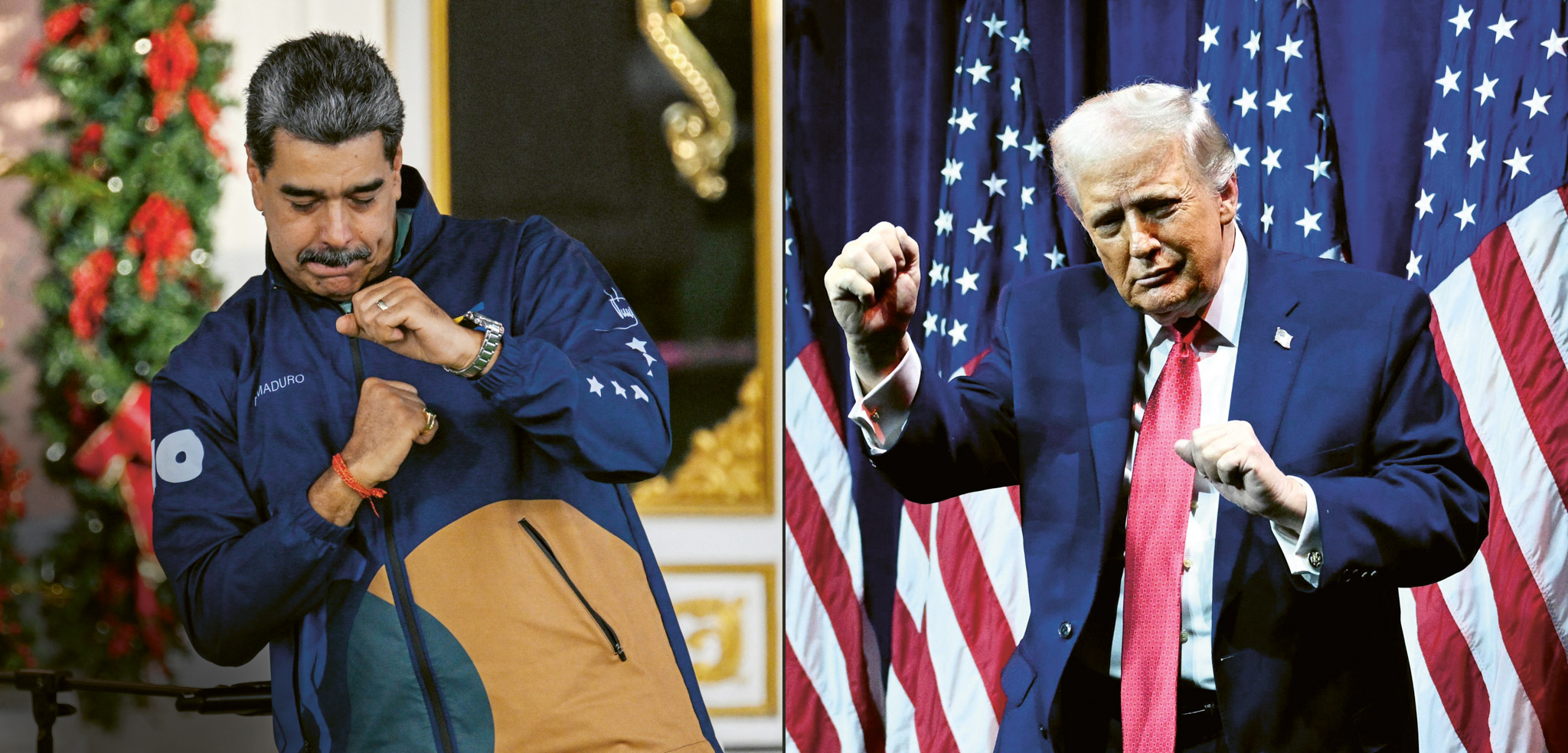
In the early hours of 3 January, US Armed Forces deployed in the Caribbean implemented Operation Absolute Resolve to capture Venezuelan dictator Nicolás Maduro and bring him to justice in New York.1 During a press conference at his Mar-a-Lago resort in Florida, US President Donald Trump hailed the operation as one of the most ‘stunning, effective, and powerful displays of American military might and competence in American history’.2 According to a survey published by the company Meganálisis, more than 92 per cent of Venezuelans approved of the action and also expressed their gratitude to President Donald Trump for having freed them from the cruellest tyrant the nation had ever had.3
However, at the same time, an international mobilization was launched, both in the streets and in public opinion, to condemn Trump, arguing that the capture of the Venezuelan dictator had violated international law and even Maduro’s own rights, since, as an allegedly sitting president, he enjoyed immunity—precisely the same arguments used by his defence before the judge in the case. The question arises: Was international law violated with Maduro’s capture? Did Trump do the right thing?
Background to the US Military Deployment
The crisis that erupted in Venezuela in 2025 with the US military deployment in the Caribbean began more than thirty years earlier, in May 1995, when Lieutenant Colonel Hugo Chávez, recently released from prison after attempting two coups, travelled to Montevideo, Uruguay, to register with the São Paulo Forum (SPF),4 which was holding its fifth meeting.
The São Paulo Forum was created in 1990 by Fidel Castro and the current president of Brazil, Lula da Silva, to bring together Latin American socialist parties after the fall of the Berlin Wall. Chávez, who at the time had no political future, made a deal whereby he would receive money, advice, and access to the media from the regional left, and in return promised to repay them with abundant funding if he became president of Venezuela. This pact meant Venezuela’s subordination to Cuba and the São Paulo Forum itself.
Chávez won the 1998 elections thanks to the support of the SPF and immediately took steps to concentrate all power in his hands. Among other measures, he drafted a new socialist-style constitution, which gave him control of all institutions; he fired 18,000 executives and workers from the oil industry (PDVSA) in order to replace them with his own people and manage the money from oil sales as he saw fit, sending 53,000 barrels of oil per day to Cuba in exchange for social control ‘services’ (intelligence, surveillance, and repression), dismantling the private sector of the economy, and closing or buying up media outlets, etc.
Chávez launched a fierce campaign of persecution against his opponents and handed over state security to Castro. He also signed agreements with Russia, China, and Iran which, although contrary to national interests, provided him with international support enabling him to remain in power indefinitely. Subsequently, Chávez began sending shipments of crude oil to Russia and China to pay off large loans that ended up in the pockets of the Chávez nomenklatura. At the same time, Chávez authorized the Colombian FARC—a terrorist and drug trafficking organization—to operate in Venezuelan territory under the protection of the armed forces, which ultimately gave rise to the so-called ‘Cartel of the Suns’, a term used to describe drug trafficking cells embedded within the Venezuelan military.5 Excessive corruption, waste of oil wealth, the elimination of freedoms, and socialist programmes imposed first by Chávez and then by Maduro generated an unprecedented humanitarian crisis, causing 7.9 million citizens, almost a third of the population, to flee Venezuela.
When President Donald Trump returned to the White House for a second time in January 2025, he was faced with a Venezuela that was sending tons of cocaine to his country, serving as a platform for the operations of hostile extra-continental powers, using oil to favour the United States’ adversaries, and causing massive illegal migration, much of it to North America. Venezuela was formally declared a threat to US security due to these four factors, all of which are considered threats in Trump’s new national security strategy. This triggered the events that led to Maduro’s capture. This doctrine clearly states the following:
‘We want to ensure that the Western Hemisphere remains reasonably stable and well-governed enough to prevent and discourage mass migration to the United States; we want a Hemisphere whose governments cooperate with us against narco-terrorists, cartels, and other transnational criminal organizations; we want a Hemisphere that remains free of hostile foreign incursion or ownership of key assets, and that supports critical supply chains; and we want to ensure our continued access to key strategic locations. In other words, we will assert and enforce a “Trump Corollary” to the Monroe Doctrine.’6
‘The United States’ interest in defending its own national security coincided with the Venezuelan people’s desire to rid themselves of a tyrant who was oppressing them’
As US Secretary of State Marco Rubio has pointed out, Donald Trump’s administration has decided to place greater importance on the Western Hemisphere. ‘I would say that if you are focused in America, and America First, you start with your own hemisphere, where we live’,7 said Rubio in an interview with Fox News. That is why Trump seeks to counter China’s growing influence in Latin America and particularly in Venezuela, China’s main ally in the region. The figures are impressive:
‘In 2000, the Chinese market accounted for less than 2 percent of Latin America’s exports, but China’s rapid growth and resulting demand drove the region’s subsequent commodities boom. Over the next eight years, trade grew at an average annual rate of 31 percent. By 2021, trade exceeded a record $450 billion, according to the Chinese government, and some economists predict that it could exceed $700 billion by 2035. China currently ranks as South America’s top trading partner and the second largest for Latin America as a whole, after the United States.’8
Venezuela and Multilateral Organizations
The opposition to Maduro did everything possible to seek a change of government through peaceful means, engaging in dialogue, negotiating with the mediation of other countries, protesting peacefully, initiating international legal actions, and contesting numerous elections, in which the Venezuelan regime perpetrated fraud while committing crimes against humanity.
It is fair to acknowledge that multilateral organizations diligently documented the abuses of the Venezuelan regime. No fewer than 31 reports were produced by the Organization of American States,9 the Inter-American Commission on Human Rights, and various UN agencies, including OHCHR, UNHCR, and UNICEF. The UN even appointed an International Fact-Finding Mission on Venezuela,10 which produced important documents detailing human rights violations by the Maduro regime. It is also fair to recall that the European Union imposed sanctions against the Venezuelan regime, though these were circumvented through international triangulations. But the Venezuelan people could be forgiven for wondering what good reports and sanctions are if they do not lead to Maduro’s departure.
The European Parliament, for its part, has issued important resolutions on Venezuela, and in 2024 awarded the Sakharov Prize to Venezuela’s president-elect, Edmundo González, and opposition leader María Corina Machado. At the same time, however, most European countries maintained diplomatic relations with the Venezuelan regime and, in some cases, notably including Spain, engaged in scandalously shady deals.
The most worrying case has been that of the International Criminal Court (ICC), which has been investigating crimes against humanity committed by Maduro and his allies for more than ten years, after receiving formal accusations from the secretary general of the OAS and countries such as Argentina, Canada, Colombia, Chile, Paraguay, and Peru, in addition to receiving, of course, files on numerous Venezuelan victims. The ICC Prosecutor’s Office formally opened an investigation in November 2021, but has not issued arrest warrants, despite at least three fully documented massacres occurring in 2014, 2017, and 2024. Venezuelans were astonished and disgusted when it emerged in 2024 that ICC Prosecutor Karim Khan was the brother-in-law of Maduro’s lawyer before the court, Venkateswari Alagendra, and as a consequence was removed from the case. For years, Kahn remained silent about this conflict of interest while the Venezuelan people suffered the abuses of the dictatorship.11
In other words, the mechanisms for defending democracies and international law were unable to stop the horrific crimes committed by the Venezuelan regime. This failure explains why, when Donald Trump ordered Maduro’s capture, Venezuelans expressed their support and gratitude. In the case of Venezuela, the United States’ interest in defending its own national security coincided with the Venezuelan people’s desire to rid themselves of the tyrant who was oppressing them.
Was There a Violation of International Law?
When Maduro appeared before the court in the Southern District of New York, he claimed that he was a head of state, and thereby sought to have the case against him dismissed on the grounds of presidential immunity. At the same time, an international propaganda machine was activated, arguing the same thing and adding that ‘international law had been violated’.
Among those who made such statements were the leftist presidents of Brazil, Chile, Colombia, Cuba, Honduras, Nicaragua, and Uruguay, all of whom belong to the São Paulo Forum, as well as the foreign ministers of Russia, China, and Iran—all countries that recognize Maduro as president despite his rigging of previous elections. But the truth is that Maduro is not a legitimate president, merely a usurper.
It should be noted that the UN did not use more forceful measures to halt Maduro’s crimes, even though its own documents require it to do so, including the principle of the ‘Responsibility to Protect’, which puts the welfare of citizens before sovereignty:
‘Sovereignty is not just protection from outside interference—rather is a matter of states having positive responsibilities for their population’s welfare, and to assist each other. Consequently, the primary responsibility for the protection of its people rested first and foremost with the State itself. However, a ‘residual responsibility’ also lied with the broader community of states, which was ‘activated when a particular state is clearly either unwilling or unable to fulfil its responsibility to protect or is itself the actual perpetrator of crimes or atrocities.’12
Repercussions of Maduro’s Capture
The military action to capture Maduro had enormous repercussions within the Venezuelan regime, because in just two hours, all the supposed defences that Chavismo boasted of having were neutralized. This explains why Vice President Delcy Rodríguez and her allies—defeated and frightened—decided to collaborate with the US government to carry out an orderly transition to democracy and the transfer of power—essentially a process of capitulation.
This transition will be a complex process, given that Chavismo is made up of various mafias, sometimes at odds with each other, which until now had been coordinated by Maduro. It remains to be seen whether Delcy Rodríguez will be able to convince the other factions to capitulate to the US government and call for free and transparent elections. In any case, Trump has said that, if necessary, he will order a new incursion to finish subduing the Cartel of the Suns.
‘Venezuela was formally declared a threat to US security due to these four factors, all of which are considered threats in Trump’s new national security strategy’
The US military incursion has also had an impact on the rest of Latin America, especially in Colombia, considering that on 19 October 2025, Donald Trump accused Colombian President Gustavo Petro of being an ‘illegal drug dealer’ who promotes drug cultivation in his country, adding that if he does not destroy the drug crops, ‘the United States will close them up for him, and it won’t be done nicely’.13 Now Petro knows that Trump means business.
Maduro’s capture will also severely affect Cuba, which is already undergoing a serious economic crisis like the one it suffered after the collapse of the Soviet Union, known as the Special Period.14 Hugo Chávez’s support may have saved the Cuban regime in the 1990s, but there are no longer any countries willing to come to its rescue, especially during Trump’s presidency. Without Venezuelan oil, the Cuban economy will suffer a suffocation that will likely lead to the fall of the regime.
On the other hand, it is very likely that in the coming weeks evidence will come to light about the dirty deals that various Latin American leftist leaders have made with the Venezuelan regime, which will affect their electoral aspirations or could even see them face trial. In recent elections in the region—Ecuador, Bolivia, Argentina, Chile, and Honduras—the left has been defeated, and it is very likely that this trend will continue in 2026 elections due to be held in Costa Rica, Peru, Colombia, and Brazil—especially after the information that will be revealed during Maduro’s trial. As a result, by the end of the year, Latin America could be almost uniformly right-wing, with the exceptions of Mexico and Uruguay, where socialist governments still have a few years left in power.
As a result of this shift, it is very likely that alliances between Latin American countries and the United States will be strengthened, both to jointly combat organized crime and drug trafficking, and to increase US investment in the region. This would fulfil the aspirations of the Trump Corollary to the Monroe Doctrine, as expressed in the National Security Strategy memorandum.
NOTES
1 Aaron Mehta, ‘150 Aircraft, Cyber Effects and “Overwhelming Force:” How the Venezuela Operation Unfolded’, Breaking Defense (3 January 2026), https://breakingdefense.com/2026/01/venezuela-150-aircraft-cyber-effects-maduro-operation-how-it-happened-caine/.
2 Aamer Madhani, ‘Trump Holds News Conference after Announcing US Has Captured Venezuelan Leader Maduro,’ PBS News (3 January 2026), www.pbs.org/newshour/nation/watch-live-trump-holds-news-conference-after-announcing-u-s-has- captured-venezuelan-leader-maduro.
3 ‘Survey: 92% of Venezuelans Express Gratitude to Trump after Maduro’s Ouster’, CBS News (15 January 2026), www.cbsnews.com/miami/video/survey-92-of-venezuelans-express-gratitude-to-trump-after-maduros-ouster/.
4 Alejandro Peña Esclusa, The Sao Paulo Forum’s Cultural Warfare (Verdad Colombia, 2022).
5 ‘Cartel of the Suns’, InsightCrime(16 January 2026), https://insightcrime.org/venezuela-organized-crime-news/cartel-de-los-soles-profile/.
6 The White House, National Security Strategy of the United States of America (November 2025), www.whitehouse.gov/wp-content/uploads/2025/12/2025-National-Security-Strategy.pdf; ‘Monroe Doctrine (1823)’, National Archives, https://www.archives.gov/milestone-documents/monroe-doctrine, accessed 19 January 2026.
7 ‘Sean Hannity Interview with Marco Rubio’, Fox News (3 December 2025), www.youtube.com/watch?v=jSMeMc9cE0g.
8 Diana Roy, ‘China’s Growing Influence in Latin America’, Latinvex (15 January 2025), https://latinvex.com/chinas-growing-influence-in-latin-america/#:~:text=In%202000%2C%20the%20Chinese%20market,whole%2C%20after%20the%20United%20States.
9 ‘IACHR Publishes Report on Human Rights Violations Following the Elections in Venezuela’, Inter-American Commissionon Human Rights(7 January 2025), www.oas.org/en/iachr/jsForm/?File=/en/iachr/media_center/preleases/2025/007.asp&utm_content=country-ven&utm_term=class-ip.
10 ‘Independent International Fact-Finding Mission on the Bolivarian Republic of Venezuela’, United Nations Human Rights Council, www.ohchr.org/en/hr-bodies/hrc/ffmv/index, accessed 19 January 2026.
11 ‘Formal Complaint Regarding Conflict of Interest and Ethical Violations Involving Ms. Venkateswari Alagendra and ICC Prosecutor Karim Khan’, International Criminal Court, Office of the Independent Counsel for Ethical Affairs (10 September 2024), www.icc-cpi.int/sites/default/files/RelatedRecords/0902ebd1809fb0e4.pdf.
12 ‘About the Responsibility to Protect’, United Nations Office on Genocide Prevention and the Responsibility to Protect, www.un.org/en/genocide-prevention/responsibility-protect/about, accessed 19 January 2026.
13 Ryan King, ‘Trump Says He’s Cutting Off All Subsidies to Colombia, Accuses Pres Gustavo Petro of Being “Illegal Drug Leader”’, New York Post (19 October 2025), https://trib.al/INBxXrd.
14 Patricia Urdánoz, ‘Cuba Faces the Risk of Another “Special Period”’, Universidad de Navarra (20 January 2020), https://en.unav.edu/web/global-affairs/detalle/-/blogs/cuba-se-asoma-al-riesgo-de-otro-periodo-especial.
Related articles: