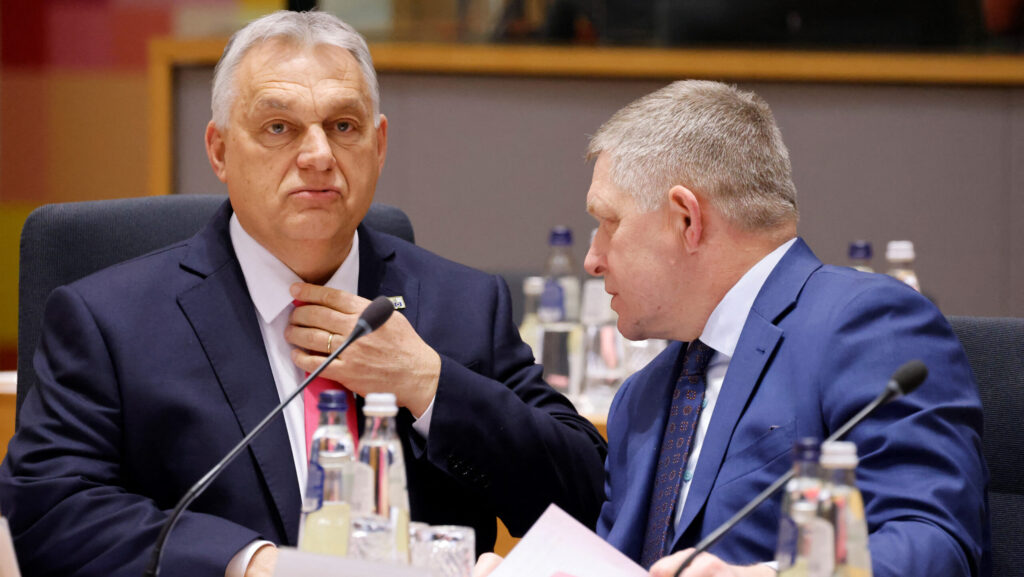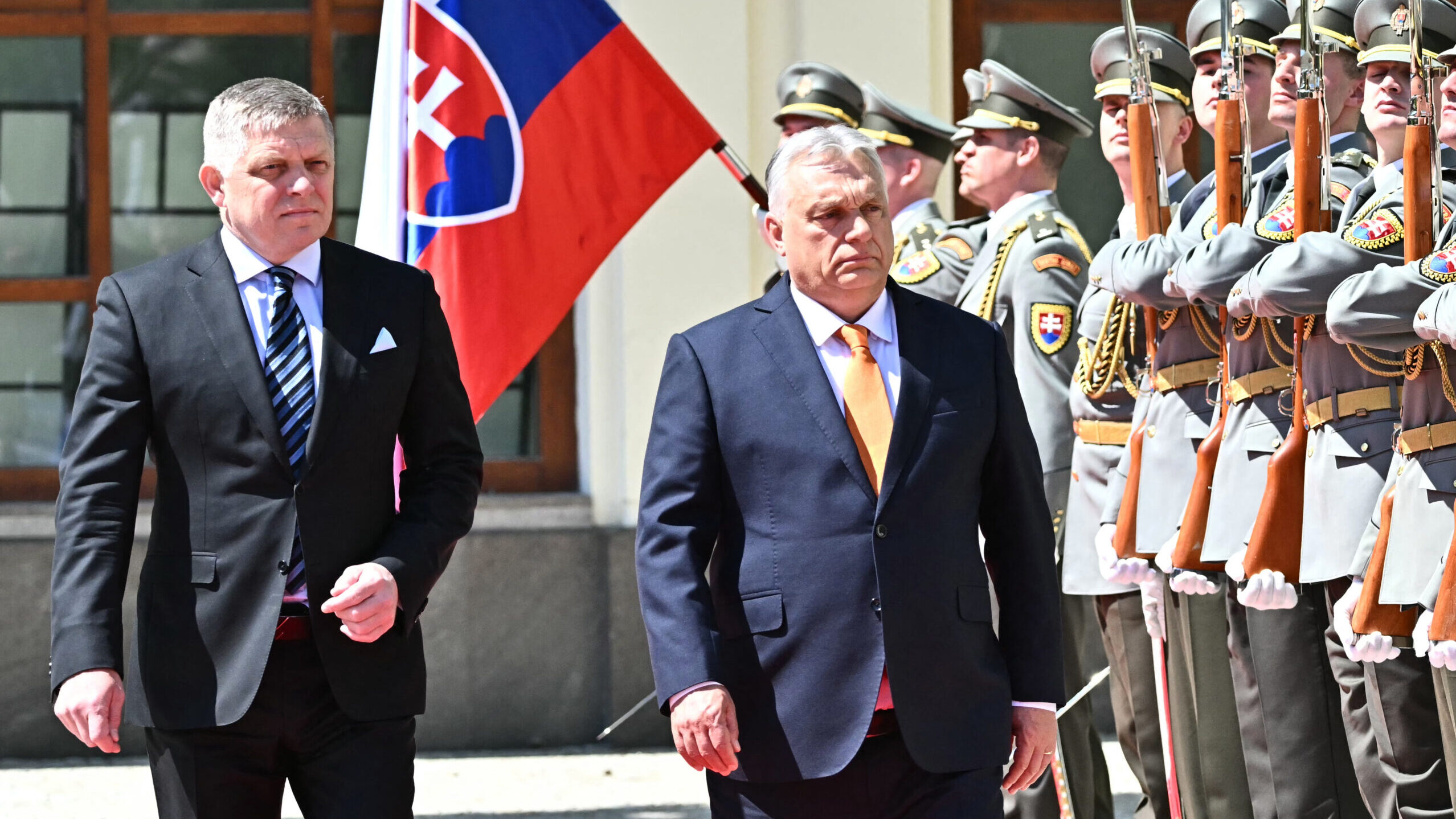
Hungarian Prime Minister Viktor Orbán said on Monday that he intends to conclude negotiations with the government of Slovak Prime Minister Robert Fico over a recently introduced law that makes it illegal to criticize the Beneš decrees in Slovakia. ‘Hungary rejects the principle of collective guilt, and the Hungarian government unconditionally supports ethnic Hungarians in Slovakia,’ Orbán underlined at an international press conference held on 5 January.
A new law that entered into force at the end of last year in Slovakia has been straining relations between the two neighbouring countries. Under the legislation, publicly questioning or denying the Beneš decrees is punishable by up to six months’ imprisonment. Slovak authorities argue that the amendment to the country’s Criminal Code protects the post–World War II settlement from defamatory challenges. Critics of the law, however, say it violates freedom of speech and argue that the decrees are fundamentally outdated and discriminatory in 21st-century Europe. The measure has triggered particular outrage among ethnic Hungarians living in Slovakia, as it affects them disproportionately.
The Ghost of Beneš Still Haunts Hungarian–Slovak Relations
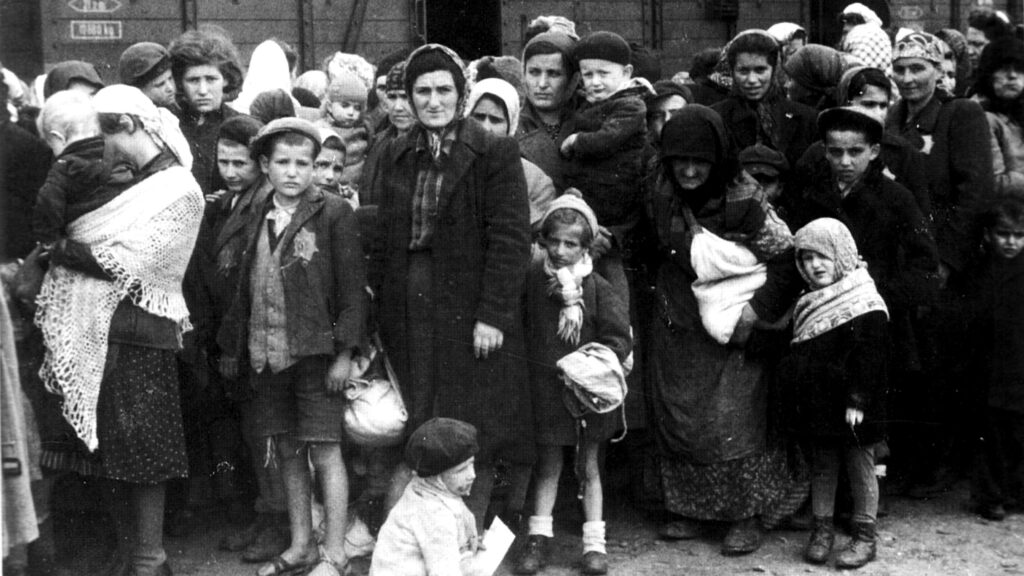
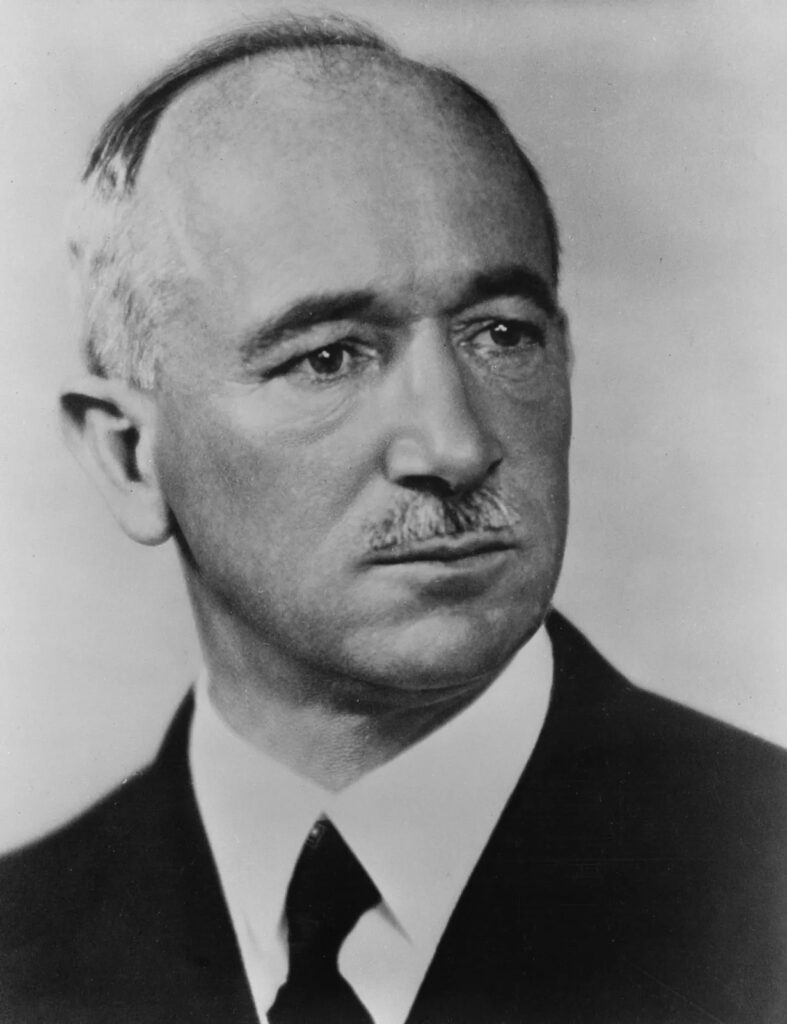
To understand the current outrage, it is necessary to examine the Beneš decrees and their historical impact on Hungarian–Slovak relations more closely. The Beneš decrees were a series of laws promulgated by Czechoslovak president Edvard Beneš before and immediately after World War II, providing the legal basis for treating ethnic Germans and Hungarians in Czechoslovakia as collectively responsible for wartime collaboration. This led to widespread loss of citizenship, confiscation of property, expulsions, and restrictions on language and cultural rights. Many of the decrees were ratified in 1946 and, although most have since been repealed or fallen into disuse, elements of their legacy—particularly in property and nationality disputes—have continued to surface in Slovak law and judicial practice.
In Hungarian–Slovak relations, the Beneš decrees are especially sensitive because they symbolize historical injustices against the Hungarian minority in Slovakia and the lingering perception of ethnic discrimination rooted in post-war transitional justice. For those historically affected and for political actors in Hungary, the decrees represent not only a traumatic chapter of collective punishment and population displacement but also an unresolved issue of moral and legal reckoning. Repeated calls for revisiting or repealing them have been met in Slovakia with strong defensive positions tied to national sovereignty.
The decrees have been a recurring flashpoint between Hungary and Slovakia throughout their shared history in the European Union. At the time of Slovakia’s EU accession, Orbán publicly called for the Beneš decrees to be repealed as part of the accession conditions for both Slovakia and the Czech Republic, the two successor states of Czechoslovakia. In response, the Slovak parliament adopted a resolution in 2007 declaring the decrees ‘inalterable’ and rejecting calls for their removal. That episode, along with other disputes—primarily affecting the roughly 400,000 Hungarians living in Slovakia—significantly strained relations between the two countries.
One of the most prominent legal disputes illustrating the lingering impact of the decrees, aside from the current situation, was the case of Bosits v Slovakia. In that case, the Slovak state forest company sought to reclaim land from a descendant of Hungarian ethnicity on the grounds that the property should have been confiscated under the Beneš decrees in 1946 because the owner’s grandparents were Hungarian. This argument was upheld by Slovak courts.
Fico Puts Orbán in an Uncomfortable Position
Following the adoption of the current amendment, protests erupted in both Slovakia and Hungary. In Bratislava, opposition parties, including the ethnic-Hungarian party Hungarian Alliance, drew thousands of demonstrators who expressed concern that the new law undermines free speech and revives historical grievances linked to ethnic discrimination. Many ethnic Hungarians in southern regions, such as Dunaszerdahely, also took part in demonstrations, including torchlit marches and public rallies.
Protests were also held in Hungary, most notably on 3 January in front of the Slovak Embassy in Budapest, organized by university students and civic activists. The demonstration brought together participants from across the political spectrum. In addition to right-wing sympathizers—traditionally more sensitive to issues affecting ethnic Hungarians beyond the borders—many liberal and progressive participants were also present.
‘Opposition parties accused Orbán of betraying the ethnic Hungarian community, although it is evident that they are seeking to extract political capital from the situation’
The Slovak legislation has placed Orbán’s government in a difficult position, as Fico is one of Orbán’s few veto partners in the European Council on issues related to military and financial support for Ukraine. Together with Czech Prime Minister Andrej Babiš, the two secured a rare victory in December by obtaining an opt-out from the €90 billion joint borrowing package intended to support Kyiv. On 23 October, during another European Council summit, Orbán even tasked Fico with representing Hungary during the first part of the meeting, as the Hungarian prime minister had to attend a state ceremony on that day.
At the same time, Orbán and Fidesz–KDNP have long been the only political force in Hungary to consistently prioritize the interests of ethnic Hungarians living beyond the country’s borders. It was the Orbán government that introduced dual citizenship for them in 2010 and allocated significant resources to education, culture, and sports for Hungarian communities in Serbia, Transcarpathia, Transylvania, and Slovakia.
Is There Anything Orbán Can Do?
This broader context helps explain why the Hungarian government initially appeared hesitant in responding to the new Slovak legislation. Opposition parties accused Orbán of betraying the ethnic Hungarian community, although it is evident that they are seeking to extract political capital from the situation, having previously opposed nearly all forms of support for Hungarian communities beyond the borders.
It is also important to note that, as Orbán himself pointed out, there have so far been no legal consequences, despite the fact that protests held in Slovakia clearly fall under public criticism of the decrees. Strategic restraint by the Hungarian government may ultimately benefit the Hungarian community in Slovakia, as pragmatic negotiations with Fico’s government remain possible due to the relatively good personal relations between the two prime ministers.
‘Strategic restraint by the Hungarian government may ultimately benefit the Hungarian community’
Moreover, Hungary’s options are limited. Budapest could summon the Slovak ambassador as a form of protest, but such a move would be unlikely to yield constructive results. Nor can Hungary realistically rely on the European Commission, as Brussels—despite its stated commitment to equality and non-discrimination—has consistently shown reluctance to protect ethnic minority rights across the Union. Although many have urged EU-level intervention to prevent ethnically based expropriations and discrimination, there has been no decisive initiative to challenge or mediate these practices in a manner that effectively safeguards minority rights.
Related articles: