We have seen that the Darwinian worldview—in close correlation with the materialism built upon it—leads to a mechanical, purposeless, and ultimately reductionist interpretation of reality. We previously alluded to the fact that the word ‘evolution’ originally had a quite different meaning. When Darwinism sought a name for the process it ‘discovered’, it began to use the term evolution (unrolling, unfolding)—essentially illegitimately, since the Darwinian theory does not describe the original meaning of this concept at all.
Conservative thought—long before Darwin—possessed its own, much deeper concept of evolution, stemming from the Latin verb evolvere: it signifies the slow, organic unfolding of a hidden potential. When Edmund Burke thought about society, he saw not a machine designed by an engineer, but a living organism whose traditions and institutions gradually ‘unrolled’ from the wisdom of the past over centuries. This perspective, acknowledging internal form and purpose, must be valid not only for society but for nature as well; for the conservative man, the world is not a battlefield of chance and brutal competition, but a cosmos in which every being is part of the unfolding of a divine plan and potential.
This genuine, organic conception of evolution stands in full harmony with a spiritually grounded understanding of the universe. Just as society unfolds its latent traditions, and a seed unfolds the tree inherent within it, so the entire created world unfolds from the infinite possibilities of the Principle. In pre-modern thought, so-called evolution is not a justification of materialism but the immanent manifestation of a transcendent order—the gradual and successive unfolding of creation, long expressed in the world’s sacred scriptures through symbolic and mythic imagery. This process may also be described as ‘emanation’ or as a ‘gradual coagulation’ from the Principle.
‘In pre-modern thought, so-called evolution is not a justification of materialism but the immanent manifestation of a transcendent order’
The temporal sequence of the various great dynasties ruling the Earth—fish, amphibians, reptiles, dinosaurs, birds, and finally man (from the simpler to the more complex, from the material to the spiritual)—represents the planes and levels of the unfolding stages of creation. We need not deny that these forms ‘have something to do’ with one another. A kind of sequence and physical resemblance can be observed among the great dynasties in the fossil record, but this does not mean that these degrees of being originate from one another in a spiritual sense, as if they were merely each other’s material–physical consequences.
Roberto Fondi, one of the most prepared critics of Darwinism, elegantly presents the two dominant but, in his view, erroneous models in his work Dopo Darwin (After Darwin). One is the mechanical–deterministic descent model of Darwinian evolutionism, which merely forces a materialist a priori onto the findings. The other is the model he calls ‘rigid fixism’ or static creationism, which proclaims the creation of types isolated from one another, without connection, ‘popping up out of nothing.’ According to Fondi, both are untenable.1
In contrast, Fondi’s own model2 resonates perfectly with conservative (and pre-modern) thought. In his view, reality consists not of atomized entities but of a single, immense, hierarchical system. The term ‘Form-circles’ (Formenkreisen) he uses describes biological types not as isolated but as nested circles showing ‘overlaps’. Fondi starts from the unity of space–time: according to this, time is not an external, linear process through which living beings ‘pass’, but an internal, organic part of every single type. The example of the butterfly’s complete metamorphosis illustrates this excellently: the egg, the caterpillar, the pupa, and the butterfly are all parts of the same space–time continuum. Following Luigi Fantappiè, Fondi also professes: ‘The universe of nature is in the totality of past, present, and future.’ The form (the complete life path of the butterfly) is given a priori in four-dimensional reality, and in time, it merely ‘unfolds’ or ‘unrolls’.
This model resonates with the ‘quantum leap’ theory of the Copenhagen interpretation of quantum physics. The traditional model, still built on Newtonian physics, holds the principle of Natura non facit saltum (Nature makes no jumps)—however, this stands in direct contradiction to quantum physics, where nature works exclusively by leaps. In geological layers, we see precisely this: species remain unchanged for millions of years, then suddenly (in a geological sense, in moments) a new species appears, without transitional forms. Just as, according to quantum physics, an electron cannot be ‘a little bit here and a little bit there’ between two energy levels, a biological system (a species) also exists in a stable energy minimum (a coherent state).
Morphological forms (eye, wing, spine) cannot be works of chance but are pre-existing mathematical possibilities (attractors) in the quantum potential. Rupert Sheldrake calls this the Morphogenetic Field in A New Science of Life. Forms (similar to Platonic ideas, but rather as developing habits) already exist in the information field, and matter (biology) ‘fits’ into these forms via quantum leaps.3
This implies that a new species appears suddenly, ‘ready-made’, rather than being assembled over millions of years. Sheldrake was a close friend of the quantum physicist David Bohm. According to Bohm’s theory, there exists an Implicate Order—a deeper level of reality from which the visible world, the Explicate Order, ‘unfolds’. The morphogenetic field is situated within this Implicate Order.
The Theory of Organicist Unfolding
Our fundamental principle is that—adhering to the criterion of falsifiability against the Darwinists—what we describe is not fact, but theory. However, while we maintain at any time that no one is ‘obliged’ to accept it, we consider this theory simply more probable and much more coherently related to paleontological facts than Darwinism. Following Fondi, we may call it the ‘organicist unfolding theory’.
There is physically no miniature oak tree in an acorn, but the full potential, the complete blueprint, or the metaphysical ‘form’ of the oak is within it. When the acorn becomes a tree, it is not a random process. The tree does not ‘evolve’ by growing leaves and branches blindly, waiting for the environment to select the good solutions. On the contrary: an internal, pre-given plan is realized in matter. The ‘evolution’ of the oak tree is, in reality, the unfolding of the form inherent in the acorn.
A more precise analogy is crystallization. When a snowflake forms from water vapour, it is not a slow, gradual process. It does not happen by one water droplet slowly sticking to another, trying out random shapes. Instead, when physical conditions (temperature, pressure) are right, the formless matter (vapour) suddenly, with a qualitative leap, assumes the highly complex crystal structure. The ‘form’ of the crystal structure is an eternal physical–mathematical possibility; the snowflake is its material realization.
‘In the cosmic order, the “form” of the species exists from eternity as a possibility’
This event is the model for the appearance of species, for ‘unfolding’. In the cosmic order, the ‘form’ of the species exists from eternity as a possibility. When conditions on the physical plane ripen, the Leap occurs. The material substrate (the ‘dust of the earth’, or the genetic stock of already existing biological organisms) is ready to receive the form. The form then ‘projects’ onto matter and rearranges it almost instantly. In a biological sense, this is not a slow series of random mutations, but a sudden, systemic activation of the latent potential within the genome (an ontological leap), resulting in a new, stable form. The process is rapid, radical, and creative in nature—and this is exactly what appears in the fossil record when a new species appears suddenly, without transitional forms.
It was not random mutations that ‘forced’ animals this way or that, but the primordial potential inherent in them via a transcendent source that unfolded. Darwinian ‘chance’, moreover, is not even an explanation, but a ‘Deus ex Machina’ in the worst sense—and in a system that a priori denies the ‘Deus’.
While the Darwinian explanation (‘an accidentally lucky chain of accidents over millions of years’) mathematically far exceeds the limits of possibility, the organicist unfolding theory is both biologically and philosophically more coherent. The possibility of a transcendent source and intervention is present from the outset, since the theory does not begin with a denial of transcendence but precisely with its affirmation. It is grounded not in chance, but in transcendent–immanent lawfulness and the ‘own nature’ of what exists. The chain did not break because it was never a random series of links; rather, like the branches of a growing tree, it was sustained by the Root and the Sun.
Animal forms do not, of course, materialize from ‘thin air’. The model according to which every new animal species enters the world in the form of an embryo is much more coherent. The key to the embryo-analogy is that the creative ‘leap’ creates not a fully developed adult being from nothing, but the very first, initial state of the species’ life cycle.
The species, once it has appeared (actualized), exists stably. It is capable of minor changes within its own form (microevolution), just as an oak tree can be taller or shorter, but the essential form does not change. Thus, when we speak of ‘unfolding’ (evolvere), we refer to the entire earthly existence of the species, its complete ‘life path’, which is an organic happening lasting from metaphysical possibility to physical realization.
The Dethronement of Chance
This ‘chance-ism’ (Tychism) is what makes materialism one of the most improbable concepts, both logically and empirically. For the sake of emphasis, let us quote George Wald again:
‘Time is in fact the hero of the plot…Given so much time, the “impossible” becomes possible, the possible probable, and the probable virtually certain. One has only to wait: time itself performs the miracles.’4
However, as modern information theory proves, time in itself does not create information, but merely increases entropy (disorder). Wald’s ‘miracle-working time’ is in reality a substitute for the Creator God in materialist mythology.
As the renowned philosopher of religion Seyyed Hossein Nasr also points out: the assumption that order can come from chaos, meaning from meaninglessness, and the greater from the lesser is not science, but ‘the absurd mythology of modernity,’ built upon a logical impossibility.5 Darwinian evolutionism actually implies a hidden ‘materialist theology’: in evolutionary mythology, Evolution with a capital ‘E’ is nothing other than the driving force of Chaos raised to divinity—a chariot rushing toward the abyss—governing the universe.
The temporal sequence of the various dynasties ruling the Earth—from the simpler to the more complex, from the material to the spiritual—marks not Darwinian development, but degrees of creation. The earliest life forms to materialize (ancient crustaceans, molluscs, insects) are performative sketches of the physical body. When the armour of trilobites appears, it signals that life forms are ‘curdling’ and solidifying on the physical plane. They represent the earliest, most mechanical levels of ‘all possibilities’—as it were, the ‘crystals’ of the living world.
‘The temporal sequence of the various dynasties ruling the Earth…marks not Darwinian development, but degrees of creation’
The age of dinosaurs, for example, is the peak of horizontal extension. Here, the creative impulse exploited the quantitative side of matter: gigantic sizes, armour, raw physical force. Manifest existence reached its limit in the proliferation of ‘solid’, ‘external’, and ‘heavy’ forms. The more the form solidified in matter (think of the armour of Triceratops or the jaw of Tyrannosaurus Rex), the further it moved from the spiritual source.
The era following the necessary catastrophe6 that destroyed the dinosaurs is, by contrast, the beginning of vertical deepening. The direction of movement changes: instead of outward, extensive expansion, an internalization follows. Biologically, this is signalled by the generalization of true warm-bloodedness (endothermy). Although a kind of elevated metabolism had already appeared in certain groups of dinosaurs (mainly predators),7 this was often merely thermal inertia stemming from gigantic body size, or a tool of sheer physical performance. With mammals, however, internal heat underwent a qualitative change: it became dominant and the fundamental principle of life.
Wolfgang Smith would call this phenomenon ‘vertical causation’: matter does not organize itself to a higher level; rather, a higher ontological principle (psychic life) penetrates matter and transforms its physiology.8 The centre of gravity of the animal kingdom shifted: the being became definitively independent of the fluctuations of the external environment. This stable ‘biological heat’ became the carrier of the emerging ‘psychic heat’: emotions, maternal care, and a more developed inner life.9
Cladistics versus Organicism
Finally, to understand the fundamental difference between the two theories—Darwinism and organicism—we must return to one of the most significant methodological turns in modern biology: the rise to dominance of cladistics (phylogenetic systematics) in the second half of the 20th century. This method, developed by Willi Hennig, presents itself as serving ‘scientific objectivity’ but is, in reality, the ultimate logical consequence of materialist reductionism, rendering the recognition of qualitative leaps impossible.
To show the ultimate consequences of the logical absurdities of Darwinian materialism, it is worth examining what cladistics actually claims. Its fundamental dogma is strict monophyly: a valid group (clade) must contain the common ancestor and all of its descendants without exception. From this follows the famous rule: ‘You can never outgrow your ancestry.’
Since birds descend from dinosaurs (Theropoda), according to cladistics, a bird remains a dinosaur forever. The ‘Bird’ category is merely a sub-box of the ‘Dinosaur’ box. Since terrestrial vertebrates (humans, mammals) descend from ancient fish, therefore—just to illustrate the logical absurdity—cladistically, a human is a ‘modified lobe-finned fish’. This view is one of the most obvious examples of Reductio ad Absurdum. If applied consistently, every qualitative difference in the biological world dissolves into a single, undifferentiated mass: ultimately, every living being is merely a ‘modified bacterium’.
The fundamental difference between cladistics and our organicist unfolding model lies in the relationship between Matter (Origin) and Form (Essence). To illuminate the situation with a vivid example: when a scientist with a cladistic mindset examines a Gothic cathedral, he determines that the stones come from a limestone quarry. From this, he draws the conclusion that ‘the cathedral and the quarry are essentially identical,’ since their material is continuous. Therefore, he classifies the cathedral under ‘Limestone Formations’. Organicism, by contrast, holds: although the material comes from the quarry, the Essence (the Form) originates from a higher spiritual principle that rearranged the stone. Therefore, the cathedral is ontologically more than the quarry.
The bird biologically uses the dinosaur substrate (as a carrier), but at the moment of the Leap, it steps out of this quality. Feathers, warm-bloodedness, and flight are essentially not ‘modified scales’ or ‘modified running’, but the overcoming of gravity, the appearance of a new biological quality. The bird is thus metaphysically the transubstantiation of the dinosaur, not its subgroup. Cladistics, therefore, while logically consistent within materialism, philosophically blinds science to reality. By calling the bird a ‘flying dinosaur’ and the human a ‘naked ape’ (Desmond Morris), it does not increase scientific accuracy, but erases the unique dignity and qualitative identity of beings in the name of mere material continuity.
The Final Convergence: Memory, Truth, and Responsibility
Man is therefore not ‘one among mammals’, and not merely a ‘naked ape’. Man is the microcosmic summary of the macrocosm. In the words of Titus Burckhardt: the human form is not one among many, but ‘the synthesis of the Cosmos and the mirror of the Spirit.’10
This thought is deeply rooted in antiquity and Christian theology. According to the teaching of St Maximus the Confessor, man is the ‘mediator’ (methorios) of the created world, who by his mere existence unites the various levels of the cosmos: male and female, inhabited earth and paradise, heaven and earth, the sensible and the intelligible. In this view, man’s task is a cosmic liturgy: to gather the scattered ‘words’ (logoi) of created things and lead them back through his own spirit to the divine Word (Logos). Without man, the world would remain mute and unfinished.11
According to this view, the human physical body resembles mammals (and mostly primates) because, in order for man to rule over earthly creation and take responsibility for it, he must unite within himself all the life forms standing below him. Man carries within himself minerals (skeleton), the vegetative functions of plants, the brainstem instincts of reptiles, and the emotional world of mammals. But he unites all this under the rule of a higher function, the Spirit (Spiritus).12
In this sense, cosmic unfolding is not a chaotic game of chances, but the consistent acts of a divine drama.
Ironically, it was the father of modern empirical science, Francis Bacon, who warned of the spiritual trap into which today’s Darwinism has fallen. As he put it in his famous essay: ‘A little philosophy inclineth man’s mind to atheism; but depth in philosophy bringeth men’s minds about to religion.’
‘Cosmic unfolding is not a chaotic game of chances, but the consistent acts of a divine drama’
It seems the representatives of materialist evolutionism got stuck halfway: fascinated by secondary causes (mechanisms), they lost sight of the Final Cause. The organicist unfolding theory is not the denial of science, but precisely this Baconian ‘step forward’ toward the depth where, behind the laws of matter, the Designing Intellect once again glimmers.
When Bacon turned toward the atomists, he wanted to adopt not their worldview, but their method: he banished the investigation of ‘Final Causes’ (purposes) from the laboratory to focus on ‘Material Causes’ (mechanisms). But he still believed that the two territories—faith and science—would eventually meet. The tragedy of modern Darwinism is that it took Bacon’s methodological self-limitation—that we examine only matter—and elevated it to a worldview dogma—that only matter exists). For Bacon, the examination of matter was only the path; for the moderns, it is the goal and the terminus. What Bacon called ‘sterile’ (the research of purposes), Darwinism declared ‘non-existent’—and thereby expelled not only God but Reason itself from the world.
The materialist ‘machine-model’ actually paves the way not only for Darwinism but also for global capitalism and progressive social engineering. The materialist worldview claims that the past is gone. What is dead is no more. Therefore, the landscape (and society) is at every moment a blank slate (tabula rasa) that we can rewrite freely.
Burke, however—and following him, the entire conservative tradition—claims that the past has not passed. The ‘dead’ are here with us: in our habits, in our institutions, and in our very instincts. Rupert Sheldrake elevates precisely this intuition to an ontological level when he asserts that nature has a memory. Past forms and events exert a physical effect on the present across space and time; that is, conservatism is not a ‘sentimental attachment to old things’, but a profound metaphysical alignment with the fundamental operating principle of nature, which is none other than habit and memory. If Sheldrake is right, if ‘habit’ is stronger than ‘law’, and memory is the building block of nature, then materialism is fundamentally wrong—and the progressive ‘tabula rasa’ politics loses its entire scientific basis.
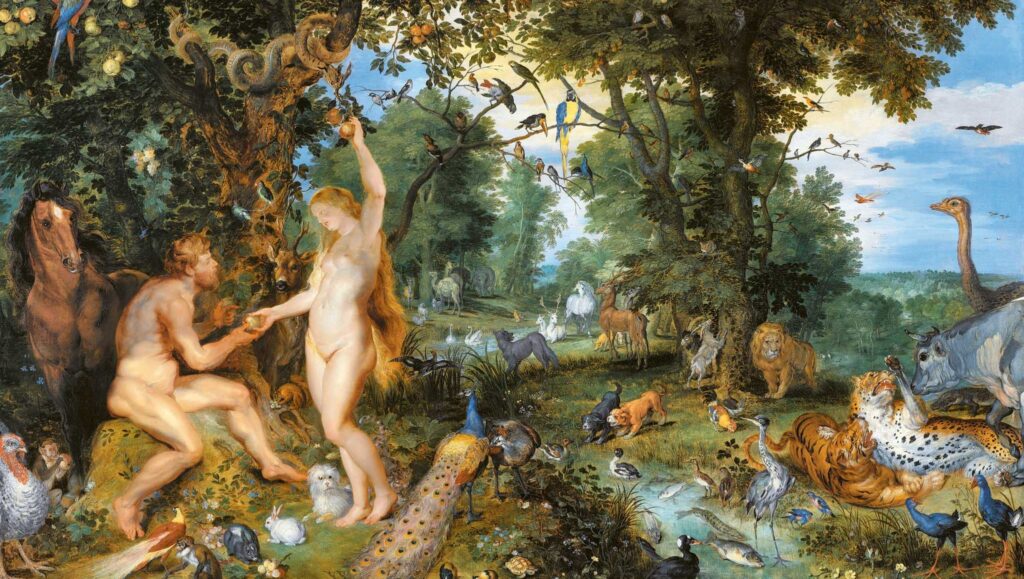
Why is this attractive to modern man? Because it fulfils the Serpent’s ancient promise: ‘Ye shall be as gods.’ If the world is only matter and mechanics, then there is no Lawgiver above us, and no objective goal to which we must conform. If there is no Creator, the throne is empty, and the modern ‘Übermensch’—the Engineer, the Scientist—can sit upon it. Materialism carries the promise that we ourselves can become the masters of existence. As contemporary thinkers such as Harari proclaim, we are no longer subjects of a divine order, but ‘divine’ hackers of our own evolution—seeking to defeat death, redesign our genes, and ultimately determine good and evil for ourselves. ‘Ye shall be as gods’: the title of one of Harari’s most influential books, Homo Deus, quite literally echoes this claim.
It is no wonder his works are global bestsellers while conservative critiques remain sidelined. When Pilate asked Jesus: ‘What is truth?’, he then washed his hands and let the crowd decide. But the question of Truth is never a question of numbers.
‘If the organicist model is true, and the world is the unfolding of a divine thought (Logos), then our life has moral weight and a cosmic stake’
The ‘darwinistic’ worldview is thus actually a desperate escape from Responsibility. However, if the organicist model is true, and the world is the unfolding of a divine thought (Logos), then our life has moral weight and a cosmic stake. We are not our own masters, but stewards in a garden entrusted to us. It is this humility that modern hubris abhors.
You can read the first part of the essay here.
- Fondi’s two most important works are Dopo Darwin. Critica all’evoluzionismo [After Darwin: Critique of Evolutionism], published in 1980, and Organicismo ed evoluzionismo [Organicism and Evolutionism] in 1984. It is no coincidence that neither work has been translated into English; only the 1984 work has a French edition (La révolution organiciste). Fondi does not attack Darwinian theory on metaphysical grounds but focuses on its internal contradictions and the deficiencies of the evidence. As a palaeontologist, he argues by referencing the fossil record of his own field, which may lend weight to his words even for those who deny the validity of metaphysics. The absence of translations reveals much—it seems Darwinism is unwilling to face, in the spirit of fair play, opponents who could defeat it with its own weapons. ↩︎
- See Figure 3 in Fondi’s article: ‘Evolutionism and Holism: Two Different Paradigms for the Phenomenon of Biological Evolution’, International Journal of Ecodynamics, 2006, last accessed 10 Dec 2025. ↩︎
- ‘If morphogenetic fields are to affect physical and chemical processes, they must be able to influence probabilistic events…The morphogenetic field could work by imposing a pattern on these probabilistic events, restricting the possible outcomes so that things happen in accordance with the morphic unit.’ Rupert Sheldrake, A New Science of Life: The Hypothesis of Morphic Resonance, London, Icon Books, 3rd ed, 2009, p. 114. ↩︎
- George Wald, ‘The Origin of Life’, Scientific American, August 1954, p. 48. ↩︎
- Seyyed Hossein Nasr, Religion and the Order of Nature, Oxford, Oxford University Press, 1996, pp. 145–148. ↩︎
- The dominion of the dinosaurs, estimated by palaeontology to have lasted more than 150 million years, came to an end with the great event at the close of the Cretaceous period: the Chicxulub asteroid impact (the so-called K–T event). ↩︎
- According to the consensus of modern palaeontology, the majority of dinosaurs were neither cold-blooded in the modern sense nor fully warm-blooded. They were likely in an intermediate, so-called ‘mesothermic’ state, or their immense body size kept them warm (gigantothermy). True, high-level endothermy independent of body size appeared only in the latest, bird-like branch of dinosaurs (Maniraptora), foreshadowing the quality of the next world age, but it became general only in the age of mammals and birds. ↩︎
- Wolfgang Smith, The Quantum Enigma: Finding the Hidden Key, Kettering, Angelico Press, 2005, pp. 115–118. ↩︎
- The English word animal also points to this, deriving from the Latin word anima (soul). The mammal is ‘ensouled’ (a being possessing anima sensitiva in scholastic philosophy). The main difference between it and man lies not in the bodily line, but in the presence of the spiritual soul (pneuma/intellectus), which belongs only to man. ↩︎
- Titus Burckhardt, Mirror of the Intellect: Essays on Traditional Science and Sacred Art, Albany, SUNY Press, 1987, p. 26. ↩︎
- On cosmic mediation in Maximus and man’s unifying role (especially based on Chapter 41 of the Ambigua), see in detail: Lars Thunberg, Microcosm and Mediator: The Theological Anthropology of Maximus the Confessor, Chicago, Open Court, 1995, pp. 140–152. ↩︎
- From a Christian perspective, this is also one of the deepest metaphysical meanings of Christ’s incarnation in a human body: God becomes man to lead matter back to the Spirit. Man is primarily a spiritual function, not a biological species. Man is the bridge (pontifex) between Heaven and Earth. The humanoid form is not accidental, but a necessity stemming from this function: the vertical posture connects the Earth with the Sky, and lifts the head toward the spiritual sphere (as opposed to the horizontal spine of animals). The free hand enables creation (homo faber), not merely survival. And the prominent forehead is the physical throne of the higher intellect (buddhi). ↩︎
Related articles: