As a researcher and writer concerned with enduring rather than transient matters—matters connected to history, religion, philosophy, culture, and the continuities and conflicts of civilizations—I rarely take interest in the pronouncements of Western politicians. Ephemeral by nature, they are typically cliché and empty of substance.
Hence the Donald Trump phenomenon. Unlike most American politicians, he spoke plainly about substantive issues that mattered to ordinary Americans—and was loved (and hated) for it.
But there is another politician who entered my radar for the same reason even before Trump: Viktor Orbán spoke not in platitudes, but in civilizational terms and expressed more concern over the welfare of his nation than saying ‘the right things’ and mindlessly following the EU’s lead.
As is well known, for example, the more Islam grew in the West throughout the 2010s—bringing with it more and more social problems—the more did Western politicians double-down in their commitment to ‘multiculturalism’, spouting only meaningless mantras such as ‘diversity is our strength,’ or ‘Islam means peace.’
Not Orbán.
I first heard of him in 2015, when ‘mainstream news’ all but introduced him to the American people as the ‘next Hitler’. He was presented as ‘xenophobic’, ‘full of hate speech’, and Europe’s ‘creeping dictator’. The Guardian simply dismissed him as a ‘problem’ that needed to be ‘solved’.
What monstrous things did Orbán say or do?
While the rest of Europe was taking in millions of (more) Muslim immigrants, he refused. Even worse was why he refused: for meaningful reasons of a historical, cultural, and religious significance—in a word, for civilizational reasons (hence why I, someone with little interest in the utterances of politicians, took note of and began writing about him a decade ago). Here is a typical, and telling, Orbán quote:
‘Those [migrants] arriving [in Europe] have been raised in another religion, and represent a radically different culture. Most of them are not Christians, but Muslims. This is an important question, because Europe and European identity is rooted in Christianity….We don’t want to criticize France, Belgium, any other country, but we think all countries have a right to decide whether they want to have a large number of Muslims in their countries. If they want to live together with them, they can. We don’t want to and I think we have a right to decide that we do not want a large number of Muslim people in our country. We do not like the consequences of having a large number of Muslim communities that we see in other countries, and I do not see any reason for anyone else to force us to create ways of living together in Hungary that we do not want to see.’
Orbán went further, grounding his position not in administrative or economic reasons but in history:
‘I have to say that when it comes to living together with Muslim communities, we are the only ones who have experience because we had the possibility to go through that experience for 150 years [a reference to Ottoman rule over Hungary c 1541–1699].’
It has been over a decade since Western media began (and continues) to demonize Orbán for his uncompromising position against migration. This passage of time is useful, as it allows us to look back and evaluate Orban’s logic for rejecting migration in light of what has actually happened over the last ten years.
‘Crime, instability, and social discord have soared in every European city that hosts a large Muslim presence’
And what has happened to those European nations which took in large numbers of migrants is certainly telling, to put it mildly. Crime, instability, and social discord have soared in every European city that hosts a large Muslim presence. As one example, ever since opening its doors to ‘multiculturalism’ and ‘diversity’, Sweden is often seen as the ‘rape capital of the West’. There, rape has seen an increase of 1,472 per cent, and violent crime has increased by 300 per cent. And these statistics were compiled and reported in 2015—before the renewed surge of migrants into Sweden that occurred over the last decade since.
The United Kingdom, Germany, and France show similar dynamics; crime, violence, sexual assault, fear, and overall instability have commensurately grown in any European city that has seen a growth of its Muslim population.
It is precisely for all these reasons that, as Orbán recently noted, Christmas in Budapest maintained its traditional charm, whereas Christmas in more ‘diverse’ nations—the UK, Germany, France, Belgium, Netherlands, Austria, Italy—was marred by extreme and obtrusive security measures, including barriers and checkpoints, general anxiety, Christmas market cancelations, and the absence of distinctly Christian symbols that might ‘offend’ or, worse, provoke a violent reaction (as seen by the many desecrated Nativity scenes and beheaded statues of Baby Jesus throughout Western Europe).
The situation has so deteriorated that Donald Trump recently warned against Europe’s ongoing ‘civilizational erasure’, as its original Christian-based, Western-oriented identity continues to give way before Islam, including through ‘migration policies that are transforming the continent and creating strife, censorship of free speech and suppression of political opposition, cratering birthrates, and loss of national identities and self-confidence. Should present trends continue, the continent will be unrecognizable in 20 years or less,’ to quote from the White House’s National Security Strategy, released in late November.
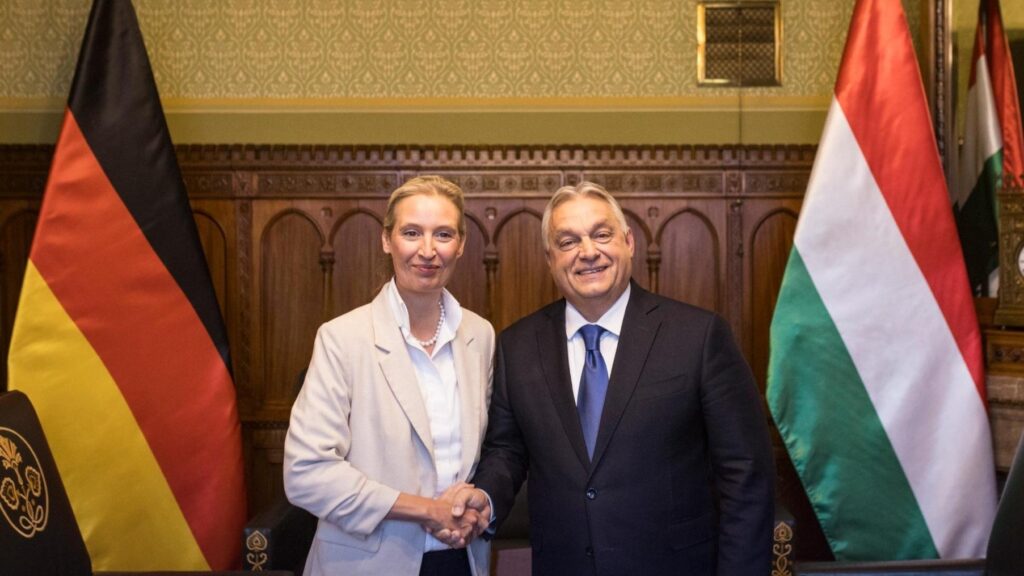
On the other hand, on 7 November, during a press conference with the Hungarian prime minister, Trump was full of praise for Orbán, referring to him as ‘a great man and a strong leader,’ particularly for his stance on behalf of the Hungarian people against the EU’s ruinous migration policies, which had rendered many European countries ‘unrecognizable’, whereas Hungary remains ‘very recognizable’. In short, time has proven that Orbán had been ‘right all along,’ said the American president.
One thing remains to be seen. In 2016, after several terror attacks in Europe, Orbán argued that ‘other European nations would come around to Hungary’s no-nonsense way of thinking as the reality of regular terror attacks set in.’ It certainly seems that a great many of Europe’s average citizens have ‘come around’ in this regard. What remains to be seen is when—and whether—their leaders ever will.
Related articles: