The Israel Democracy Institute published a poll on 11 November stating that approximately half of the Israeli populace believes that the United States has a ‘greater influence on security decisions’ than its own government.
This has drawn criticism from Israeli columnists that the U.S. is treating Israel as its 51st state and not as a sovereign, independent country, leading them to question whether this is to their detriment or not.
Yet, this may not matter much because lo and behold, weeks later, Washington published its annual National Security Strategy—a 29-page document—in which Israel hardly gets mentioned at all.
It goes without saying that the relationship between the U.S. and Israel is unlike any other in the world. Washington’s support for the Jewish state has been steadfast throughout the (unsuccessful) peace processes in 1990s with the Palestine Liberation Organization; the Second Intifada (also known as the Al-Aqsa Intifada) from 2000–2005; and, of course the Hamas attack on 7 October 2023, and the subsequent war in the Gaza Strip, with both Biden and Trump administrations providing unconditional diplomatic and military support.
Yet given the catastrophic casualties in Israel’s war in the Gaza Strip, maintaining this type of bilateral rapport has come at a hefty price, for aside from some rare exceptions, like the ceasefire that went into effect in early October 2025, the U.S. has not been able to shape Israel’s conduct of the war.
‘When other countries buy U.S. weapons, the sales are subject to a bevvy of U.S. laws; Israel has never truly been compelled to comply.’ So argues Andre P. Miller, a Senior Fellow in National Security and International Policy at the Center for American Progress.
‘Other partners refrain from displaying overt preferences for one American political party; Israel’s leaders do so and face no consequences. And Washington does not typically defend another country’s policies that are contrary to its own, nor does it block mild criticism of them in international organisations—but this is standard practice when dealing with Israel.’
‘Washington does not typically defend another country’s policies that are contrary to its own’
The November document, while still viewing Israeli security as a priority, lists other American interests in the Middle East as of greater importance. This includes avoiding ‘forever wars that bogged us [the U.S.] down in that region at great cost.’
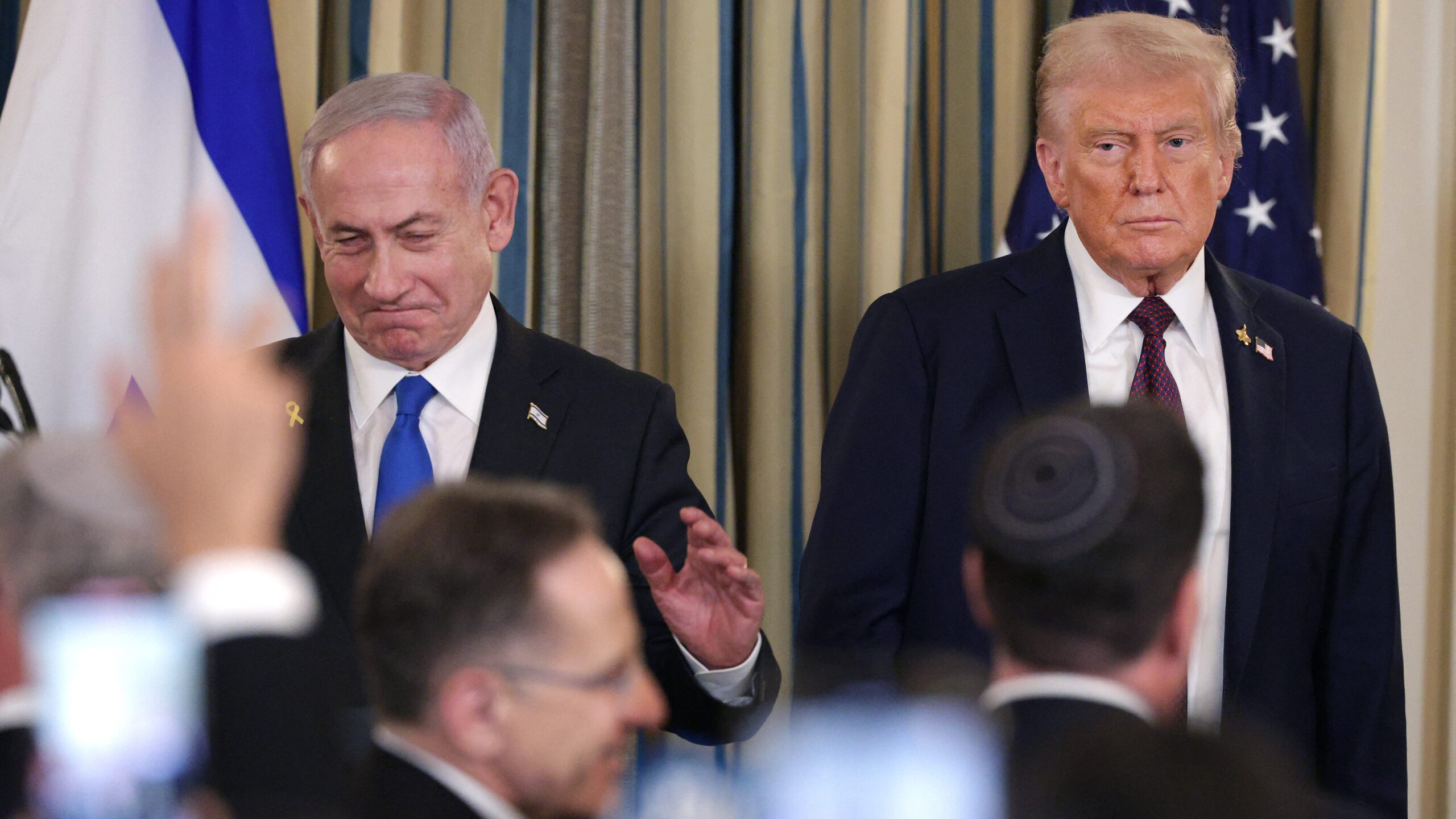
In a rare rebuke towards the Israeli government under Prime Minister Benjamin Netanyahu, Trump recently warned Israel to avoid actions that could disrupt Syria’s political transition. He posted on his Truth Social media that his administration is ‘very satisfied’ with Syrian President Ahmad al-Sharaa’s efforts to stabilize the country as it approaches the one-year anniversary of Bashar al-Assad’s ousting.
Last year al-Sharaa, who once had ties to the jihadist al-Qaeda and had a $10 million U.S. bounty on his head, was the first Syrian head of state to visit Washington since his country’s independence in 1946.
Trump said that it is ‘very important that Israel maintain a strong and true dialogue with Syria, and that nothing takes place that will interfere with Syria’s evolution into a prosperous state.’ He added that the U.S. has worked ‘within our power’ to support Syria’s rebuilding, including lifting what he described as ‘strong and biting sanctions’.
It is true that the Israelis have dealt severe blows to enemies it shares with the Americans. But because they know that there is not a single Middle East country or terrorist group that can pose an existential threat to Jerusalem, Washington’s unconditional support has both given Israel a green light to act rashly and without necessity in a way that draws the U.S. into unwanted military engagements.
In June, Trump blasted Israel (and Iran) for violating the then ceasefire terms, saying: ‘[T]hey don’t know what the f*** they’re doing.’
Trump clearly wants to get out of the Gaza conflict, just as he is trying to pull out of Europe vis-à-vis Ukraine, so that he can dedicate his efforts to containing Communist China’s growing power in the Pacific.
It is obviously in Israel’s interest to keep America at its side. At the same time, many Jews, whether they are Israeli citizens or not, do not want to be patronized, as evident when this past April over 550 rabbis and cantors signed a letter criticizing the Trump administration for ‘abusing the issue’ of antisemitism, joining a growing chorus of opposition from Jewish leaders.
Let us keep in mind that, like in 2017, Trump’s first presidential visit after being re-elected was to the Middle East—only this time around, he did not visit Israel.
Does this signal a ‘restructured’ relationship with Israel? I personally believe that the pro-Israel lobbyists in Washington will ensure that the status quo with the Israelis will be maintained, but then again, given the president’s unpredictable behavior, who knows?
Related articles: