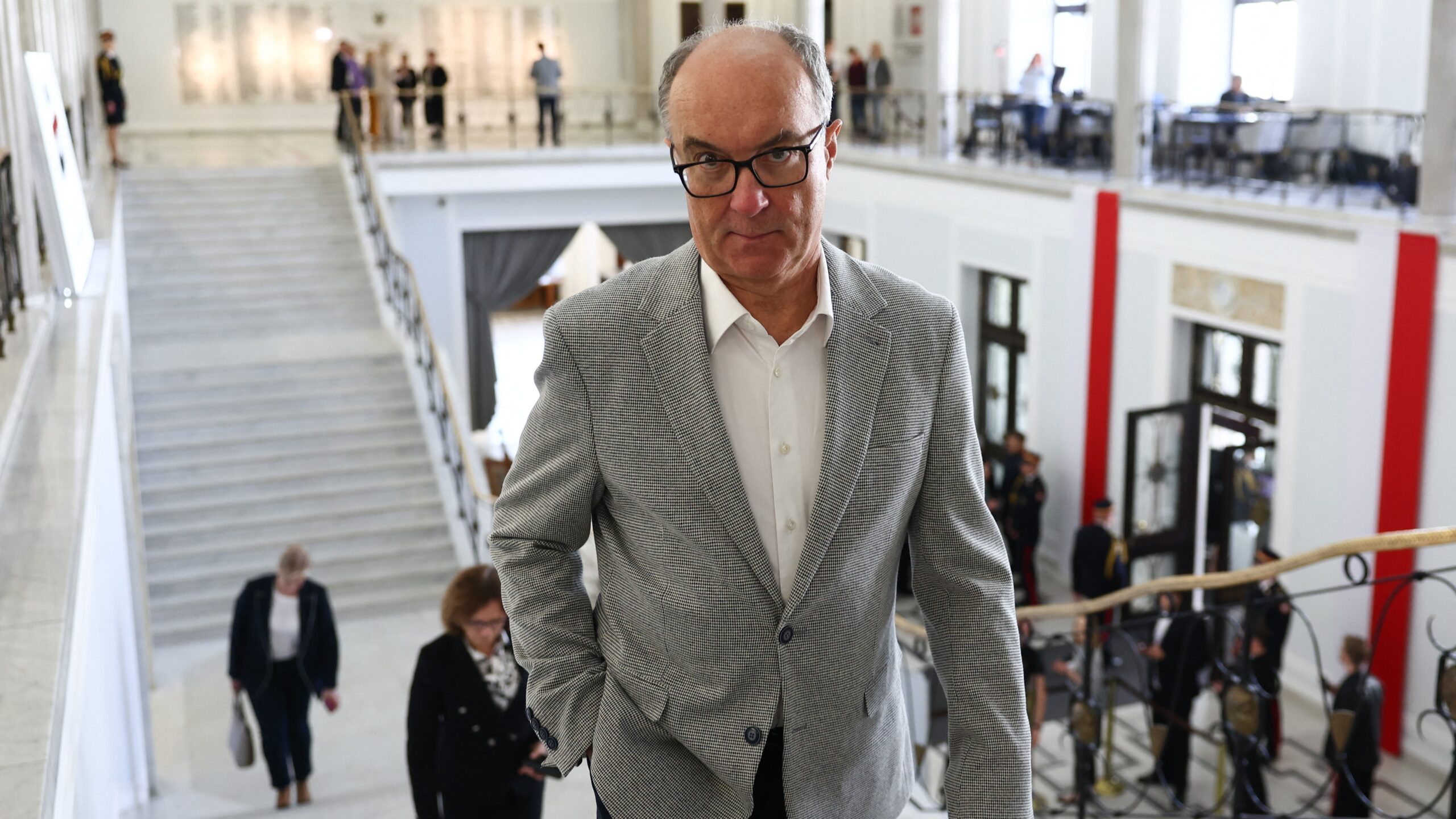
The left-liberal coalition, installed in Poland two years ago through Brussels-backed political pressure and now forming the backbone of Donald Tusk’s administration, has elected as Speaker of the Polish Sejm a former communist apparatchik and party official from the era of Soviet occupation—a long-standing activist of a small but radical left-wing party. He is a man far more inclined than his predecessor to take an active role in a final unlawful move to eliminate the sovereigntist, pro-Atlantic opposition and President Nawrocki.
Many observers outside Europe shake their heads in disbelief when they learn that the lawlessness unfolding in Poland under Tusk’s left-liberal administration since December 2023 is aimed, to a large extent, at restoring the influence of post-communist interest groups and reflects a renewed neo-Marxist mentality. How can this be possible, they ask, when 36 years have passed since the fall of the Iron Curtain and the defeat of the evil empire?
And yet this is precisely what has happened. Under the coalition agreement that brought Tusk to power, the office of Speaker of the Sejm—constitutionally the second-highest position in the state after the President—has been handed to Włodzimierz Czarzasty, a former communist functionary and a leading figure of the radical left.
One might object that in many post-communist countries, individuals who were members of communist parties before 1989 still hold public office. In Poland, too, almost every political camp—including PiS—has included a handful of such figures in its second or third ranks with similar biographies.
‘The office of Speaker of the Sejm—constitutionally the second-highest position in the state after the President—has been handed to…a former communist functionary’
At the turn of the 1970s and 1980s, roughly three million people belonged to the Polish United Workers’ Party (PZPR), often out of opportunism or fear. Some later rejected the ‘errors of youth’ or redeemed their involvement through genuine service to national sovereignty and the values underpinning the Polish nation, just as in other Central European countries. Others quietly withdrew from public life.
But the new Speaker does not belong to that category—aside from opportunism. He is part of the post-communist nomenclature: a network of individuals who, despite the collapse of communism and the withdrawal of Soviet troops, continued to see themselves as entitled to shape Poland’s social, economic, cultural, and political life.
To this day he calls Colonel Ryszard Kukliński a traitor. Kukliński, a Polish army officer, in the late 1970s uncovered Soviet nuclear-war plans that placed Poland at the centre of a catastrophic atomic conflict and, at great personal risk, delivered this information to the United States—contributing to the weakening of the Soviet empire. His two sons later died in unexplained circumstances. Yet a Speaker of the Sejm in 2025 publicly brands such a man a traitor.
It is equally unsurprising that he repeats the old propaganda line about being ‘grateful’ to the Red Army for having ‘liberated’ Poland—even though in 1945 the Red Army merely replaced German occupation with Soviet domination. In the first years of that domination, especially between 1945 and 1947, a brutal civil war unfolded: many soldiers of the Polish Underground State, after a five-year partisan struggle against the Germans, took up a hopeless armed resistance against Moscow’s rule.
For the Speaker of the Sejm, these men are not heroes, but ‘criminals’! That is how he and the activists of his post-Bolshevik left-wing party—now a pillar of Tusk’s coalition—describe them. For the globalist establishment, such radical leftism is no obstacle. On the contrary: they share its neo-Marxist agenda—the moral corruption of children and the destruction of the family through woke and transgender ideology; mass Islamic immigration designed to erode the Christian foundations of Polish identity; radical zero-emissions policies; and the dismantling of national sovereignty in favour of a European superstate.
Formal Russian occupation ended in 1989, but the people, networks, dependencies, and money remained—all carefully secured. In no sector of public life in Poland was there ever a serious process of criminal accountability, property restitution, or genuine systemic reprivatization.
‘Formal Russian occupation ended in 1989, but the people, networks, dependencies, and money remained’
It is no coincidence that circles shaped by the communist mentality came to dominate major media institutions. One of Poland’s biggest private television networks, TVN, was founded by protégés of the communist government’s spokesman during martial law—the regime’s chief propagandist—and to this day the sources of its financing have never been clarified, being linked to the largest financial fraud of the post-1989 transition. Although now owned by Warner Bros Discovery, it remains the main propaganda outlet of Tusk’s pro-German government, consistently defending post-communist elites and attacking conservative and Christian values.
Another example: shortly before the partially free elections of 1989, the communist authorities established the National Council of the Judiciary—an institution equipped with powers to decide access to the judicial profession and promotions, and therefore designed to preserve their influence by obstructing any meaningful reform of the courts. This is why the judicial reforms pursued by the conservative government from 2015 to 2023 became the primary target of furious attacks from Tusk’s circle and Brussels elites.
The PiS governments (2015–2023) represented an attempt—sometimes successful, sometimes too cautious—to repair the state. One key challenge, though not the only one, was freeing it from the dependencies of late post-communism in the judiciary, intelligence services, military, and public administration.
It is worth remembering that Leszek Miller, prime minister from 2001 to 2004 and the negotiator of Poland’s EU accession, was a member of the communist party’s central authorities and received a loan from Moscow in 1990 to establish a new ‘social democratic’ party after the dissolution of the PZPR. Until recently, he sat in the European Parliament as an MEP elected from Tusk’s lists.
Aleksander Kwaśniewski, president from 1995 to 2005, also served as a minister in the last communist government. The list is long: Prime Minister Józef Oleksy, Interior Minister Czesław Kiszczak—responsible for the murder of Blessed Fr Jerzy Popiełuszko—and many others. Many of the former communist apparatchiks, in their corrupt manner of operating, simply exchanged their loyalty to Moscow for a stance of subservience to other foreign centres of influence. Many supposed ‘dissidents’ gathered today around Tusk were in fact secret collaborators of the communist Security Service.
Even in 2015, when the PiS government came to power, individuals with communist pedigrees were still numerous within the less visible but essential layers of state administration, the judiciary, the economy, NGOs, and the media. Today these networks are returning. Their first targets after 2023 were the judiciary and the media. The goal is clear: to maintain control over social and state institutions regardless of electoral outcomes.
After 13 December 2023, the new globalist authorities forcibly took over public media and the prosecution service, removed lawful court presidents, conducted purges in criminal divisions, and abolished the random allocation of cases—all in open violation of statutory law and in defiance of rulings of the Constitutional Court. They also blocked the financing of the largest opposition party, despite Supreme Court decisions affirming its rights. These are the mechanisms of a system weaponizing state institutions against political opponents.
‘The goal is clear: to maintain control over social and state institutions regardless of electoral outcomes’
All this fully justifies calling this administration the ‘Coalition of 13 December’. On that day in 1981, the communists imposed martial law and crushed the ten-million-strong Solidarity movement. The scale is different, but the goal—reshaping state institutions into a machine for persecuting the opposition—is strikingly similar.
All the more so because they have plunged Poland into a grave public-finance crisis—its deficit now approaches the constitutional limit—and the health-care system has run out of money. At the same time, they must service obligations to Berlin and Brussels, both of which played a decisive role in the EU-level pressure campaign that installed a pro-German, globalist coalition in Warsaw.
And now, in this situation, a former communist apparatchik, capable of any form of lawlessness, becomes Speaker of the Sejm—the second-highest office in the state. Recall that the Speaker assumes presidential duties should the President be unable to perform them.
The previous Speaker, although himself responsible for many unlawful and criminal actions (including a key role in the illegal deprivation of liberty of opposition MPs), nonetheless pulled back from carrying out a constitutional coup d’état. He lacked the determination to join Tusk in preventing Nawrocki from assuming the office of President in August 2025, despite being encouraged to do so. For indeed, after two years in power, Tusk and his circle have already incurred criminal liability for actions that could lead to years of imprisonment. And removing President Nawrocki from office is their only hope of holding on to power and avoiding prison.
Tusk cannot simply change the laws, because he lacks the parliamentary majority needed to override a presidential veto. And the President also holds the power of pardon—something Tusk and his people may desperately need. They have nowhere to retreat and therefore are capable of anything.
The new Speaker of the Sejm would have far fewer doubts. And the ground has already been prepared: in September 2025, the CJEU ruled (of course ultra vires and in open contradiction with the Polish Constitution and the case law of the Polish Constitutional Court) that one of the new chambers of the Supreme Court is not a court—namely, the chamber responsible for ruling on the validity of elections. Voices are already emerging that in 2026, after filling a majority of seats on the Constitutional Court, Tusk will proceed to a final confrontation with the opposition, including the removal of Karol Nawrocki from office. The pretext: the court that confirmed the validity of his election is, according to Brussels, not a court.
To the critics who say this is impossible, it is worth recalling that two years ago it likewise seemed impossible that the government would seize by force the headquarters and studios of public television, or physically remove the head of the Polish prosecution service from his office. Today, symbolically and politically, Tusk and his team have fully earned the label ‘Coalition of 13 December’. And they have confirmed that Poland’s late post-communism—strengthened by the support of Brussels-based neo-Marxists—remains capable of damaging a fundamentally conservative society and destabilizing a key state on NATO’s eastern flank.
Related articles: