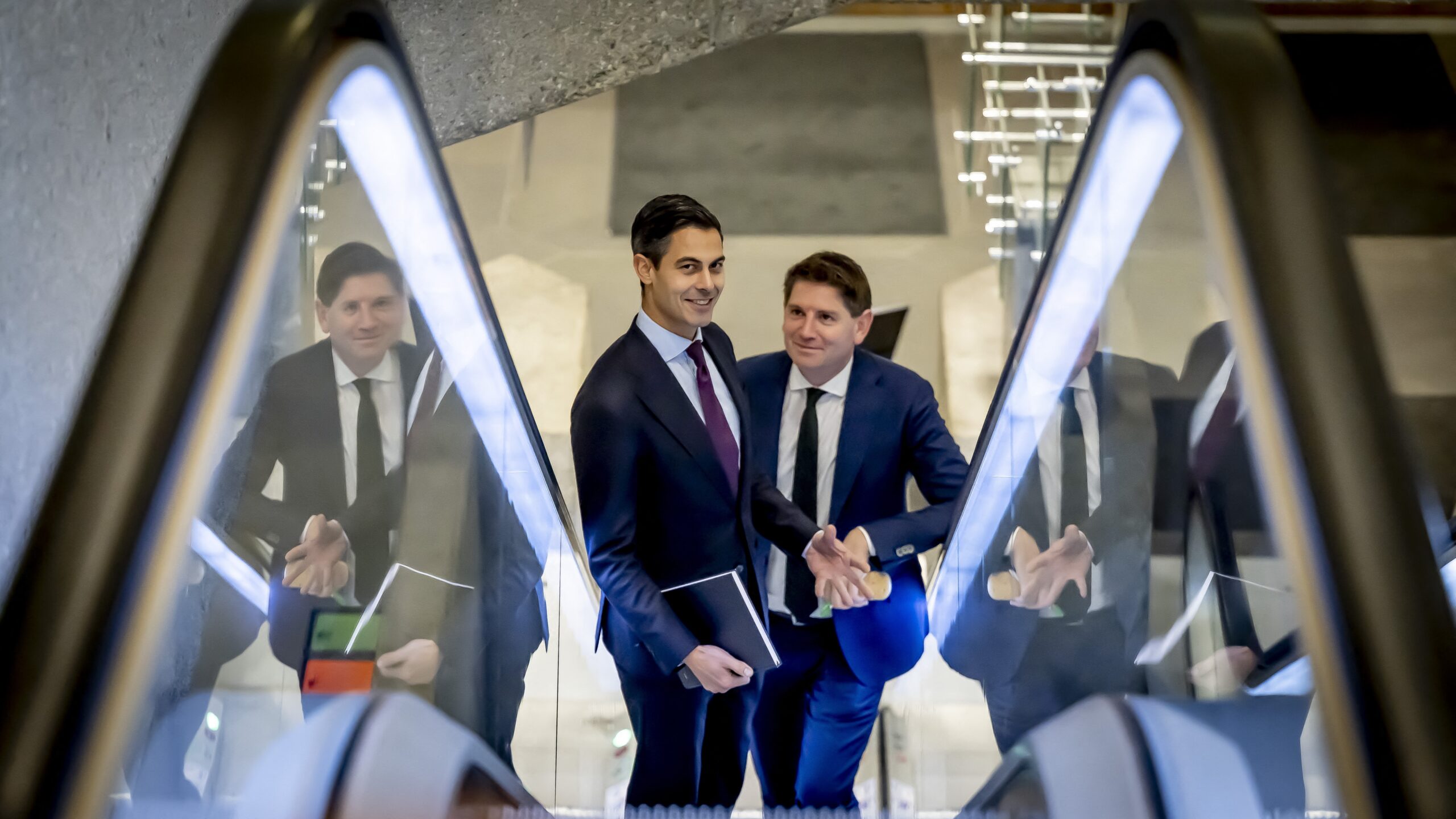
As morning broke on 30 October, the Dutch woke up to a radically changed, and even more convoluted, parliament.
The Party for Freedom of veteran right-winger Geert Wilders, the surprise winner in the previous elections and driving force behind Dick Schoof’s right-leaning coalition, had suffered major losses. Of the other parties in the coalition, only the liberal People’s Party for Freedom and Democracy (VVD), of former Prime Minister (and present NATO Secretary-General) Mark Rutte, did not suffer major losses. Conversely, the left-wing GreenLeft-Labor opposition alliance, headed by former European Commission Vice-President and Green Deal architect Frans Timmermans, also suffered a major setback.
Benefitting from this general fallout were, on the right, several minor conservative and nationalist parties. On the left and centre, instead, voted coalesced around the Democrats 66, a liberal-progressive party that had until then mostly played a secondary role in Dutch politics. D66, led by Rob Jetten, a young former minister of Rutte, outperformed even the most optimistic polls to tie with Wilders’ PVV for first place, both with 26 seats in the 150-seat Dutch Parliament. With Wilders already positioning himself in opposition, Jetten, a little-known figure outside of the Netherlands, was now set to be its new Prime Minister.
A full month has passed since then.
Coalition negotiations, convoluted as per Dutch tradition, drag on at their own pace, with Schoof serving as acting Prime Minister until a new government can be sworn in. A (classical) liberal centrist ‘coalition of the willing’ formed by the D66, the Christian Democratic Appeal—one of the Netherlands’ ‘legacy’ centrist parties—the VVD and the conservative JA21 party was considered the most likely outcome as the votes were being counted. Altogether, however, the four parties total 75 seats, one short of an absolute majority.
Another alternative, ie a grand, left-leaning coalition of liberals and socialists, is complicated by VVD’s refusal to work with GreenLeft-Labor, a position the party has so far refused to compromise on.
Nevertheless, there is now a much clearer picture of the new Dutch political scenario than one could have hoped to find in the days following the election. My choice to write and publish this article only now, rather than in the immediate aftermath of the results, stems as much from my own experience with Low Countries’ psephology—itself an exercise in prudence and patience—as it does from the rather caricatured coverage the Dutch elections have been given in most respected English-language media outlets.
‘What happened on election day was…a major internal realignment within the existing so-called political families or camps’
From the morning after the elections, the Dutch vote was ‘hailed’ by mainstream media outlets across the West as a ‘resounding defeat’ of the ‘far-right’, embodied in Wilders, the populist bête-blonde of Dutch politics. This is, at best, an erroneous interpretation imbued in the authors’ own wishful thinking and, at worst, an oversimplification of a complex political system.
What happened on election day was, rather, a major internal realignment within the existing so-called political families or camps. Politics in the Netherlands is an exercise in factionalism—a legacy from earlier times—with several political parties competing for relatively similar voter bases. These parties are informally grouped into ‘political families’, according to their broader ideological outlook. The most relevant among such political families are liberals, socialists, Christian democrats/centrists and lato sensu right-wingers.
In a multiparty system where nuance and specific policies are often the defining issues in coalition building, internal realignments such as these may prove even more consequential than major seat losses by an entire political family.
The liberal camp was the most affected by this realignment. For most of the post-War era, Dutch liberalism was synonymous with VVD leadership. Other parties, though often working in tandem with the VVD, were relegated to a secondary role, in policy and power alike. VVD liberalism, despite a leftward turn under Rutte, has traditionally had a stronger focus on individual and economic liberty.
If the VVD was the ‘classical’ wing of Dutch liberalism, its progressive soul was, par excellence, D66. The party was founded in 1966—hence its name—by left-leaning liberals dissatisfied with the VVD. Benefitting from the late-60s zeitgeist in the Low Countries, D66 quickly became the party of choice of upper-middle-class Dutch urbanites. In its external outlook, it is almost dogmatically Europeanist. As a minor member of several ruling coalitions since the 1980s, D66 was instrumental in consolidating this brand of progressivism as the Netherlands’ de facto State ideology.
A D66 premiership, be it in the person of Rob Jetten or of any of the party’s leading figures, is seen as a best-case scenario in Brussels. The party’s elevation as the standard-bearer of Dutch liberalism, even if by a few percentage points, is highly consequential. Under Rutte, the Netherlands had been a cooperative, if somewhat reluctant, partner of the EU’s ever-expanding geopolitical and economic agendas. In the corridors of Brussels, the Dutch were known as economically ‘frugal’ and ambivalent on enlargement.
‘D66 is not so much aligned to Brussels as Brussels has, over time, become aligned to what D66 has defended for decades’
A D66-led government would most likely eliminate most Dutch resistance, from environmental projects to diplomatic disputes between EU Members and foreign policy. It is in the latter domains that the Netherlands is expected to take a much more hawkish position, particularly in intra-EU matters. D66 is not so much aligned to Brussels as Brussels has, over time, become aligned to what D66 has defended for decades.
A D66-led government is likely to bring about a more hawkish position towards the EU’s Eastern flank, notably Hungary, Slovakia, and now the Czech Republic, where Andrej Babiš is set to return to the helm of a staunchly sovereigntist coalition. In the case of Hungary, though its disputes with the Commission over alleged ‘rule of law’ violations precede the War, both have become interlinked, in rhetoric and praxis alike. The Netherlands has mostly sided with Brussels in its disputes with Budapest, Bratislava, and Prague.
A Jetten Premiership could and would likely further escalate those and other disputes. For D66, an escalation of the disputes with Orbán and Fico (and of potential, and almost certain, conflicts with Babiš), particularly as Hungary will hold Parliamentary elections next April, is as much a ‘pro-European’ political move as they are a moral action in defence of ‘liberal democracy’. In both The Hague and Brussels, liberal-progressivism is neither a self-contained ideology nor can it be separated from personal morals.
The Netherlands’ position on Ukraine, already strongly favourable and aligned with Brussels, is unlikely to experience major shifts. If anything, Jetten, a liberal Atlanticist, would be an even stronger advocate of Kyiv and its EU Membership than Schoof or even Rutte. Where Jetten is likely to take a softer line than his predecessors is on the broader issue of EU enlargement, for long a contentious matter in the Netherlands.
There is growing impatience in the bloc’s neighbourhood towards the long waiting periods for membership, and the ever-growing demands put on prospective members. A D66-led government will not oppose enlargement, though it may be much more scrutinous on matters related to civil and minority rights, from, naturally, a Dutch liberal viewpoint. These issues, at the core of D66’s political theology, are likely to be reflected in its votes and demands for prospective new members. Likewise, the party’s liberal-progressive sensibilities mean that the Netherlands is more likely to come out in defence of Maia Sandu’s Moldova than, for example, Georgia or Serbia.
The Netherlands is still far from having a new government, and negotiations will likely take more months. Schoof himself does not expect there to be a new Prime Minister until next year, and even expecting a new government in its first months is, at best, optimistic.
So far, the D66 and the CDA have taken the leading role in coalition negotiations, alongside the VVD. The latter was given the post of Speaker of the Dutch House of Representatives, signalling the Premiership is likely to be held by either the CDA or, more likely, the D66.
‘As is often the case in Dutch politics, principles may end up taking the backseat in favour of pragmatism’
Either way, arithmetic is not on anyone’s side. The numbers for the centrist coalition are insufficient without external support or the addition thereto of another party. Whoever would be included in this case would fundamentally alter the ideologically liberal character of the coalition. A left-leaning coalition is made impossible by the principled stance of the VVD and especially that of party leader Dilan Yeşilgöz on GreenLeft-Labor.
As is often the case in Dutch politics, principles may end up taking the backseat in favour of pragmatism, even at the cost of Ms Yeşilgöz’s leadership of the party, or, at the very least, of its incontestability. This is complicated by the refusal, so far, of VVD to work together with the GreenLeft-Labor joint list. Jetten remains the most likely future Prime Minister.
Even if he were not to be so and the CDA were to take on that role, the D66 will be the driving force behind any new government. Its actual policies will depend as much on the future coalition agreement as they will on the synergies that will be formed between The Hague and Brussels.
Related articles: