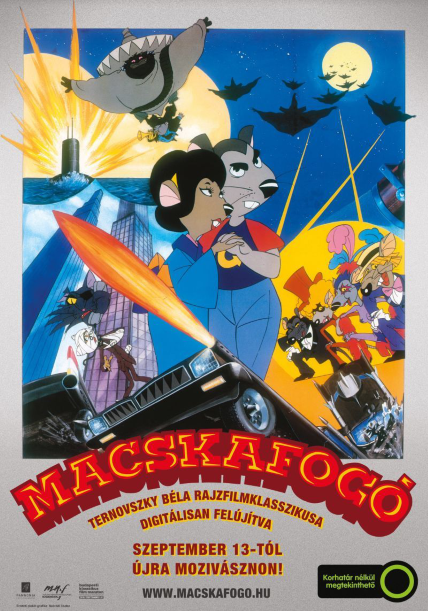
The world of Cat City (1986) is animation at its most bonkers and most charming. You will see mob bosses, dodgy salesmen, and spies, sea battles, cabaret and heists, San Diego-esque metropolises, jungles straight out of Kipling and interplanetary party venues. Not to mention vampiric bat banditos.
Crime caper, parody, and historical allegory all in one, a horn of plenty and then some.
The yarn goes like this. Mouse society on Planet X in the year 80 AMM (after Mickey Mouse) is plagued by a nefarious multinational syndicate of cats who aim for total mice annihilation.
Before the mice are forced to leave the planet, a new hope arises when Agent Grabowski is pulled out of retirement by Intermouse intelligence to retrieve plans from the far eastern city of Pokio that will prevent the cats’ supremacy.
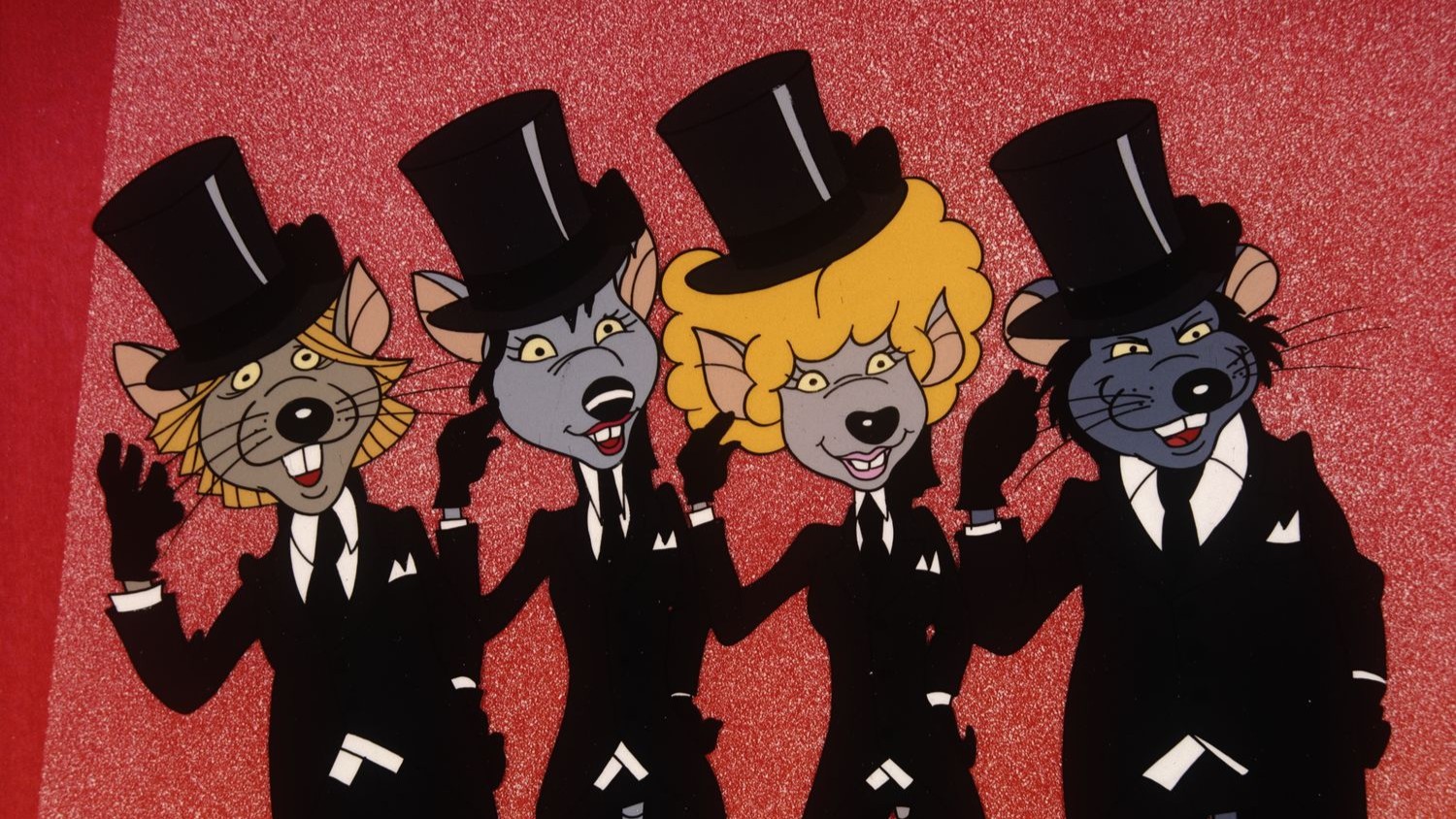
But Cat capo Mr Teufel is tasked with stopping Grabowski, for which he hires a haphazard gang of ex-ballet dancing rats.
The only extant contemporary review of Cat City online appears to take the whole thing seriously. Since then, the film has been seen as primarily a parody of the James Bond series.
However Grabowski grunts the most dull lines, wears a red and blue T-shirt with a yellow capital G on the front, and so most obviously has the appearance of Superman with the personality of Batman.
But these plays on various action classics are a sideshow. The main event of the film is the unmistakable satirizing of the communist regime under which it was originally released.
Perhaps the fact that Teufel is German and reports to an Italian fat cat chairman named Giovanni Gatto was felt to be disguise enough, but the Soviet tropes are plain to see.
Teufel’s relations with Gatto are like satellite state leader to the central authority. Teufel is meek towards his superiors while he terrorizes his underlings. There is the clever conceit of his technicians’ costly mouse-liquidating inventions failing on first contact with reality and the arbitrary sackings and disappearings which follow. The punishment scratchings Teufel administers to Safranek, his poor assistant, become increasingly unsettling as the action progresses—the only dark element in a film where there is plenty of violence but never any bloodshed.
In contrast to the cats’ brute force and overreliance on zany experiments, the mice make ingenious use of their rodent physique—using their tails to pick locks and as makeshift propellers, and their teeth to fashion holes for rigging. It is difficult not to identify the plucky mice with the Hungarian people.
For this reason, the film watches well today: it feels like Hungarian director Béla Ternovszky plied every Western motif he had seen to smuggle behind the Iron Curtain a film about communism. I cannot see any good reason for the manifest Polishness of Grabowski’s name other than to keep the hero Central European.
Stitching together the pictures of chaos is Tamás Deák’s original score. And in one of the most beautiful scenes in cinema, a character saves his own life by playing a bossa nova trumpet solo, upon which the other instruments of the ensemble are layered one by one, like a jazz version of Benjamin Britten’s The Young Person’s Guide to the Orchestra.
I’d watch the film again for this alone, but the comical mercy the victorious mice show the cats makes Cat City the perfect watch with children this Christmas.
Related articles: