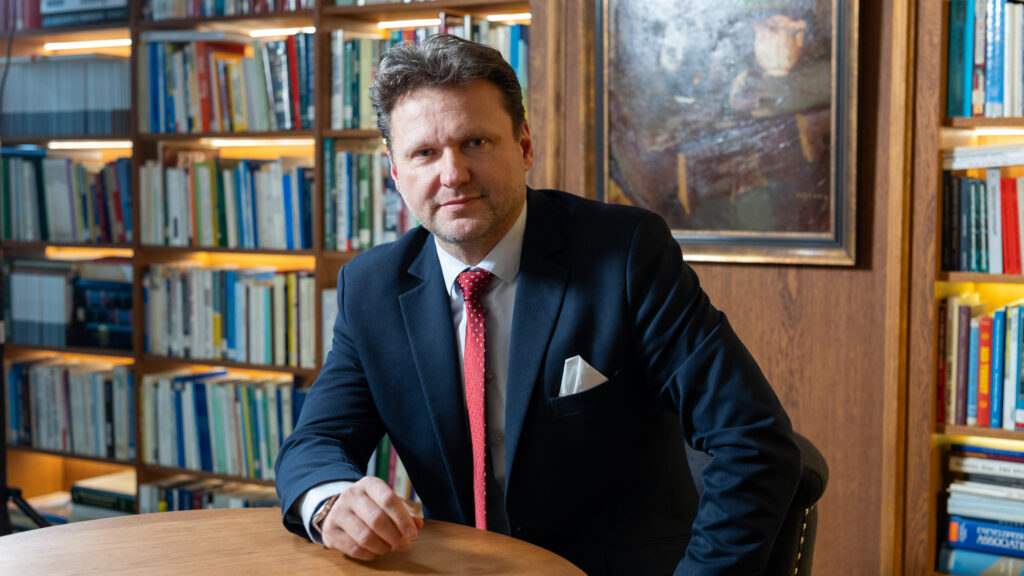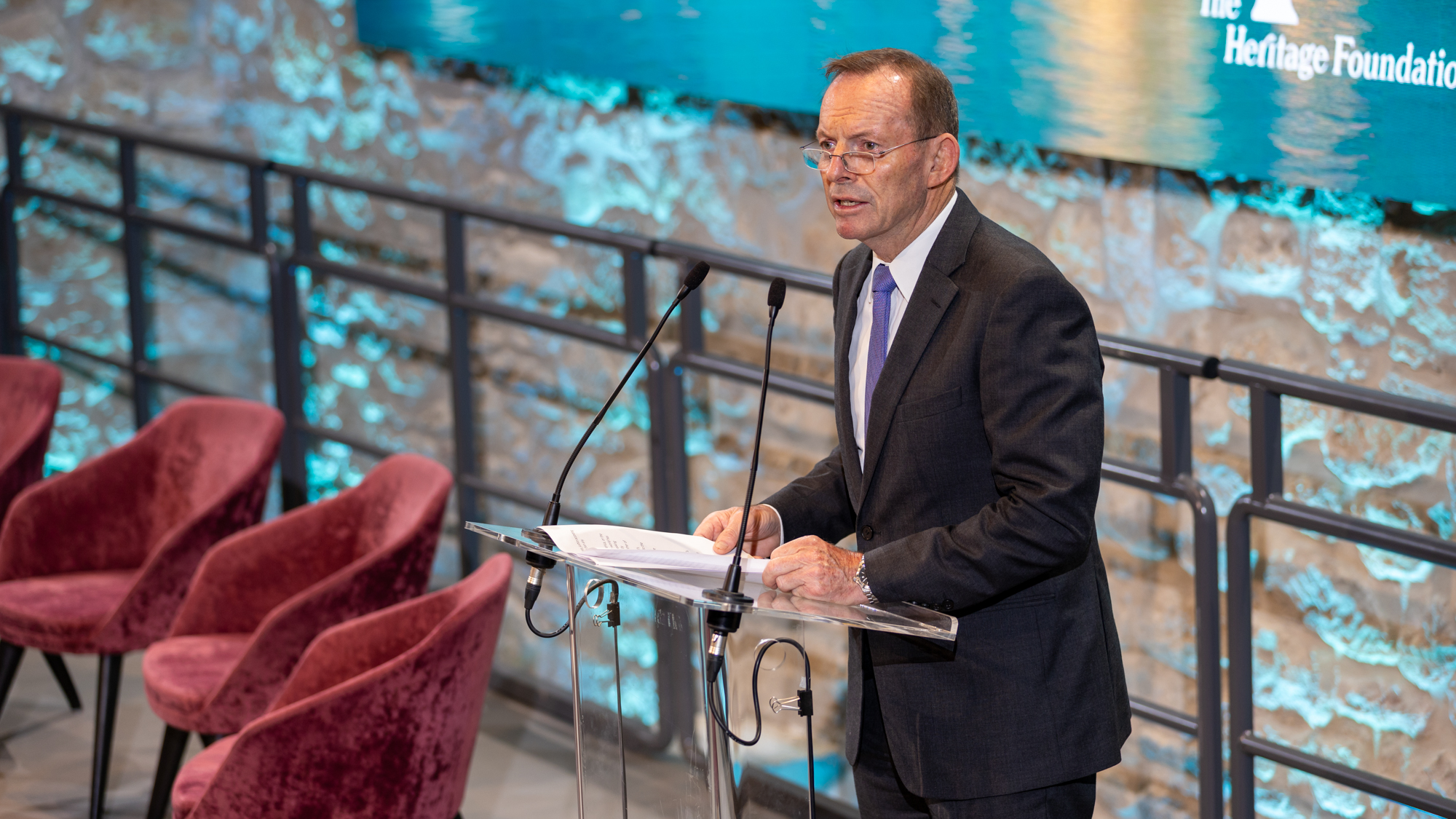
Tony Abbott, a veteran Australian conservative politician, served as prime minister from September 2013 to September 2015. He is best known for ‘Stopping the boats’ and drastically reducing sea-borne illegal migration.
Mr Abbott has long been one of the most outspoken critics of the failure of the left-wing Australian government and Prime Minister Anthony Albanese to tackle the explosion in antisemitism and Islamist radicalization that followed the 7 October 2023 terror attack in Israel.
Now a Senior Visiting Fellow at the Danube Institute, he spoke exclusively to Adam LeBor about the lead-up to and aftermath of the December 14 Bondi Beach attack—and what the Australian government, and the country as a whole, need to do next.
***
I’d like to start by asking you, on a personal level: where were you when the Bondi Beach attack happened? How did you first hear about it, and when did you realize the magnitude of it?
I was at the local fire brigade, where I’ve been a member for some 25 years. Every Christmas, we do these Christmas lights as a community fundraiser. I was helping on the barbecue, and someone said there’d been a shooting at Bondi. I assumed that it would have been, say, some organized crime figure being shot. But then I started getting text messages saying that there’d been a massacre.
That was when I put out my first social media post, just saying that this was a dreadful escalation of the rampant Jew hatred, which has been so obvious in our country since the original 7 October rampage and which all levels of government have lamentably failed to act against. The Albanese government, in particular, has been guilty of impotent hand-wringing in the face of this obvious challenge to our way of life and this obvious challenge to our social cohesion. That should have been patently obvious to senior people in our official establishment. From the very beginning, from the welcome that local Islamist hate preachers gave to the original carnage, then there was that, excuse me, appalling display on the Opera House forecourt where we heard ‘Gas the Jews’ and ‘F the Jews’.
Was that actually said in the demonstration at the Sydney Opera House on 9 October 2023, ‘Gas the Jews’?
Well, it sounded like ‘Gas the Jews’. Certainly, it was ‘F the Jews’. The police, I think, as much as anything to justify their failure to take action against the demonstration, subsequently claimed that analysis of the tapes revealed that the demand had not been so much to ‘Gas the Jews’ but rather, there was a question: ‘Where’s the Jews? [sic]’—as if that’s somehow an innocent question from an angry mob.
The whole thing was just embarrassing. The only person who was arrested that night of 9 October was someone holding a Jewish flag. That person was arrested and made to leave lest he cause a breach of the peace. Otherwise, the police just shepherded this large and angry crowd down to the opera house forecourt. The opera house had actually been lit up with the Israeli flag as a way of demonstrating solidarity with Israel, 36 hours or so after the original atrocity. Yet we had hundreds and hundreds of angry people, saying not just that they were indifferent to the atrocity but that they actually supported it. So this was the evil inside our country, which, regrettably, the Albanese government up till now has proven completely incapable of dealing with.
Why are they so incapable of dealing with this evil?
There are two issues. The first is the presence inside some senior cabinet ministers’ electorates of large, not particularly well assimilated Islamic populations, and I guess, the leftist ideology which sees Jews as possessors of white privilege and Israel as an exemplar of settler colonialism and therefore as oppressors. So I think it’s a combination of political cowardice and leftist ideology which has stayed the government’s hand in dealing with all of this.
‘We had hundreds and hundreds of angry people, saying not just that they were indifferent to the atrocity but that they actually supported it’
What you are saying is word-for-word almost exactly the same as what’s happened in Britain. For weeks after 7 October, we saw sometimes hundreds of thousands of people taking over the centre of London, screaming for the destruction of Israel and the total failure of the police to deal with it. So, what puzzles me, with your vast political experience and your experience of government, is how Western democratic states can fail so catastrophically to deal with a threat of this level?
This is a very good question, and I think at heart it boils down to the cultural relativism which has tainted so much of our academic and then our official establishments over the last couple of decades. We find it almost impossible to make moral judgments. We have a chronic tendency to be on everyone’s side but our own, and I think that’s what’s really to blame.
We just find it very, very difficult to be clearly against anything if that anything is somehow, I suppose, evoking in us feelings of guilt and ambivalence about our own societies and our own cultures.
How did we get here?
I think for too long, too many people have been too polite. For too long, too many people have been reluctant to disagree with or confront things that they must have known in their hearts were palpable nonsense or at least dangerously misguided. And look, there’s a litany of things that have become prevalent in recent times and yet which I think are in defiance of common sense, whether it be the emissions obsession, the gender fluidity push, the virus hysteria we all succumbed to a couple of years back, or the magic pudding economics. But the worst failing, the worst of our failings, is the cultural self-loathing that is so prevalent in the Anglosphere, particularly, notwithstanding the fact that the West, generally, but the Anglosphere in particular, has produced the best societies in human history, at least in terms of freedom, fairness, and prosperity. I mean, we are the least racist, most colour blind societies. And yet there’s this general self-loathing.
I’ve often thought that the reason why Western civilization was likely to last in a way that previous civilizations have not was this capacity for self-criticism. We don’t assume that we have all the answers. We don’t assume that we’re the last word in wisdom and knowledge. We have historically lacked that kind of arrogance. Yet that healthy capacity for self-criticism has more recently metastasized into this self-loathing—almost a paralysing one. It expresses itself in so many ways—our inability to promptly police these incitements to violence demonstrations, our inability to rein in the welfare state, our inability to boost our military preparedness against obvious potential aggressors. I don’t know whether it’s decadence or whether it’s just general passivity.
What do you think should have been done if you’d been in power, say, over the last four or five years?
So we’ve now got quite a large Muslim population, close to a million people here. As in Britain, they tend to be concentrated in certain parts of our bigger cities, and therefore have quite a significant influence on local politicians and political parties that are strong in those areas. Now, I should stress that the vast majority of Australians who happen to be Muslim are good people. If there was a bright spot to the catastrophe of 14 December, Sunday evening, it was Ahmed al-Ahmed disarming one of the gunmen.
‘We just find it very, very difficult to be clearly against anything if that anything is somehow…evoking in us feelings of guilt and ambivalence about our own societies’
So there are lots of Muslims who don’t believe in death to the infidel and just want to get on with having a decent life. But there are too many who, under the influence of extremist preachers, do seem to believe in death to the infidel and some who are prepared to put that into practice. We’ve just got to be completely vigorous in tracking that down and stamping that out. And if that means deporting hate preachers, closing down the Islamist mosques and prayer halls, if that means much closer vetting of long-term visa applicants, their social media, their associates, etc, to ensure that we’re not importing hatreds into our country, well, so be it. It just has to happen.
You have been extremely critical of the Albanese government since 7 October.
By taking no effective action against two years of incitement to violence and lower-level incidents of violence such as vandalism of Jewish property and firebombing of synagogues and so on, the government has, in effect, licensed the attitudes which have produced the horror that we saw now. I think the government is no less shocked than the rest of us, and yet it shouldn’t have been because it has been warned time and time and again, including by the head of ASIO [the domestic intelligence service], that this kind of thing could and would happen. He has been speaking out against the rising tide of hate speech and incitement to violence, particularly directed by Islamist preachers and Islamist organizations against the Australian Jewish community.
How many people are on terror watch lists in Australia?
I can’t give you precise numbers, but I think we would be talking in the low thousands rather than the high hundreds. To maintain 24-hour surveillance over people, as we know, is an extraordinarily manpower-intensive exercise. And this is why it’s very important to try to ensure that, as far as is humanly possible, we don’t have significant populations that are prone to this kind of violent extremism.
How important do you think it is that the state shows it’s in control of public space? We see in London that the British state has totally failed to take control of public space. It does not assert itself by saying: ‘We are running this. You do what you’re told. We decide what can be done and what can’t be done.’ That’s not happening. The protesters see this state failure and weakness.
This is exactly right. Almost nothing is more corrosive of public confidence in its own safety and the tranquillity of society than to see the police surrender the streets to people who are calling for violence and are obviously having intimidatory intent against some of their fellow citizens. I’ve routinely contrasted the behaviour of the police who cracked down with extreme vigour on freedom protests during the pandemic. We’ve seen nothing like the same vigour. I mean, the police are more than capable of acting pre-emptively to arrest so-called white supremacists. But for some reason, there’s kid-glove treatment with these Islamist protesters. I think when you’ve got people who are plainly promoting violence, who are plainly trying to intimidate their fellow citizens in favour of or against some particular ideology, well, the police have got to be absolutely even-handed and completely relentless in breaking them up.
If you were prime minister now, what are the top four, five, six things that you would be doing? You would summon your cabinet and say: ‘This is what we’re going to do’, in the short-term, medium-term, and long-term.
In the short term, I think you’ve got to be absolutely clear that there will be zero tolerance for hate preaching. You will close down mosques and prayer rooms where this takes place, and you will prosecute and, if possible, deport anyone who is practising hate preaching.
You’ve got to make it crystal clear that there will be no more hate marches permitted. They will be stopped. And if they take place, any of their participants will be prosecuted and punished. I do think we’ve got to make it clear that visas will not be issued to people with a history of antisemitism or a history of support for ideologies which are inconsistent with the liberal, pluralist, democratic way of life that we enjoy in this country.
I think more generally, we’ve just got to have a much greater stress on Australian values. I mean, I’m not saying for a second that we should discriminate in our immigration programme on the basis of race or religion. But we certainly should discriminate very strongly on the basis of values. One of the points that I’ve often made in recent times is that new citizens in this country are required to take a pledge from this time forward: Under God, I pledge my allegiance to Australia and its people. And this is the critical bit—‘whose democratic beliefs I share, whose rights and liberties I respect, and whose laws I will uphold and obey’. Now, we’ve got to not just say it, people have got to mean it and live it. And if they don’t mean it and live it, well, there should be some consequences, because as it is, we have been far too acquiescent and I suppose, far too tolerant of the intolerant. And that must change if we are to survive in the long term as a free and peaceful society.
What do you think the impact of the Bondi massacre has been on society as a whole?
Well, the initial response has been shock. I think for at least some members of the government, it has been a wake-up call. Let’s hope it’s a lasting one and that we don’t just go to sleep again in a couple of months’ time—because that is exactly my fear. I just think there are too many people in our official establishment who are, by nature, social justice campaigners as opposed to national security warriors. That’s what we need in these perilous times. We need more people who are national security warriors.
‘We need…people who believe passionately in our countries, in their fundamental goodness, and are prepared to act strongly where necessary to keep them safe’
Do you think that over the last couple of decades, the West, in general, Britain, France, Germany, and Australia, have all been naive about the people that they have let in? In Britain, we’ve had this scandal about Pakistani rape gangs for going on for decades; they’ve had terror attacks in London, in Paris, in Brussels. In Germany, they were handing out sweets in Berlin on 7 October. It feels like something has gone wrong on a strategic level.
We need, at all levels, people who believe passionately in our countries, in their fundamental goodness, and are prepared to act strongly where necessary to keep them safe. And we haven’t had nearly enough of that.
Are there any specific lessons for Hungary and Central Europe here? They haven’t had these kinds of incidents, and they haven’t allowed this kind of migration either. The cultural Marxism, this idea that everything in our society is wrong and evil and based on imperialism, colonialism, and slavery, that massive guilt complex in the governing class doesn’t exist in Central Europe. These countries are just very happy to be free and to decide their own destiny, finally. There’s a kind of confidence here in the national identity that you just don’t see, or you see very rarely in the West now, at least in governing circles in the West.
Well, perhaps because the countries of Eastern Europe have a recent history of oppression, they, I suppose, have a stronger sense of what they need to do to protect themselves and preserve themselves. We in Australia did successfully stop a wave of illegal migration by boat. But Viktor Orbán has gone one better than us. He’s, first of all, accomplished a harder task of stopping a wave of illegal migration by land, but he’s also strictly controlling legal migration because he thinks, quite rightly in my belief, that Hungary has a right and even a duty to keep its culture. And large-scale migration by people who don’t share that culture inevitably will, over time, water down and eventually, I suppose, evaporate the distinctive Hungarian culture.
Related articles: