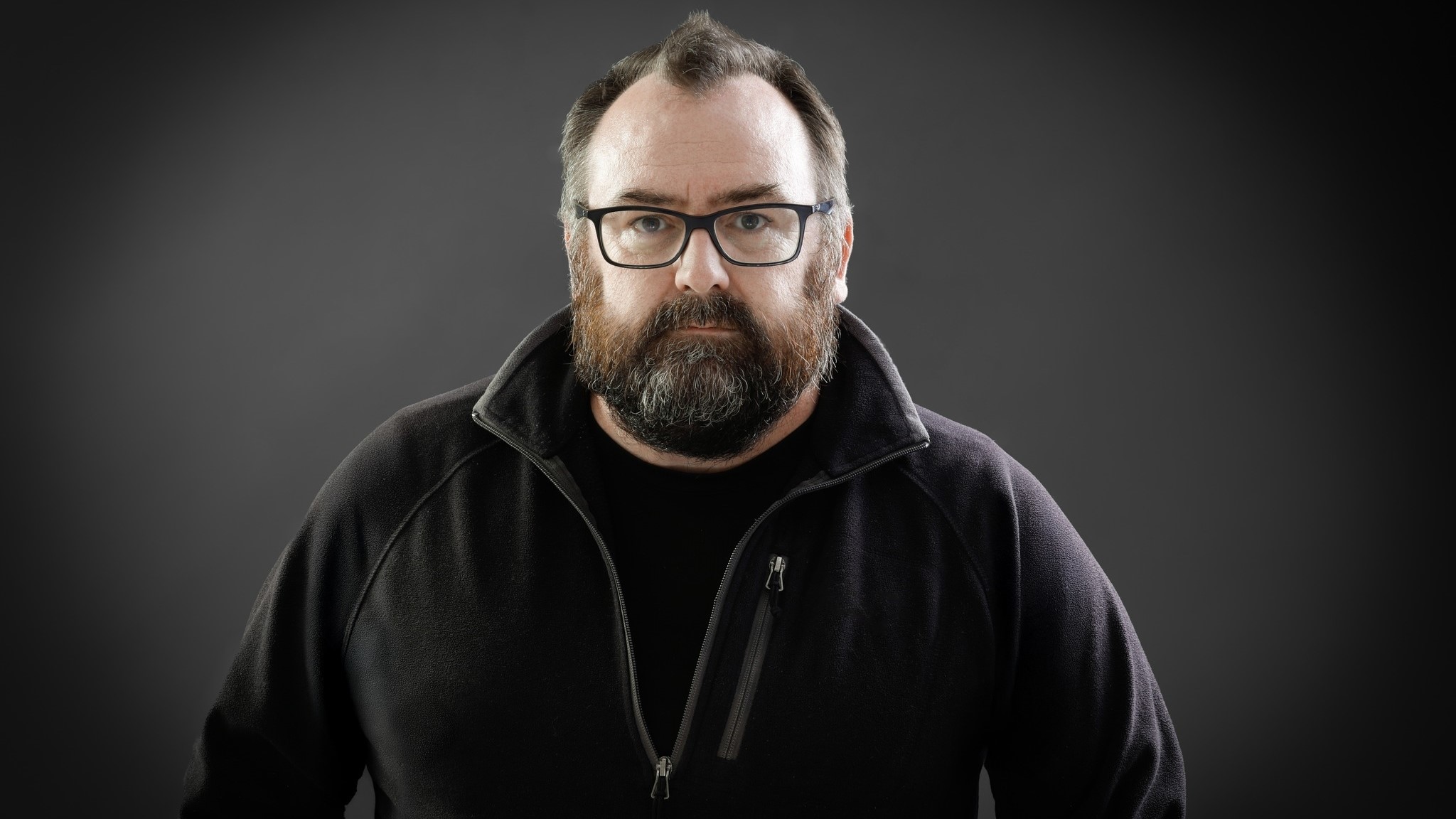
Dr Eoin Lenihan is an independent journalist and researcher. Lenihan holds degrees in History and Archaeology from the National University of Ireland, Galway, and a doctorate in Pedagogy from the University of Augsburg. Focusing primarily on politics today, he has written for a wide range of international news outlets, including The Federalist, The European Conservative, Gript, Daily Caller, Quillette and Post Millennial, and has featured on AlJazeera and Fox News, among others. His peer-reviewed study of Antifa uncovered damning evidence of how Antifa in the US infiltrated the national media and remains the largest empirical study of the group to date. His new book, Vandalising Ireland, has become an Irish bestseller. Hungarian Conservative has previously reviewed it.
***
I don’t know how closely people pay attention to this, but Leo [Varadkar], Simon [Harris] and Micheál [Martin] are [in the United States] on their knees every St Patrick’s Day, meeting with the President. They also go to Australia and Canada and the UK as well, doing the same routine and pushing this traditional image of Ireland that doesn’t exist anymore, right?
Absolutely. They have a very cynical tradition that’s come up in the past five to seven years in Ireland, where Micheál Martin and Leo Varadkar before him, and all of them, they all have the same routine down. They stand in these incredibly important revolutionary or historical landscapes and deliver these open-borders globalist messages. So, for example, they’ll stand on the block where Mikey Collins, our great revolutionary leader, was assassinated, and this happened when Simon Harris first came to power. Then he started talking about the dangers of mis- and disinformation of the far-right online.
‘I think that they use our history, culture and identity as a skin suit when it suits their political agenda’
When Ireland was gearing up to try and take in massive numbers of Ukrainian refugees—we took in over 100,000, far above the average of any other European nation—Micheál Martin stood at the Famine Memorial, where there was a double-centenary, a landmark event taking place, to talk about how Ireland and Ukraine have a shared history of struggles. And it was totally shoehorned in. They like to stand in our landscapes that have extraordinary historical meaning to the people, and then deliver these politically charged and globalist messages, which I find quite offensive, because I think that they use our history, culture and identity as a skin suit when it suits their political agenda.
Other than that, on a daily basis, they do anything they can to erode it. For example, while you say that these boys are out in America and elsewhere peddling this romantic idea of Ireland that they’re undermining and no longer exists, the Dublin St Patrick’s parade will have every culture represented except our own kind. It’ll be this multicultural hodgepodge of New Ireland. So again, there’s a great degree of cynicism and political opportunism at play with these people, and because it’s impossible to get them out of power, they know they can be blatant about it.
I want to ask you a quiz question for our Hungarian audience. Do you know in which Hungarian city does Joyce’s Leopold Bloom have his roots?
Oh, I’m not a big Joyce scholar. I’m going to have to go with one of the secondary cities because it’d be too obvious, wouldn’t it? It’s not Budapest? My father would have killed me. He was an English teacher.
It’s Szombathely, near the Austrian border, a beautiful place. And I highly recommend that Irish take advantage of this literary connection and see Szombathely.
Well, I will. I was at a conference in Brussels recently with MCC, and I learned a great deal about Hungary. I was told that I have to go to Lake Balaton before I die. That every year there’s a 5k swim across the lake. That’s kind of a rite of passage. And, having spent a little time with Hungarian people, I was interested. I felt that they were a remarkable group of people.
But it was amazing just to see how united in vision and how connected they were. And it just basically reminded me of Ireland when I was young. Do you know, where you have this high-trust society, where you have people who have a very strong sense of self and identity, and who are pushing for something that they’re proud of in a really beautiful way? And that’s what I came away with, this idea of Hungarian identity. You can tell it’s motivated by a very deep love, and of identity, culture, history, of course, overcoming incredible struggles. And I did see a lot of similarities with Ireland, and it did make me sad to see how we went on such very different paths.
And, I think that’s fundamentally underpinning the different trajectories that we’ve gone on. You see that in our economic models, in particular. For Ireland, in the 1950s, we pursued this EU- and FDI-economy path. But it worked up until around 1995, and then we were reaching full employment, and we had a very high standard of living. We were self-assured. Culturally, I would say that’s when we peaked. That was a great time. But then our government got greedy, and they decided: ‘No, we want more and more and more.’ So they put the foreign-direct-investment economy on steroids by introducing a 12.5 per cent tax break. But very quickly, we didn’t have the manpower to support all of the different industries that we were bringing in. And that’s been the case for 25 years now, where, even though Ireland is the headquarters of every tech giant in Europe, they overwhelmingly—and we’re talking about up to the 90th percentile—now employ people from India, primarily, and people with non-EU visas, generally.
And so, we’ve gone down this pathway where, just for greed, and I think because of the underlying self-hatred and anger that underpins the social wins driven by Sinn Féin, that we went down this very self-destructive and self-hating path which is now leading us into this globalist mess. Whereas Hungary have taken it a different direction. I know Hungary came out a little later than us, joined the FDI economy, maybe 20 years later or so. But it is noticeable, the difference that, so far, Hungary has been pursuing multinationals that fit the employer profile of the country. They’re not expanding beyond what they can handle. In Ireland, we went from a population of 4.9 million in 2005 to five-and-a-quarter. Now, a quarter of all people in Ireland were born overseas. That happened in 25 years. That’s insane. There’s nothing comparable to that. And there’s no hope of integrating, even if you wanted to. And we don’t, because multiculturalism has been the de facto religion of the nation for the past 20 years, along with this mass immigration.
‘Hungary has been pursuing multinationals that fit the employer profile of the country’
So, we’re losing ourselves. We’re losing our sense of identity. We’re losing our sense of who we are at a rapid pace. And anyone who wants to point that out is heckled and booed and attacked, which is what happened at the start with this book Vandalising Ireland from Official Ireland. But it just makes me sad, because I look at what has been achieved in Hungary. I’m not against the FDI economy. If it works for the nation—and it has to work for the nation—that’s fine, but Hungary has been much more deliberate and much more careful in pruning it to make sure that it works for the nation.
What ultimately underpins that—maybe it’s religion, maybe it’s faith, maybe it’s a brutal past. Maybe it’s just this beautiful sense that we are special, we are unique, we are a wonderful people. Hungarians seem to have made a decision, somewhere, that a barbecue on the deck and a flatscreen TV doesn’t plug the hole. Somehow Irish people sold out their soul for a very poor return. And it has been a very poor return indeed.
In a 2023 interview with the Budapest Times, then-Ambassador Ronan Gargan said this:
‘I can only speak for Ireland’s experience. I don’t think the perception that it was very easy for Ireland to come to an epiphany overnight that we had to be open, progressive, and inclusive. It wasn’t that way at all—it took decades for us to get to the point where we are today. Lots of factors contributed to our transition—investment in education, EU membership, globalization, immigration, the waning influence of the Catholic Church in Ireland. These have all contributed to us dealing with important societal issues, whether it’s marriage equality, abortion, and reproductive rights for women. These issues haven’t been easy for Ireland. To some extent, we have to give countries like Hungary space and time to be able to look at these things themselves…There are certainly some concerns and questions of whether Hungary’s current government is fully living up to those obligations as an EU member state, and that’s where countries like Ireland and other countries are willing to raise their voice and raise questions and concerns in relation to those issues.’
To what extent do these sentiments reflect Irish attitudes toward Hungary?
I would say that they very strongly represent Irish political class across the spectrum, but they bear virtually no resemblance to the electorate’s feelings on the matter. Like I said, Ireland is a crippled democracy, whereby the two big parties have jumped into bed together and have a silent partner in the main opposition. They don’t have to care what the Irish electorate think. So these guys can go out to Europe and make extraordinary statements, extraordinarily condescending statements. Who on earth is Ireland to talk down to Hungary and tell Hungary how to do their business? They don’t do so with any authority, vested authority. Yes, they’re elected.
But, as I said, Ireland has very much a crippled democracy. We saw that recently, where over 200,000 people spoiled their votes in the presidential election because all of these parties colluded to stop a conservative, middle-of-the-road, Christian candidate getting on the ballot. So, these people do not speak, in my opinion, with authority when they say things like this. But, more importantly, they never asked. There was no mandate from the Irish people to turn Ireland into a multicultural, mass-immigration, open society. We didn’t ask for that.
In fact, there’s now a growing resistance to it. Because, for decades, Irish people were stood down on electorally. And it’s a very real buying-off process that they eliminated VAT on newspapers. They are the number-one employer for top editors in the newspapers, the special advisers in governmental positions. They do this through Coimisiún na Meán, the government’s regulatory body. They hand out a series of grants to keep the national public and private media afloat. Literally, they’re the biggest advertisers, public and private, to all media in Ireland. So, without the funding, direct funding from the government, Irish public and private media cannot exist. It does not exist. It collapses overnight.
And so, they are, in a very real sense, beholden to the government and obviously will then follow the government line on all matters. They have been complicit in the past two decades in shutting out any criticism of government policies. So, as this government stands confidently in Europe and says that they will use their voice against countries like Hungary, they do so without the backing of the Irish public.
What’s at the nub of it is this clash of world views. These people who represent Ireland and are backers in the media and the NGO classes, who are pushing it, have a very dismissive view of Irish history, identity and culture. They hate it. They reject it. They see it as backward-looking. That’s what Micheál Martin called it. He wants nothing to do with a backward-looking notion of sovereignty, he said in the Dáil. So these people despise our own identity and heritage, and they’re then going on a European platform to talk down on Hungary, because Hungary has this very positive self-image, this very attractive self-image, this drive that says: ‘Hey, we’re not going to sell out our sovereignty, our identity, our demographics, whatever else you want to put under that umbrella. We’re not going to sell that out for some American multinational dollars.’ That’s what it comes down to. It comes down to a very simple choice: Is your country for sale, or is it not? Hungary has said: ‘No, leave us alone. We’re happy being Hungarian and doing our thing.’ And the Irish, along with the rest of Western Europe, are attacking them because they have this self-confidence.
‘These people who represent Ireland…have a very dismissive view of Irish history, identity and culture…They see it as backward-looking’
What I hope that Hungarians are aware of, and if I could shout from 1995 to Hungary, what I would say is: ‘Know your cut-off with the foreign direct investment.’ Because, what happens is that it’s a powerful drug for politicians who want to stay in power, but especially for those who are pro-EU. And it’s how the EU manages to reach in and destroy borders.
Once you expand beyond your native workforce, you’re finished. A small handful of American tech multinationals are propping up the entire Irish economy, and they’re overwhelmingly employing from overseas. Once you’ve over-leveraged yourself on this FDI economy, you’re finished. What you’ll have noticed in every European nation is that the globalist blob works closely with the Left and the socialists, because they both want the same thing, which is open borders. Globalists want open borders because it fuels cheap labour. And the leftists want open borders because they’re true believers. So, they work very well together. That’s why you don’t want to allow in the European federalists at any cost. Once you do, you’re letting in a coalition of globalists and leftists, and you’re done. You’re cooked once you open that door. There’s no going back.
But this is my warning to Hungary: The Irish Ambassador who spoke so condescendingly to Hungary in that 2023 interview talks about how wealthy Ireland is. He talks about how well we’re doing, and what we went from. We went from a backwater, like you, Hungary, to this powerful, world-beating nation. Well, first of all, Ireland owns nothing. We’re owned by America. But secondly, we are a rich country on paper, but we aren’t actually a rich country. This GDP-chasing is an extremely artificial way of pumping up numbers. We are going through the biggest housing crisis in our history right now. 40 per cent of all working young people are living in their parental home, with no hope of ever buying their own home. That’s going to have a cataclysmic effect on birth rates, family-formation and the nation. If that continues, we also have the highest rate of young people who want to emigrate in the EU. So, even though we have this guy going out to Europe, preaching down to Hungary, Ireland is the most young-person-unfriendly nation in Europe. It’s the nation young people want to leave, and it’s the nation where young people can’t afford to live and start a family.
One element of your book that struck me was the section on Irish media. Hungarians, of course, are accustomed to foreign accusations that the Orbán government does not permit media plurality. It’s an absurd accusation, though I always encourage people to visit Hungary and experience it for themselves. What would you say to Hungarian readers on this topic?
I would say that you need to cherish it, and you need to fight for it, and you need to protect it, because in Ireland, the media is owned by the state. Again, what comes to mind very often is: ‘Lies, damn lies.’ Very often you’ll see EU-backed studies which put Ireland very high up the rankings of media freedom, press freedom and journalistic freedom, which is a total ruse. It’s a complete myth that the government is able to completely manage and editorialize what’s said in the public and private media, because they literally own the media. So, they’re able to do it from a hands-off position.
You don’t need to come in with truncheons, and bust up media offices, and breathe down people’s necks and make threats if you own them. If you own them, they do what you say. And that’s how Ireland has done it, and I would imagine it’s the same in other small nations, but I have never seen it to the degree we have it in Ireland. There is no media plurality in Ireland. You can turn on the television any night, and you can watch any political debate, and it’s all just theatre. You’re going to have maybe two journalists, maybe from different papers. You’re going to have an NGO head and a politician, and they’re all saying the exact same thing, because they’re all paid from the public purse. They’re all paid by the government.
‘There is no media plurality in Ireland’
The biggest danger, and the worst thing that’s happened to Ireland, is that we used American capitalism, so the billions that came in from American multinationals to fund socialism at home. That’s what happened. It’s more of a clientelism than a true democracy. They are very good at strategically doling out grants and handouts and getting people hooked on socialism as a means of getting them to do what they want.
So, just to sum it up, here is how the Irish media is owned by the government. There’s a number of ways.
The first way is that the Irish government is the biggest spender on advertising in all news outlets, public and private.
The second way they propped them up is that they got rid of value-added tax on all newspapers, online and physical, even though, for example, our biggest employer, the hospitality industry, is struggling on its knees, and they reduced the media VAT from 12.5 to 9.5, thinking they’ve done a wonderful thing, even though hundreds of businesses are going out of business every year. So, they protected their own, the media landscape.
The third way they buy them off is through strategic grants and Irish state media regulator Coimisiún na Meán.
Now, I’ll to give you a sense of why all of this matters. RTÉ, the national broadcaster had to be bailed out by three-quarters of a billion euros this year because the losses it incurs year-on-year are so great.
As gor the private media, there’s three conglomerates. There’s media based in Brussels or Belgium. They’re really on the bread line. They cannot exist without the government. If the government pulls their advertising, they fold tomorrow. If the government reinstates that VAT, they’re close to folding tomorrow. And so, what the government have done is quite brilliant. They don’t make them rich. They don’t offer them riches such that they can get bloated and get ideas of grandeur. They give them just enough to survive and just enough to keep toeing the government line, and the most strategic way to do that is Coimisiún na Meán.
How would you describe state media regulator Coimisiún na Meán to a non-Irish reader?
They hand out, a couple of times a year, a series of grants, essentially to prop up government narratives on anything from migration to LGBTQ matters. First of all, Coimisiún na Meán are extremely rooted in ‘social-justice theory’. If you look at their mission statements and whatnot, they state repeatedly their commitment to various social-justice tenets. So, they will hand out grants, for example, for any production that has more than 50 per cent women in front and behind the camera, that gives representation to gay characters, that tell stories about migrant experiences. Now, if you were to apply for that and say: ‘Here is a critical documentary about why maybe migration isn’t good,’ you’re not getting the money.
I’ve looked through all of the data. I’ve looked through all of the grants that have been handed out. The only people who are getting funding are those who tell positive stories about migration, positive stories about LGBTQ, positive stories about feminist causes. So, this is the government, hands-off, supporting and driving radical and progressive government policy through Coimisiún na Meán and dangling it in front of the national media, who are not in a position to turn it down. They are skinned. They’re about to go out of business, and they understand that they have to take this and create pro-government, positive narratives. That, or they better start laying off staff. So, this is how the Irish government owns, quite literally, the media in Ireland.
Then there’s that extra layer, which is that Ireland doesn’t do investigative reporting. Say there was scandal in Ireland, where we have the most expensive unbuilt building in Europe at the moment, and that’s the National Children’s Hospital. It was going to come in under a billion euros, and now it has ballooned to an extraordinary sum. And it keeps going out and out and out.
Now, in any functional democracy or normal country, heads would have rolled. But in Ireland, it doesn’t happen. Because of media being backed by the government, they’ll lob some softball questions at the media, like ‘How could this happen?’ And the government would say: ‘Well, lessons will be learned.’
‘Let me be clear.’
‘Let me be clear,’ exactly. It’s a running joke in Ireland, but underneath the joke, it’s not funny at all, because nobody ever is held to account. Nobody’s ever fired. A free media, that’s their job, to protect democracy by holding the powerful to account. In any other country where there’s free press, they would have pushed: ‘Who exactly is at fault here? Why has this been allowed to go on?’ That never happens in Ireland.
If they turn the blind eye to government excesses and corruptions, they can end up as a government adviser. And this is what has happened. In the last number of years, Micheál Martin, Simon Harris and Roderic O’Gorman all had up to 10 advisers, each costing over a million euros per year. And these were disproportionately drawn from journalists, political journalists.
So, it’s a fantastic carrot to dangle before would-be investigative reporters. If you play nice with me, you’re going to get the nice, secure job with the government. And again, as newsroom cuts deepen, they’re not solvent anymore, and these editors know they exist at the whim of the government. They know that their positions are untenable and are deteriorating. When you offer them the security of a government position at a significant pay rise, of course, they’re going to jump.
This is Part Two of the interview. It has been edited for brevity and clarity. You can read the first part here.
Related articles: