Viktor Orbán’s Fidesz–KDNP alliance would secure a clear victory if parliamentary elections were held this Sunday, according to a recently published poll by the Budapest-based conservative think tank Center for Fundamental Rights.
Among committed party voters, 49 per cent said they would support the governing parties’ national list, compared to 42 per cent backing the opposition Tisza Party. The data suggest that while the race remains competitive, Fidesz–KDNP has stabilized its advantage in recent months, with the lead fluctuating within the margin of error but generally remaining between five and nine percentage points.
The Center for Fundamental Rights has published monthly party-preference estimates since October 2025. Since the start of the autumn political season, the trend has consistently shown the governing alliance consolidating its position, with its lead widening from an initial five-point margin to seven points in the latest measurement. Despite the continued advantage, the poll highlights that the outcome cannot be taken for granted and that voter mobilization will remain decisive in the run-up to the election.
According to the analysis accompanying the survey, the right-wing bloc’s resilience may be linked to perceptions of stable government performance and firm positions on key geopolitical issues, including opposition to financing the war in Ukraine and resistance to accelerating Kyiv’s accession to the European Union.
The Center on X (formerly Twitter): “📊 🇭🇺 According to our latest nationally representative public opinion poll:4⃣9⃣percent of certain voters would support the Fidesz-KDNP national list in an election held this Sunday, while 4⃣2⃣ percent would vote for the Tisza Party. pic.twitter.com/dNcbOmz6EF / X”
📊 🇭🇺 According to our latest nationally representative public opinion poll:4⃣9⃣percent of certain voters would support the Fidesz-KDNP national list in an election held this Sunday, while 4⃣2⃣ percent would vote for the Tisza Party. pic.twitter.com/dNcbOmz6EF
By contrast, the Tisza Party’s deficit may stem from what the report characterizes as the revival of a familiar left-wing political pattern, drawing support primarily from the electorate of the former opposition alliance while aligning with external political and economic centres of influence.
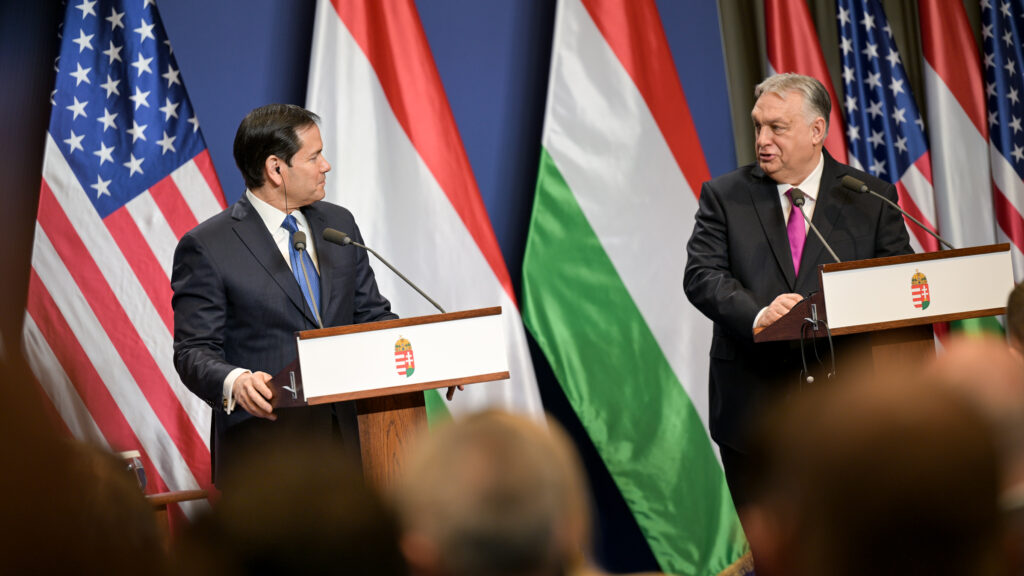
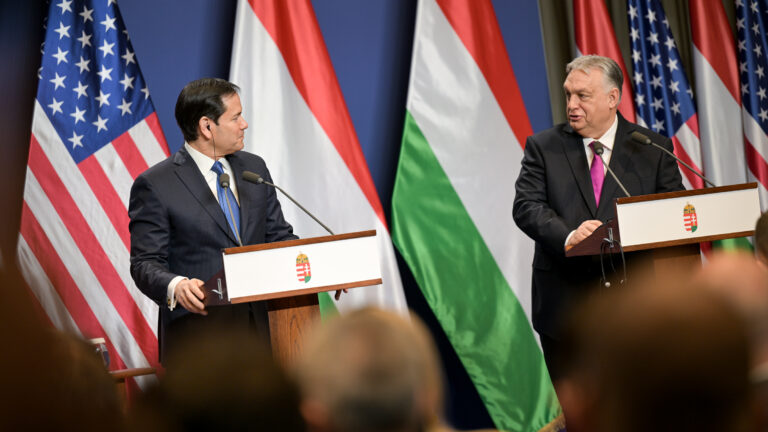
The governing parties presented their national list on Monday, 16 February, led by Viktor Orbán. On the same day, the prime minister met US Secretary of State Marco Rubio, who said that Orbán’s leadership is ‘essential’ for American interests in Central Europe, adding that President Trump is ‘committed’ to Orbán’s success in the April election.
Surveys published by the Center for Fundamental Rights are among the most accurate in Hungary. The institute was the third most accurate during the European elections in 2024, missing the final results by only 1.6 percentage points. By comparison, some institutes polling the opposition Tisza Party ahead by a wide margin, such as Publicus, missed the results of the 2022 parliamentary election by 20 percentage points, consistently underpolling Viktor Orbán’s party.
Related articles: