Viktor Orbán’s governing alliance Fidesz–KDNP is on track to retain a parliamentary majority in the upcoming high-stakes parliamentary election, according to the results of a recently published survey by the Nézőpont Institute.
According to the data, Fidesz–KDNP candidates could win 66 of Hungary’s 106 individual constituencies. In a statement released on Tuesday, 31 March, Nézőpont considers 44 of the districts an ‘almost certain’ victory for Orbán’s party alliance, while opposition candidates are expected to secure 27 constituencies in a similar manner. Of these, 26 are projected to be won by the leading opposition party Tisza, led by Fidesz defector Péter Magyar.
In the remaining 35 districts, Nézőpont argues, the race is expected to be more competitive; however, Fidesz–KDNP candidates are still likely to prevail in 22 of them, while 13 are projected to be won by Tisza.
The forecast is based on a combined methodology incorporating historical election data, national polling trends, and constituency-specific surveys conducted in 30 districts during the first quarter of 2026. The institute argues that, given Hungary’s first-past-the-post system in individual constituencies, estimating district-level winners can be done with relatively high accuracy.
Overall, Nézőpont concludes that the governing alliance can realistically expect to win 66 individual mandates, while the Tisza party may secure 39, alongside one additional seat for an independent candidate aligned with Tisza.
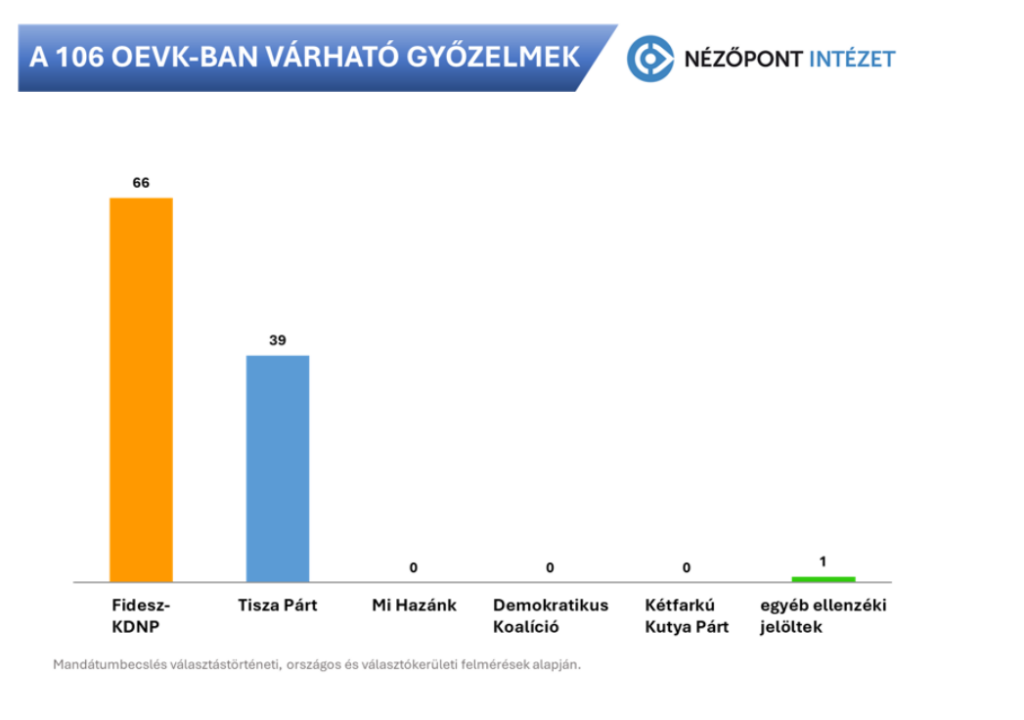
Other opposition parties—including the socialist Democratic Coalition (DK), the hard-right Our Homeland, and the Two-Tailed Dog Party (MKKP)—as well as independent candidates, are deemed unlikely to win any constituencies.
The projection also carries significant implications for government formation. With 66 individual seats, Fidesz–KDNP would need to secure at least 34 mandates from the national party list to achieve a parliamentary majority, paving the way for the re-election of Orbán.
Hungarians will go to the polls on 12 April in what is described by many as the most important election in the country’s post-Communist history. Orbán faces his strongest challenger since returning to power in 2010, after winning four consecutive elections with a supermajority.
Polling data in the country varies widely, with gaps of 10–20 percentage points between pro-government and opposition-aligned pollsters. Last week, Medián published its own results, showing Tisza leading at 58 per cent, 23 percentage points ahead of Fidesz–KDNP. According to Nézőpont’s latest survey, which examined national list voting intentions, Orbán is leading with 46–40 ahead of Tisza.
Related articles:
At a time when public debate is increasingly polarized and superficial, Hungarian Conservative remains committed to depth, intellectual honesty, and independent conservative thought.
Producing high-quality journalism requires resources. Your contribution helps us expand our coverage, reach new audiences, and keep our content accessible.

Please consider supporting our mission.