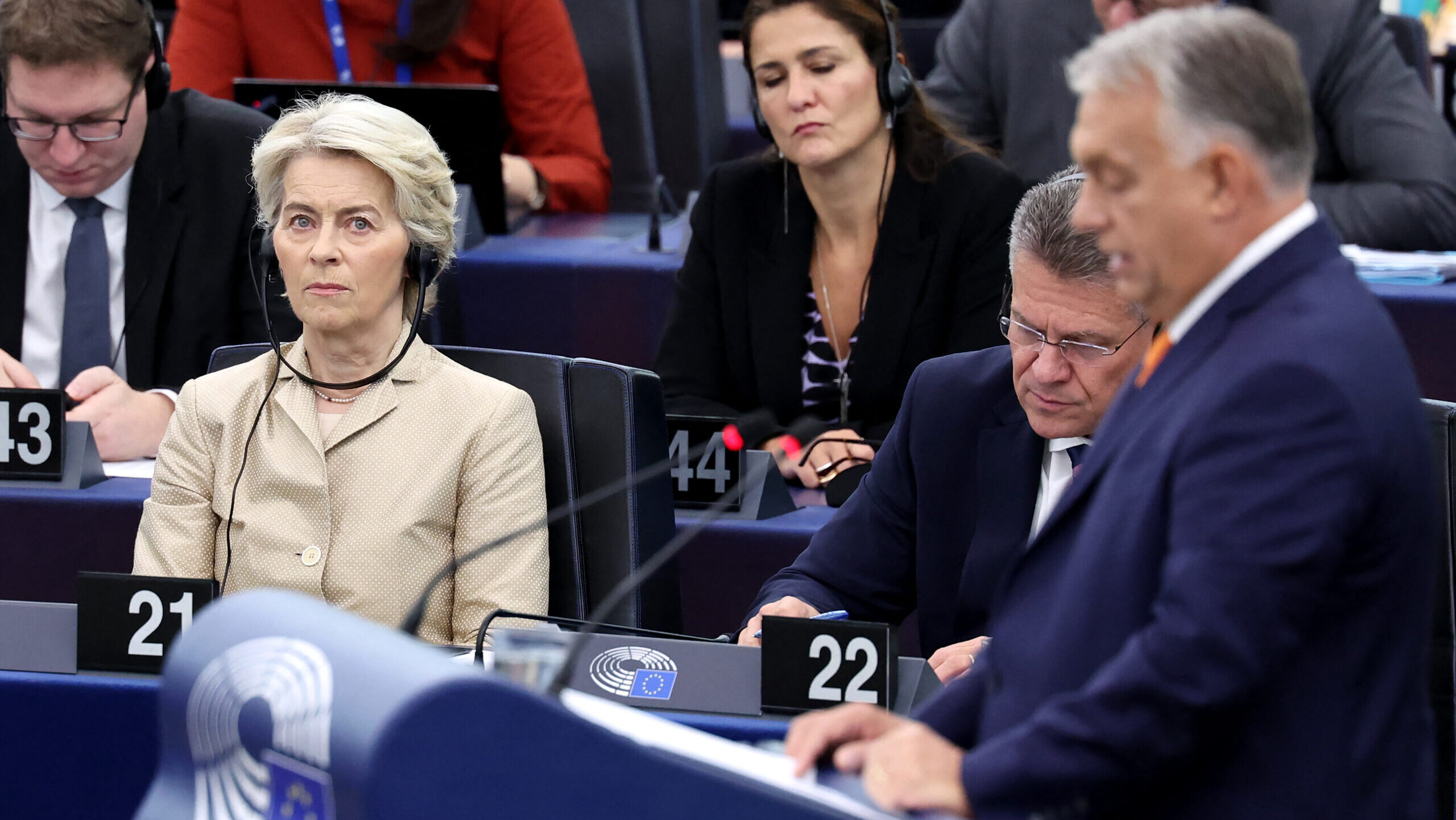
Hungarian Prime Minister Viktor Orbán has accused the European Commission of ‘systematically raping the European law’ after Brussels decided to trigger an emergency clause to indefinitely immobilize Russian assets held in Europe. Because the Commission invoked Article 122, Russian assets would be immobilized by qualified majority instead of the unanimity required under a standard sanctions regime.
In its new—and highly questionable—interpretation, the Commission argued that the shockwaves unleashed by Russia’s full-scale invasion of Ukraine have caused a ‘serious economic impact’ for the EU as a whole, triggering ‘serious supply disruptions, higher uncertainty, increased risk premia, lower investment and consumer spending’, as well as hybrid attacks in the form of drone incursions, sabotage and disinformation campaigns. ‘Preventing that funds are transferred to Russia is urgently required to limit the damage to the Union’s economy,’ the proposal stated. Article 122 has previously been used to cope with economic emergencies such as the Covid-19 pandemic.
However, despite the Commission’s justification, the frozen assets have nothing to do with the economic situation of EU member states. Article 122 was invoked solely to pave the way for the highly controversial €165 billion loan for Ukraine—which is not a member state of the Union. According to the proposal of Commission President Ursula von der Leyen, the €165 billion reparations loan includes €25 billion of immobilized Russian state assets held in private bank accounts across the bloc, in addition to €140 billion held in the Euroclear bank in Belgium. Ukraine would only have to repay the loan if Russia ends the conflict and pays war reparations—an unlikely scenario.
Within the reparations loan, €115 billion has been earmarked to finance Ukraine’s defence industry, while €50 billion would cover Kyiv’s budgetary needs. The remaining €45 billion would be used to repay a G7 loan to Ukraine from 2024.
‘Today, the Brusselians are crossing the Rubicon,’ Viktor Orbán, one of the critics of von der Leyen’s reparations loan scheme, wrote on X in reaction to the announcement. ‘At noon, a written vote will take place that will cause irreparable damage to the Union,’ he added. According to Orbán, the procedure abolishing the requirement of unanimity is ‘clearly unlawful’, meaning that with today’s decision ‘the rule of law in the European Union comes to an end’, and Europe’s leaders are ‘placing themselves above the rules’. ‘The rule of law in the European Union is being replaced by the rule of bureaucrats,’ Orbán continued, adding that ‘a Brusselian dictatorship has taken hold.’
‘Hungary protests this decision and will do everything in its power to restore a lawful order,’ Orbán concluded.
Orbán Viktor on X (formerly Twitter): "Today, the Brusselians are crossing the Rubicon. At noon, a written vote will take place that will cause irreparable damage to the Union.The subject of the vote is the frozen Russian assets, on which the EU member states have so far voted every 6 months and adopted a unanimous... / X"
Today, the Brusselians are crossing the Rubicon. At noon, a written vote will take place that will cause irreparable damage to the Union.The subject of the vote is the frozen Russian assets, on which the EU member states have so far voted every 6 months and adopted a unanimous...
Indefinitely freezing Russian central bank assets removes a key procedural and political obstacle for the European Commission’s plan, because it replaces the current six-monthly unanimous renewals with a long-term immobilization decided by qualified majority. This prevents any single member state from vetoing the freeze, stabilizes the legal basis for the scheme, and reduces the risk that the assets could be returned to Russia. The greater certainty is specifically aimed at securing support from hesitant governments such as Belgium’s, which holds most of the assets and has raised legal concerns.
EU member state leaders will decide on the plan during the European Council summit scheduled for next Thursday, 18 December.
Related articles: