For over half a decade, one of the main issues facing Hungary has been its economic problems. These problems are in no way unique to Hungary: since the global pandemic in 2020 and the Ukraine war in 2022, most major Western economies have faced persistent economic issues, namely, stagnation and inflation. These problems have played a large role in the political cycles in many countries, with incumbent parties getting voted out in the hope that a change of government will solve these economic problems.
A survey in Hungary carried out after the 2022 election found that even before the full impact of the Ukraine war was felt on the Hungarian economy, rising costs of living were the leading issue for most Hungarians, with 47 per cent saying it was their primary concern. Other studies showed that the only reason the incumbent Fidesz government managed to win the 2022 election in the face of these economic problems was that Hungarian voters were so shocked by the Russian invasion of Ukraine in February of that year and were very receptive to the incumbent government’s message that it would keep them out of the war.
Contrast this with what happened in the recent Hungarian election in April of this year. Once again, the government campaigned on a message of peace and de facto neutrality, but they lost the election in a landslide. On paper, fewer people cited the economy as their top concern—23 per cent versus 47 per cent in 2022—but one suspects that the 28 per cent that cited ‘politics/government’ as their top concern were convinced that they felt poorer because of supposed government corruption. The key difference in the 2026 cycle appears to have been that Hungarian voters had cooled on the Ukraine war issue, and their attention had turned elsewhere. The election became, in part at least, a referendum on the economy.
Yet now, together with the rest of Europe, Hungary is facing down a serious economic crisis. The closure of the Strait of Hormuz in late February has meant the loss of a large part of the global energy supply. A study we recently published with the Hungarian Institute of International Affairs estimates these losses as follows: 10 per cent of the global petroleum supply; 15–20 per cent of the global supply of jet fuel; 15–20 per cent of the global liquified natural gas (LNG) supply, which is around 5–10 per cent of the total global gas supply; and 8–12 per cent of the global diesel supply.
Prices at the pump are already rising. In February, the price of petrol was around 560–572 forints per litre. In May, this has risen to around 704 forints per litre. In February, the price of diesel was around 572–613 forints per litre. In May, this has risen to around 802 forints per litre. Yet this is merely a reflection of rising global energy prices. These prices have not yet factored in the fact that the world will soon start to run low on these energy prices. In normal times, prices can rise enough to ensure that there is enough fuel, albeit at a higher price. But analysts in the energy market increasingly think that the world may soon be facing down actual shortages of many of these products–and these shortages are expected to start to manifest as we enter the summer.
Energy feeds into all prices in the economy. The food in the shop is farmed using equipment that needs access to cheap, plentiful diesel fuel and is delivered by vehicles that need that same fuel. If there is not enough cheap diesel, farmers must increase the price of the food that they produce. Even a business that does not produce goods but only offers services—like a bank or an accountant—must pay their energy bills, and if these bills rise, they must raise their prices to the end consumer.
‘If there is not enough cheap diesel, farmers must increase the price of the food that they produce’
Our study at the Hungarian Institute of International Affairs shows that most of the inflation that we have seen in Hungary since the start of the 2020s can be directly linked to rising fuel prices. The same is true of the decline in the value of the forint on international exchange markets in that time. This means that we can use the energy price projections currently being published by energy market analysts to forecast the impact that the current energy crisis will have on Hungarian inflation and on the forint. We find that ‘inflation could rise from 2.1 per cent today to anywhere between 34 per cent and 59 per cent in July 2027. This compares with the previous inflationary peak of 26 per cent in January 2023. We also find that the forint–euro exchange rate (HUF–EUR) could fall anywhere between 17 per cent and 31 per cent compared to the previous decline in the value of the forint in the last energy crisis between February and October 2022 of 15 per cent.’
But these numbers do not quite tell us the impact that these price increases will have on Hungarian living standards. To better understand this, we must undertake a separate forecast of inflation-adjusted wages. This forecast is shown in the chart below, together with inflation-adjusted wage data since 2021. This data, together with our forecasts, tells a fascinating story.
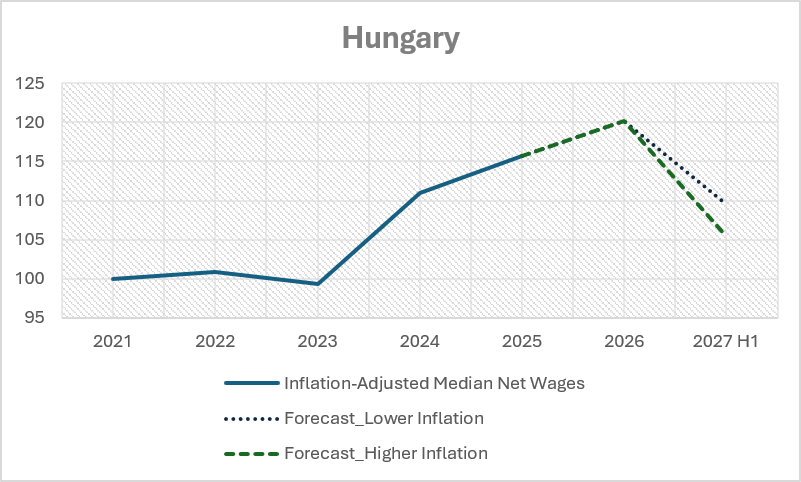
In 2022 when 47 per cent of voters cited rising costs of living as their main concern, inflation-adjusted wages had not actually fallen by that much. In the year before the 2022 election, living standards had largely stagnated. Because people’s wages tended to rise in lockstep with inflation, their living standards remained largely intact. In 2023 there was a more substantial decline in living standards, but even this was very modest. Throughout the 2020–2023 period, it is more accurate to say that Hungarian living standards stagnated rather than saying that they fell, and yet this stagnation was sufficient to make issues with rising costs the top electoral concern for Hungarian voters at that time.
Now compare that to the forecasts for Hungarian living standards that we arrive at using energy price forecasts from market analysts: here we see that over the next 12 months, Hungarians could see a substantial fall in their living standards. Our projections predict a decline in Hungarian living standards of anywhere between 9 per cent and 12 per cent. For context, Hungarians have not seen declines in living standards of this magnitude since the mid-1990s. Put differently, many Hungarians alive today cannot even remember what a decline in living standards of this size feels like.
The consensus amongst energy market analysts is that the coming energy shock is now effectively guaranteed. Even if the Strait of Hormuz were to be opened tomorrow, we would still have to face the consequences of the supply disruption that has taken place so far. The projections above are based only on this current supply disruption. It is hard to imagine what the biggest shock to living standards that Hungary has faced since the 1990s will have socially and politically. But we can be confident in saying that the impact will be profound.
Related articles:
At a time when public debate is increasingly polarized and superficial, Hungarian Conservative remains committed to depth, intellectual honesty, and independent conservative thought.
Producing high-quality journalism requires resources. Your contribution helps us expand our coverage, reach new audiences, and keep our content accessible.

Please consider supporting our mission.